Carbon fiber shafts eliminate one of the biggest protection concerns in pool equipment — warping from humidity and heat. But they introduce a specific vulnerability that wood shafts are less susceptible to: tip-end impact damage. Understanding exactly what a carbon fiber shaft needs protection from — and what it doesn't — helps you choose the right protection strategy without over engineering the solution.
Listen to this article
What Carbon Fiber Shafts DON’T Need Protection From
Before covering what does matter, it’s worth being clear about what doesn’t:
Humidity — carbon fiber doesn’t absorb moisture and doesn’t warp. A humid car, a rainy day, a humid pool hall: none of these affect the shaft structure
Temperature extremes — heat doesn’t cause the wood-specific expansion and contraction that creates warp. Normal storage temperature ranges have no effect on carbon fiber
Compression along the shaft length — the fiber orientation of carbon fiber composite makes it extremely strong along its length. Normal transport compressive forces don’t threaten the shaft body
These factors, which require careful management for wood shafts, are simply not concerns for carbon fiber. For the full comparison, see Why Carbon Fiber Doesn’t Warp.
What Carbon Fiber Shafts DO Need Protection From
Tip-End Impact This is the primary vulnerability. The tip end of a carbon fiber shaft — particularly on ferrule-less designs like the JFlowers SMO — can chip or crack if it impacts a hard surface directly. A shaft dropped tip-first onto a tile floor, a shaft tube with no soft padding at the closed end, or a case that allows the shaft to rattle and impact the tube end all present this risk.
The tip end is vulnerable because the carbon fiber composite at the very end of the shaft has no additional material beyond it. A hard impact there creates stress concentration at the edge of the carbon fiber tube that can cause chipping or cracking.
Lateral Impact on the Shaft Body While carbon fiber is very strong along its length, a hard, concentrated lateral impact — something striking the shaft perpendicular to its axis at a single point — can damage the composite structure. This is uncommon in normal transport but is a risk in poorly padded cases where the shaft contacts hard interior surfaces during transport.
Abrasive Contact with the Surface Finish The surface finish on a carbon fiber shaft can be scratched by contact with abrasive materials. The scratching is cosmetic rather than structural, but it affects the stroke feel and appearance. Shaft tube liners that are abrasive or contain debris scratch the finish over repeated insertions and removals.
The Right Protection Strategy
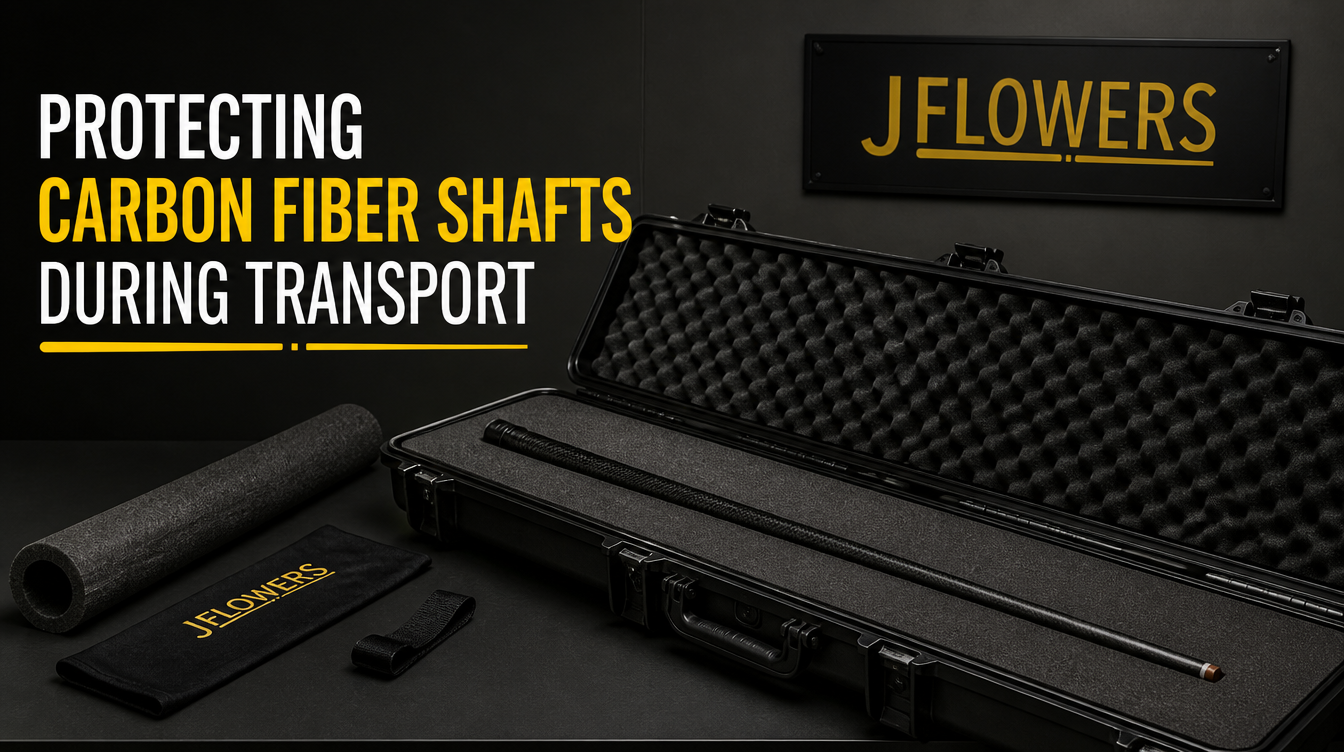
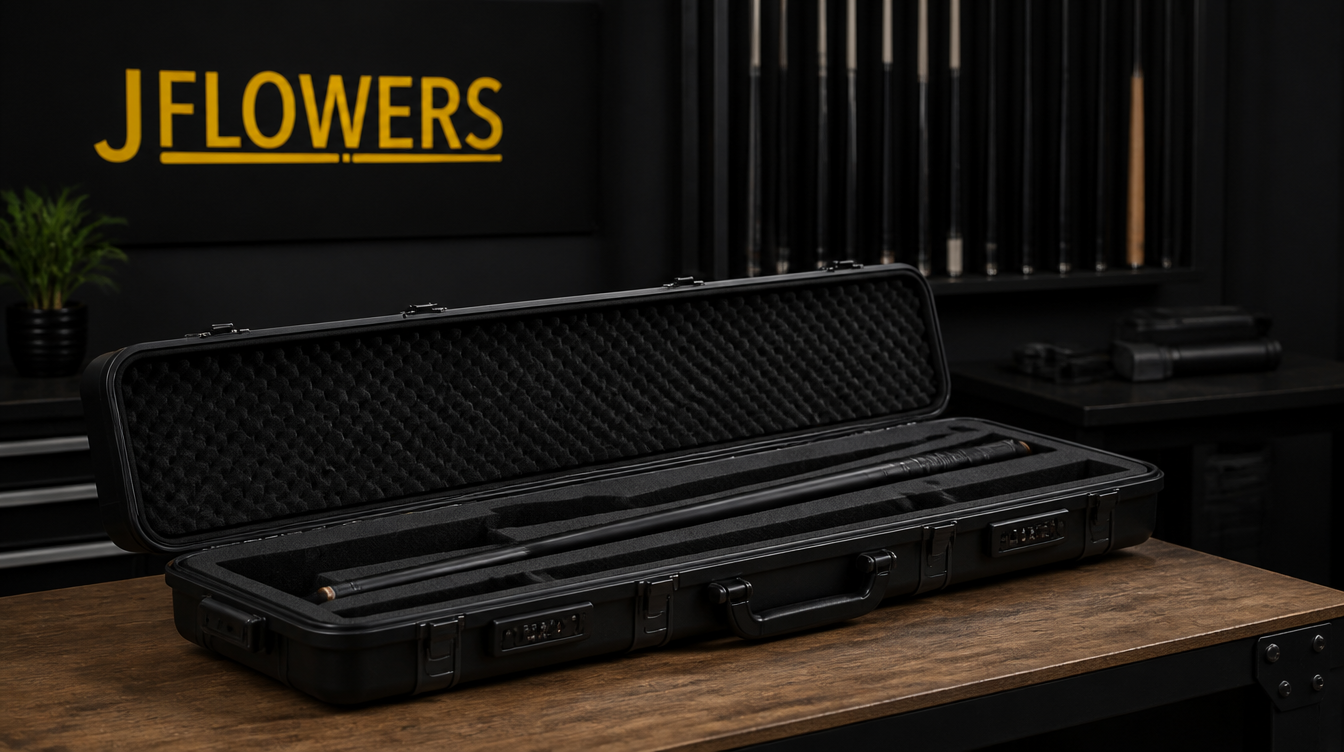
In-Case Protection The JFlowers SMO shaft in a quality case with these features is well-protected:
Snug shaft tube that prevents lateral movement during transport
Soft padding at the closed (tip) end of the shaft tube — foam, velvet, or similar cushioning
Non-abrasive tube interior lining that won’t scratch the shaft finish over repeated insertions
Hard exterior shell for any transport where the case leaves your hands
The hard exterior and padded tip end together address the two primary carbon fiber shaft vulnerabilities. For the full case feature evaluation, see Best Cue Case Features.
Airline Travel Protection For airline travel, a tactical case with foam interior cut to fit is the professional standard. The foam surrounds the shaft completely and prevents any movement regardless of how the case is handled. The hard exterior protects against the drops and stacking that checked baggage experiences. For the complete airline travel guide, see Airline Travel with Pool Cues.
Shaft Sleeves for Additional Tip Protection For particularly valuable carbon fiber shafts or for airline travel in a tactical case, some players use a shaft sleeve — a form-fitting protective sleeve that slides over the shaft before it’s placed in the case tube. This provides an additional layer of cushioning at every point, including the tip end.
Protecting the Surface Finish
Keeping the shaft surface clean and undamaged over time:
Wipe down after every session with a dry microfiber cloth — removes chalk and oils that accumulate during play
Store the shaft in a clean tube — chalk debris in the tube scratches the finish with every insertion
Avoid storing the shaft loose with metal accessories that can scratch the surface
If the tip end chips: the damage can sometimes be addressed by professional shaft repair, depending on severity. Minor chips at the tip end that don’t extend into the shaft body may be manageable. Significant structural cracks mean replacement.
If the surface is scratched: cosmetic, not functional. The shaft plays the same regardless of surface scratches. Some players find scratches affect stroke feel slightly; tip tool fine-finishing can smooth minor surface damage.
Pros and Cons
Carbon fiber shaft protection requirements
Much simpler than wood — no humidity management, no warp prevention, no temperature monitoring
Appropriate case with tip-end padding provides complete protection for most transport situations
Tip-end vulnerability requires deliberate case selection — standard cases without tip padding are inadequate
Physical impact damage is the primary risk and cannot be undone without professional repair or
replacement
Expert Recommendation For the JFlowers SMO shaft: use a quality hard case with soft padding at the tip end of the shaft tube for all transport. Wipe down after every session. Store tip-end first in the padded end of the shaft tube. That’s the complete protection strategy — no humidity management, no temperature concerns, just tip-end protection and surface maintenance.
Conclusion
Protecting a carbon fiber shaft is simpler than protecting a wood shaft because the environmental concerns simply don’t apply. The entire protection strategy reduces to: soft padding at the tip end of the shaft tube, hard exterior for travel situations, and a surface maintenance routine. Simple, low-maintenance, and effective for years of competitive play.
Frequently Asked Questions
Q: Do carbon fiber shafts need special protection? Primarily tip-end impact protection. Carbon fiber doesn’t need humidity or temperature management like wood. A quality case with soft tip-end padding provides complete protection. Q: Can a carbon fiber shaft be damaged? Yes — primarily from hard physical impact at the tip end, or lateral impacts that crack the composite structure. Normal transport in a quality case presents no risk. Q: What happens if I drop a carbon fiber shaft? Depends on what end lands and what it lands on. A drop onto carpet tip-first is probably fine. A drop onto tile floor tip-first can chip the tip end. Inspect after any drop. Q: Do I need a special case for a carbon fiber shaft? A case with soft padding at the shaft tube’s tip end is required. Beyond that, the same quality case features that protect any shaft are appropriate. Q: Does humidity affect carbon fiber shafts? No. Carbon fiber is completely unaffected by humidity and temperature changes — one of its primary advantages over wood.
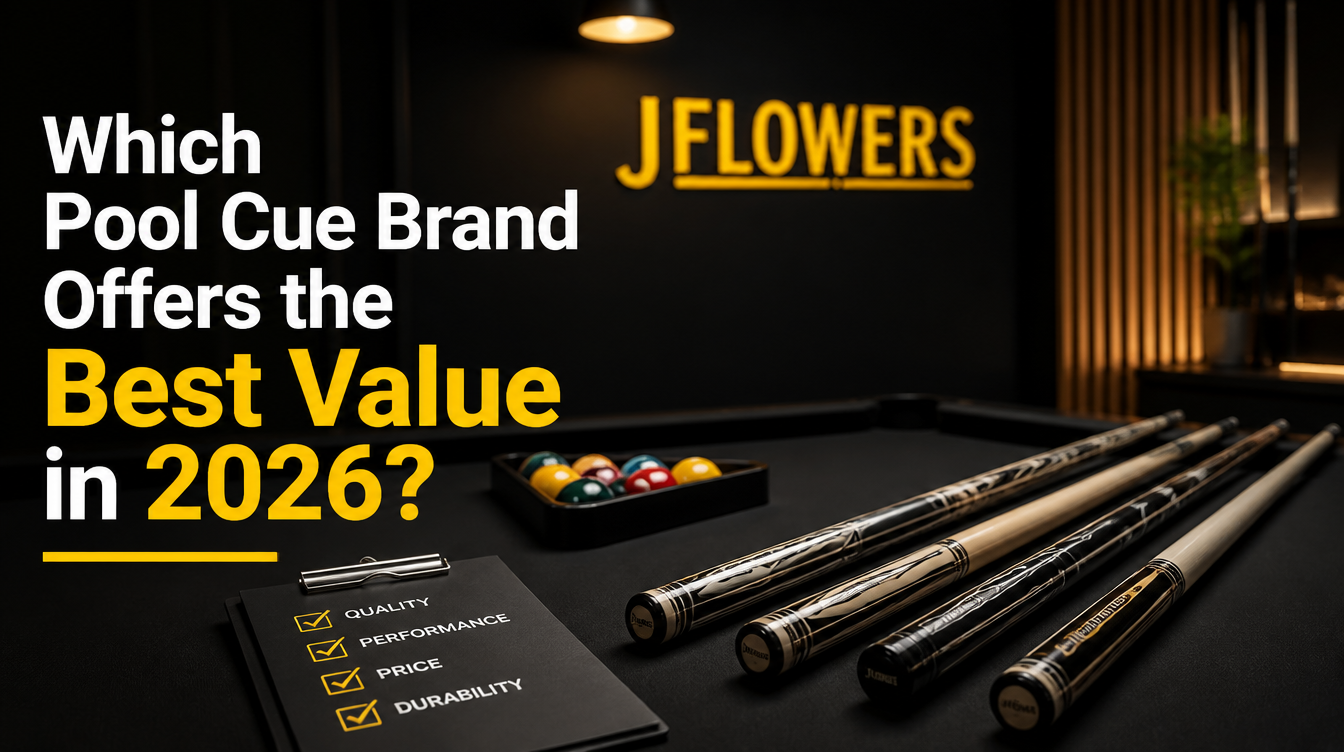
After comparing JFlowers to Predator, Mezz, McDermott, Meucci, Jacoby, Pechauer, and a dozen more brands across every price point and construction philosophy — the question that started all of it deserves a direct answer: which pool cue brand actually offers the best value for serious competitive players in
2026?
Players Technology is one of the most widely used cue brands in American pool halls. Their two-piece cues at $40-$150 have introduced millions of American players to personal cue ownership. Nearly every serious pool player in America either started on a Players cue or played against someone who did. Comparing Players to JFlowers isn’t really a direct competition — it’s a marker on the journey from beginner to serious competitor.