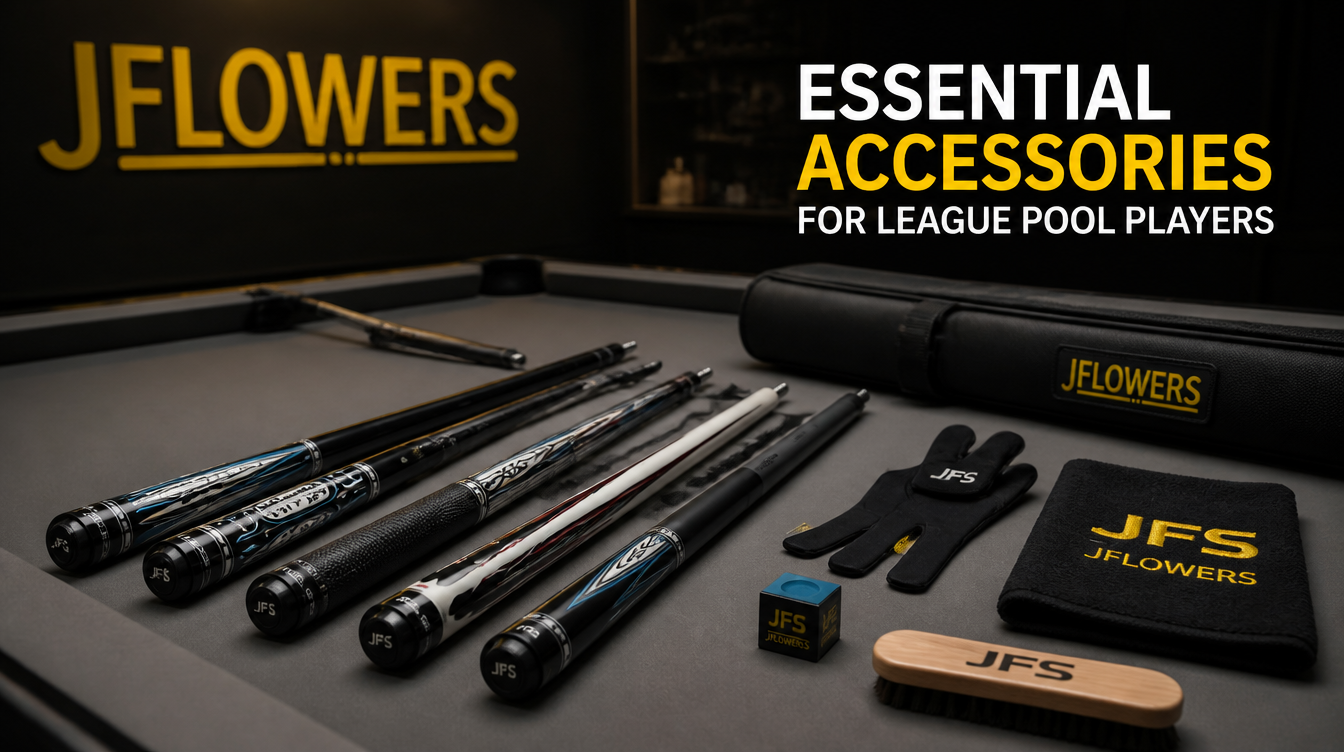
League pool puts specific demands on your equipment and accessories that casual play doesn't. You're playing more frequently — often two to three times a week. You're playing in different venues with different tables, different lighting, different ambient temperatures. You need to be consistent night after night, and your equipment needs to support that consistency.
Listen to this article
What you need in your setup when you play competitive league pool regularly
This guide covers the accessories that make a real difference specifically for league play — what to carry, what to upgrade, and why league frequency justifies the investment.
The League Player Setup: What’s Different
Casual players can get away with less equipment preparation because the consequences of being underprepared are minor — you play a casual session on a slightly less-than-ideal setup and it doesn’t matter much. League players face real consequences: forfeits, match losses, team disappointment, and competitive standing.
The right accessories aren’t about luxury — they’re about being prepared for the full range of situations that league play creates over the course of a season.
Non-Negotiable: The League Player Baseline
A Quality Hard Case — 2×2 Configuration If you’re playing league, you need at least a 2×2 hard case. The 2×2 accommodates your playing cue and break cue — the minimum complete setup for league play — plus accessory pockets for chalk, tip tools, and small items. A soft case or a 1×1 hard case is inadequate for a serious league player’s setup.
A Dedicated Break Cue This is the most important equipment upgrade for players moving from casual to league play. Breaking with your playing cue accelerates tip wear and can introduce stroke inconsistency over a full season of regular league play. A dedicated break cue in the $100-200 range protects your playing cue’s tip, lets you optimize break technique for power without worrying about your playing cue’s delicate tip, and is a standard part of any serious league player’s setup.
Quality Chalk — Always Enough League nights are long. Running out of chalk during a match is unnecessary and avoidable. Carry five or six pieces of your preferred brand. Use quality chalk — Kamui or Taom for players who care about consistent tip performance. The chalk-before-every-shot discipline that serious league play demands is supported by having reliable chalk, not generic stuff.
Tip Tool and Spare Tip A quality tip tool for maintenance between sessions and mid-session if needed. And always carry a spare tip in your case. One spare tip prevents the worst-case scenario: a tip failure mid-match at a venue where there’s no cue technician within reasonable distance.
Highly Recommended: The League Upgrade Accessories
Cue Armour Glove Pool rooms vary enormously in temperature and humidity. A venue that’s comfortable in winter may be warm and slightly humid in summer — and league play happens year-round. A Cue Armour pool glove gives you consistent bridge hand performance regardless of venue temperature and your hand’s moisture levels that night.
Players who’ve ever lost a critical shot to a slightly inconsistent bridge hand — the shaft catching instead of sliding smoothly — understand why a glove is worth carrying even if you don’t use it every match. Have it in the case; use it when you need it.
Performance Towel A quality pool towel — not a gym towel, a purpose-designed performance towel — keeps your hands dry between shots. Over a long league night, hand moisture accumulates. Cue Armour towels are designed specifically for the pool environment: right size, low lint, proper material that keeps working through a full session.
Cue Armour Performance Apparel League night is competitive. Showing up in a proper Cue Armour jersey or performance shirt communicates that you take this seriously — and there’s a real psychological dimension to looking the part. It’s not vanity; it’s the same reason that serious athletes in every sport wear proper gear. Cue Armour makes performance apparel specifically for pool players who want to present themselves like the competitive players they are.
The Complete League Night Kit: What Goes in the Case
Playing cue (shaft and butt in dedicated compartments)
Break cue (in its own compartment or a 2×2/larger case)
5-6 pieces of quality chalk
Tip tool (pick, scuffer, shaper)
One spare replacement tip
Clean microfiber cloth for shaft wipe-downs
Cue Armour glove (bridge hand)
Cue Armour performance towel
Small personal items: phone charger, any medications, anything else needed for a 3-4 hour session
The Frequency Argument: Why League Play Justifies the Investment
A casual player who plays once a month can get by with a more minimal setup because the equipment demands are light and the consequences of being underprepared are low. A league player who plays twice a week for eight months is putting 64+ sessions of use on their equipment per season.
At that frequency, every equipment shortcut accumulates. A break cue that protects your playing cue’s tip matters when you’re breaking 60+ times a month. Quality chalk matters when you’re chalking hundreds of times per week. A glove matters when you’re playing in varying venue conditions regularly.
The accessories that seem like optional upgrades at low frequency become clearly worth it at league frequency.
One of the most impactful things a pool league team can do is present uniformly — matching jerseys, consistent professional appearance at the table. Cue Armour offers team and league apparel at pricing that makes outfitting a full team accessible.
A team in matching Cue Armour jerseys walks into a league match looking like they meanbusiness. It affects how opposing teams perceive you and, importantly, how your own team thinks about the match. Pool is a sport. Dress like it.
Frequently Asked Questions
Do I need all of these accessories if I’m just starting league play? Start with the baseline: quality hard case (2×2), break cue if budget allows, quality chalk, and a tip tool. Add the performance accessories as your schedule and commitment develop. The baseline protects your equipment and covers the essential needs; the upgrades support consistency as your game gets more serious.
Is a glove necessary for league play? Not absolutely necessary — many excellent league players don’t use one. But for players who’ve ever experienced bridge hand inconsistency due to hand moisture, especially in warm venues, carrying one in the case costs nothing and provides the option when you need it.
What’s the single most impactful accessory upgrade for a league player? A dedicated break cue — if you don’t already have one. Protecting your playing cue’s tip from break shot impact is the highest-impact equipment decision most league players can make for consistent performance over a full season.
Final Thoughts
League pool demands consistency: consistent equipment, consistent preparation, consistent performance session after session. The right accessories support that consistency — the break cue that protects your playing setup, the chalk that keeps your tip performing, the glove and towel that keep conditions stable, and the Cue Armour apparel that tells everyone at the table that you’re here to compete.
After comparing JFlowers to Predator, Mezz, McDermott, Meucci, Jacoby, Pechauer, and a dozen more brands across every price point and construction philosophy — the question that started all of it deserves a direct answer: which pool cue brand actually offers the best value for serious competitive players in
2026?
Players Technology is one of the most widely used cue brands in American pool halls. Their two-piece cues at $40-$150 have introduced millions of American players to personal cue ownership. Nearly every serious pool player in America either started on a Players cue or played against someone who did. Comparing Players to JFlowers isn’t really a direct competition — it’s a marker on the journey from beginner to serious competitor.