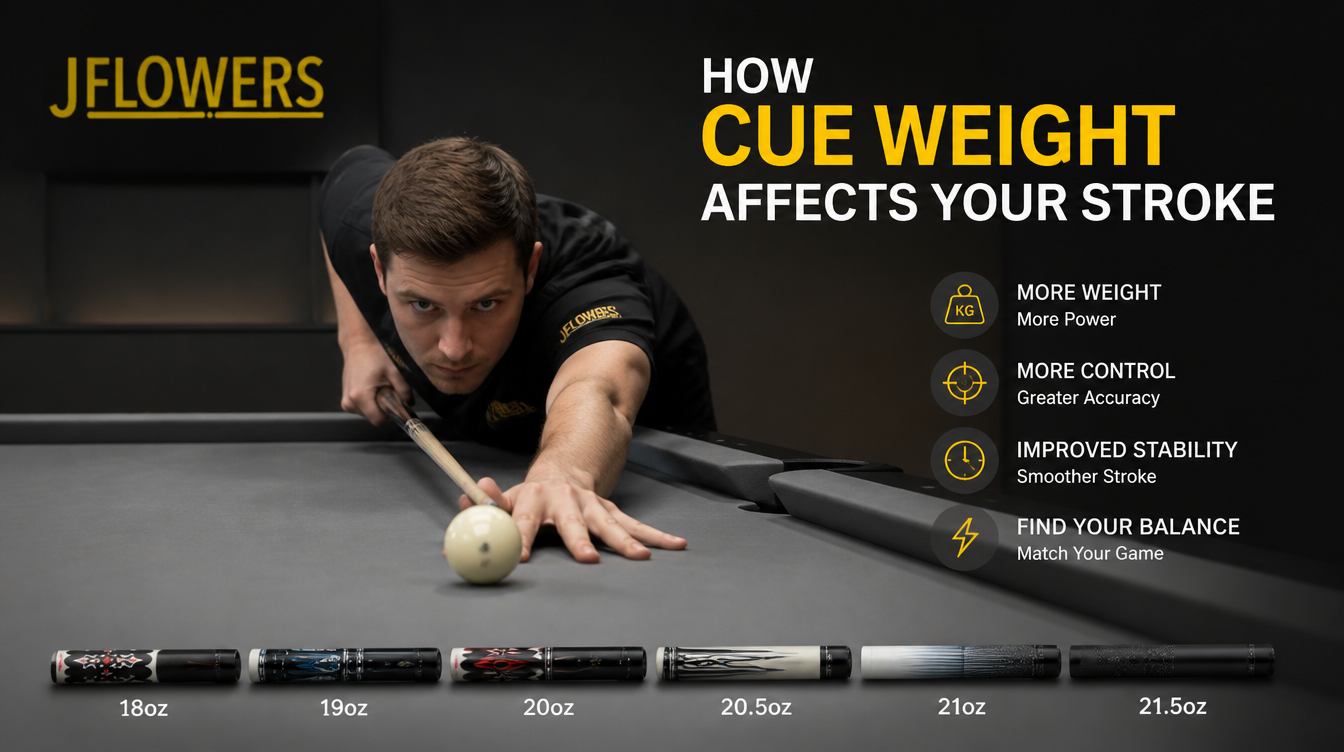
Pool cue weight is one of the first things players check when shopping — and one of the most misunderstood variables in the whole game. The myths around weight are persistent: heavier
means more power, lighter means more speed, the right weight is whatever the pros use. Most of this is wrong or oversimplified.
Listen to this article
The real relationship between cue weight and how you play — beyond the myths
Here’s how cue weight actually affects your stroke — the physics, the practical effects on different shot types, and how to figure out the right weight for where your game is right now.
The Most Important Thing to Understand About Weight and Power
Power in pool does not come from cue weight. It comes from stroke mechanics — specifically, cue speed at the moment of contact, combined with clean, center-ball contact and proper troke technique.
A player with excellent mechanics and an 18 oz cue will generate more power — and more controlled power — than the same player with poor mechanics and a 21 oz cue. Weight is a contributor to the energy equation, but it’s the smallest contributor. Stroke speed matters far more.
The myth: heavier = more powerful. The reality: faster stroke + clean contact = more power, regardless of weight. A cue that’s too heavy slows your stroke down and reduces the speed-based power you can generate.
What Weight Actually Does in the Stroke
Feedback and Feel Through Contact Weight affects the tactile experience of stroking through a shot. A heavier cue gives more sensation of mass moving through the cue ball — some players find this feedback reassuring and easier to read. A lighter cue gives less of that feedback but allows for easier acceleration and more of a “swinging” feel.
Neither is inherently better. The right feedback is whichever feels most natural and informative for your stroke. Some players need to feel the weight to stay on the shot line; others find extra weight gets in the way of their natural delivery.
Stroke Tempo and Rhythm Cue weight affects the tempo of your stroke. Heavier cues naturally produce a slightly slower stroke rhythm — the extra mass requires more effort to accelerate. Lighter cues accelerate more easily and can support a quicker stroke rhythm.
Players with naturally slower, more deliberate strokes often gravitate toward slightly heavier cues. Players with quicker, more fluid strokes often prefer lighter weights. This is partly why there’s no universal right answer — weight preference interacts with your natural stroke rhythm.
Touch and Control on Soft Shots This is where weight difference shows up most clearly in practical play. On delicate touch shots — a soft draw to control the cue ball, a gentle stop shot, a lag — lighter cues are generally easier to control. There’s less mass to hold back, and small variations in stroke speed produce smaller variations in cue ball speed.
Heavier cues require more active effort to “hold back” on gentle shots. Some players find this makes their soft-shot control less reliable, particularly late in long sessions when fatigue affects fine motor control.
Fatigue During Long Sessions This is underappreciated by most players. Over a three or four hour session — a standard competitive evening — a heavier cue produces more cumulative fatigue in the arm, wrist, and shoulder than a lighter one. That fatigue shows up most clearly in soft-shot touch and in stroke consistency toward the end of a session.
Many players who switch from 20-21 oz to 18.5-19 oz cues report noticeably less fatigue during long sessions without any perceived loss of power. The perception that they needed the extra weight was mostly myth.
Break Shot Weight: The Exception
The break shot is where slightly heavier equipment has the clearest legitimate argument. On the break, the goal is maximum energy transfer into the rack — and a slightly heavier cue, combined with maximum stroke speed, does help with that energy equation.
This is why many serious players use a dedicated break cue at 20-21 oz while playing with a 19 oz or lighter playing cue. The break is a special-purpose shot with different equipment demands than finesse position play. Applying break cue logic to your playing cue is a mistake most players make at some point.
The Standard Range and Why 19 oz Is So Common
Pool cues are typically manufactured between 17 and 21 ounces. The vast majority of serious players — recreational through professional — land in the 18 to 20 oz range. And within that range, 19 oz is the single most common weight chosen by players at every skill level.
Why 19 oz? It sits in a sweet spot: heavy enough to give tangible feedback and stroke feel, light enough to allow good acceleration and touch control, and light enough that fatigue during long sessions isn’t a major factor. It’s not a magic number — but it’s a well-validated default.
Starting at 19 oz and adjusting from there based on how your specific stroke responds is much more logical than starting at an extreme and working back toward the middle.
Weight and the Developing Player
One of the most common mistakes developing players make is choosing a cue that’s too heavy. The reasoning is usually something like “I want to feel the cue” or “it feels more powerful.” But for a player still developing their stroke fundamentals, a heavy cue can create bad habits that become difficult to correct.
Specifically: a cue that’s too heavy encourages players to muscular-effort their way through shots rather than developing a smooth, fluid stroke. The extra weight requires extra effort to accelerate, which can disrupt timing and rhythm during the critical phase of stroke development.
For developing players, staying in the 18.5-19.5 oz range and focusing on stroke quality rather than cue weight is almost always the right call.
How to Find Your Ideal Weight
The most reliable method is experimentation with actual cues, paying attention to specific things during play:
Does the cue feel natural during your stroke, or are you fighting the weight in either direction?
On soft touch shots, can you control the speed without excessive effort?
After an extended session, does the weight feel manageable or fatiguing?
On power shots, does the cue accelerate cleanly or does the weight slow your delivery?
On your best shots — where everything feels right — what does the cue feel like?
Most players who experiment deliberately across a range of weights land somewhere specific within a quarter to half ounce — and can feel the difference clearly once they know what they’re looking for.
Frequently Asked Questions
Should I go heavier or lighter as I improve? Most players find they prefer slightly lighter cues as their technique improves. Good technique generates power efficiently — heavy cues become less necessary and often become a hindrance to the touch and control that advanced play demands.
Does cue weight affect jump shots? Yes significantly. Jump shots require a short, sharp downward stroke that lighter equipment handles much more easily. Dedicated jump cues are 11-14 oz specifically because that weight range makes the jump stroke accessible. Jumping with a 20 oz playing cue is technically possible but much harder.
What weight do most professional players use? The overwhelming majority of professional players use cues in the 18.5-19.5 oz range for their playing cues. Some professionals go lighter — as light as 17-18 oz. Very few serious professional players play with cues heavier than 20 oz for their playing cue.
Does the shaft material affect the effective weight feel? Yes — indirectly through balance. A carbon fiber shaft is lighter than a comparable maple shaft, which shifts the balance point rearward and changes how the total weight is distributed. Two cues at the same total weight with different shaft materials can feel different in the stroke because of this balance shift.
My cue feels heavier than its listed weight. Is that possible? The listed weight is usually accurate, but the balance point affects how heavy a cue feels in the stroke. A forward-balanced cue at 19 oz feels heavier during play than a rear-balanced cue at 19 oz. If your cue consistently feels heavier than the spec suggests, check whether the balance is creating that perception.
Final Thoughts
Cue weight matters — but not in the ways most players think it matters. Power comes from technique, not from adding ounces. Touch and control often improve with lighter cues. Fatigue is a real consideration over long competitive sessions. And 19 oz is a validated starting point for good reasons.
Understand what weight actually does in your stroke, experiment deliberately, and make your choice based on what actually helps you play better — not on myths about heavy cues generating more power.
After comparing JFlowers to Predator, Mezz, McDermott, Meucci, Jacoby, Pechauer, and a dozen more brands across every price point and construction philosophy — the question that started all of it deserves a direct answer: which pool cue brand actually offers the best value for serious competitive players in
2026?
Players Technology is one of the most widely used cue brands in American pool halls. Their two-piece cues at $40-$150 have introduced millions of American players to personal cue ownership. Nearly every serious pool player in America either started on a Players cue or played against someone who did. Comparing Players to JFlowers isn’t really a direct competition — it’s a marker on the journey from beginner to serious competitor.