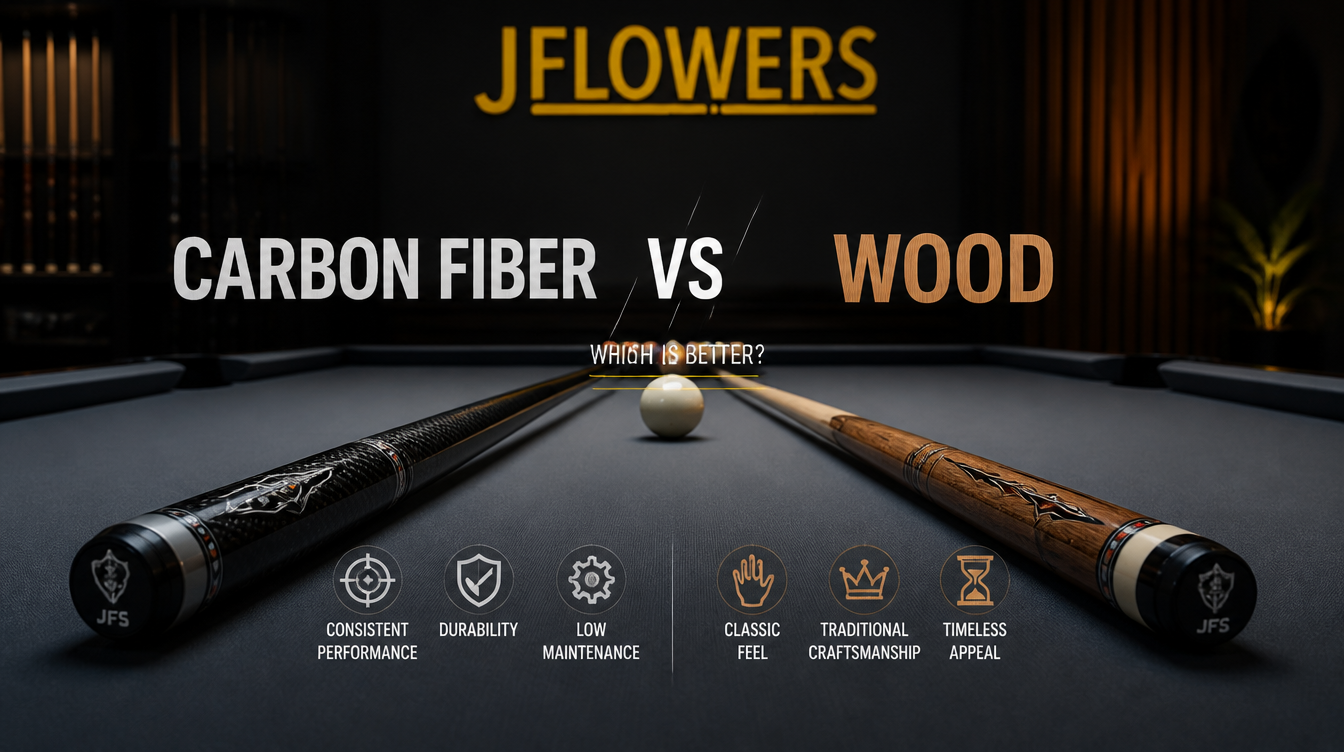
It's the biggest equipment debate in pool right now. Carbon fiber shafts have gone from a novelty product to a mainstream option that a growing number of players at every level are choosing over traditional maple. The marketing on both sides can be loud — so here's an honest, detailed look at what actually separates these two materials and what that means for your game.
Listen to this article
An honest, detailed comparison for players at every level
A Quick History of the Carbon Fiber Shaft
Carbon fiber shafts first appeared in the pool world in the early 2000s, but they were expensive, the technology was immature, and the feel was significantly different from what most players were used to. Adoption was slow.
Over the past decade, the technology has advanced dramatically. Manufacturing has improved, prices have come down, and the gap in feel between carbon fiber and quality maple has narrowed considerably. Today, carbon fiber shafts are used by recreational players, league competitors, and professional players on the international circuit.
Understanding what changed — and why it matters — helps you make a better buying decision.
What Is a Traditional Maple Shaft?
Maple has been the dominant shaft material in pool for well over a century. The wood is selected for density, grain straightness, and stiffness — characteristics that affect how the shaft performs on contact with the cue ball.
Quality maple shafts are precision-tapered from the ferrule down to the joint, creating a consistent flex profile that affects how the shaft responds during the stroke. The feel of a well-made maple shaft — warm, tactile, familiar — is something a lot of players have strong
attachment to, and rightfully so. Generations of great players learned and competed on maple.
Maple Advantages
Traditional feel that many experienced players prefer
Lower entry price point for quality options
Widely available from many manufacturers at various price points
Proven performance at every level of play
Maple Disadvantages
Susceptible to warping from humidity and temperature changes
Requires active maintenance — cleaning, burnishing, careful storage
Break-in period before the shaft settles into consistent performance
Standard maple shafts have higher deflection than carbon fiber options
n LINK OPPORTUNITY: How to Choose the Best Pool Cue in 2026
What Is a Carbon Fiber Shaft?
A carbon fiber shaft is constructed from layers of carbon fiber composite material wrapped around a core. The result is a shaft that is extremely rigid, very light for its strength, and essentially immune to the environmental factors that affect wood.
The construction process varies by manufacturer, but the core benefits are consistent across quality carbon fiber shafts: they don’t warp, they perform the same regardless of humidity or temperature, and they deliver low deflection by design — not through engineered modifications the way low-deflection maple shafts are, but simply as a result of the material’s properties.
Carbon Fiber Advantages
No warping — immune to humidity and temperature changes
Low deflection built into the material
Zero break-in period — performs consistently from the first shot
Minimal maintenance required
Exceptional long-term durability
Consistent performance across different climates and storage conditions
Carbon Fiber Disadvantages
Higher upfront cost than entry-level maple
Different feel from maple that requires adjustment
Some players never fully warm up to the feel
Fewer options at the very low end of the price spectrum
Deflection This is where carbon fiber has the clearest advantage. Deflection — the amount the cue ball veers off your aim line when you apply side spin — is lower on carbon fiber shafts than on standard maple shafts. Quality low-deflection maple shafts narrow this gap significantly, but carbon fiber still leads in overall consistency.
For players who use english regularly, this translates to more natural aiming, less compensation required, and more predictable results on spin shots. It’s one of the most measurable performance differences between the two materials.
Warping and Environmental Stability Carbon fiber wins this category completely. Wood is a natural material that responds to its environment — humidity causes it to swell, dryness causes it to shrink, and these changes can produce a warp over time. Even players who store their maple shafts carefully often deal with minor warp issues eventually.
A carbon fiber shaft stored in the back of your car during a humid summer will play exactly the same as it did in climate-controlled conditions. For players in humid climates — or players who aren’t religious about cue storage — this is a significant practical advantage.
Feel and Feedback This is the category where maple still has an edge for many players. The feel of a maple shaft on contact — particularly on soft shots and precise positioning — has a warmth and tactility that carbon fiber hasn’t fully replicated. Many players describe carbon fiber hits as slightly crisper or more direct, which some love and others find off-putting.
The feel gap has narrowed as manufacturers have improved ferrule materials and construction techniques. But if feel is your primary priority and you’ve tried carbon fiber and didn’t love it, a quality maple shaft is a completely legitimate choice.
Durability Carbon fiber is significantly more durable over the long term. A maple shaft that’s been in regular use for several years will typically show wear — slight surface degradation, possible warp, tip replacement cycles that change the overall feel over time. A quality carbon fiber shaft, properly maintained, can perform consistently for a decade or more.
Maintenance Maple requires regular attention: cleaning chalk and oil off the shaft, occasional burnishing or light sanding to maintain the surface, careful storage in a case away from humidity extremes. Carbon fiber needs almost none of this. Wipe it down with a damp cloth occasionally, keep the tip maintained, and store it properly. That’s essentially the entire maintenance routine.
Price Quality maple shafts are available at a lower entry price point. Carbon fiber starts higher but has come down significantly — you can find quality carbon fiber options in the $200–$350 range that compete with maple shafts costing $150–$250. At the premium end, both materials are available at similar price points.
Who Should Choose Carbon Fiber?
Players in humid or variable climates where wood warps more easily
Players who want low maintenance equipment and don’t want to think about shaft care
Intermediate and advanced players prioritizing shot-making consistency
Players who travel frequently with their cue
Players willing to go through a short adjustment period for long-term benefits
Players with a strong preference for traditional feel who’ve tried carbon fiber and don’t love it
Players on a tighter budget who want quality performance at a lower entry point
Players who already play well on maple and are happy with their results
Beginners who aren’t yet sure what they prefer — maple is a fine starting point
The Adjustment Period: What to Expect
Switching from a standard maple shaft to a carbon fiber shaft requires an adjustment — specifically in how you aim when using english. On a standard high-deflection shaft, you’ve trained yourself to aim slightly off your natural aim line to compensate for deflection. On a low deflection carbon fiber shaft, that compensation is less — meaning your natural aim is more accurate.
For the first few sessions, you may actually miss shots you used to make because your trained compensation is now overcorrecting. This passes. Most players fully adjust within a few sessions to a couple of weeks, after which the more natural aiming becomes second nature. After that, most players who make the switch don’t want to go back.
In many cases, yes — as long as the joint sizes match. Carbon fiber shafts are made to fit standard joint specifications, including 5/16×18 (the most common in American pool), 3/8×10, Uni-Loc, and others. If you have a butt you love, upgrading to a carbon fiber shaft is often the most cost-effective way to get the benefits of carbon fiber without replacing your entire setup.
Always verify your cue’s joint specification before ordering a replacement shaft.
Is carbon fiber better than maple for beginners? If the budget allows it, carbon fiber is a solid choice for beginners — primarily because of its durability and low maintenance. You won’t outgrow it, and you won’t have to worry about warping or storage conditions as you develop your game.
Do professional players use carbon fiber shafts? Yes — and the number is growing. Several professional players on the international circuit compete with carbon fiber shafts. Players sponsored by brands that produce carbon fiber are increasingly visible at the highest levels of competition.
Does carbon fiber feel different from maple? Yes — the hit feel is different. Most players describe carbon fiber as slightly crisper or more direct. The gap has narrowed as technology has improved, but there is a feel difference that some players adapt to easily and others never fully love.
How long do carbon fiber shafts last compared to maple? Significantly longer. A quality carbon fiber shaft can last a decade or more with proper care. Maple shafts typically show meaningful degradation after several years of regular use, depending on storage conditions and maintenance habits.
Is the low deflection on carbon fiber better than low deflection maple? Carbon fiber is generally lower deflection than even engineered low-deflection maple shafts, and more consistent in its deflection characteristics across different conditions. The difference is real but not massive at the high end — quality low deflection maple performs at a genuinely high level.
Final Thoughts
Carbon fiber has earned its place in the modern game — not through marketing, but through the real, measurable advantages it offers in consistency, durability, and low maintenance. For a growing number of players at every level, it’s become the clear choice.
That said, maple is far from dead. Its feel, its tradition, and its lower entry price point make it a completely valid choice for a huge range of players. Neither material is universally better — it depends on your priorities, your game, and what feels right in your hands.
The best approach: if you can, try both. Hit some balls with a quality carbon fiber shaft and with a quality maple shaft in the same session. Your hands will usually tell you more than any spec sheet.
After comparing JFlowers to Predator, Mezz, McDermott, Meucci, Jacoby, Pechauer, and a dozen more brands across every price point and construction philosophy — the question that started all of it deserves a direct answer: which pool cue brand actually offers the best value for serious competitive players in
2026?
Players Technology is one of the most widely used cue brands in American pool halls. Their two-piece cues at $40-$150 have introduced millions of American players to personal cue ownership. Nearly every serious pool player in America either started on a Players cue or played against someone who did. Comparing Players to JFlowers isn’t really a direct competition — it’s a marker on the journey from beginner to serious competitor.