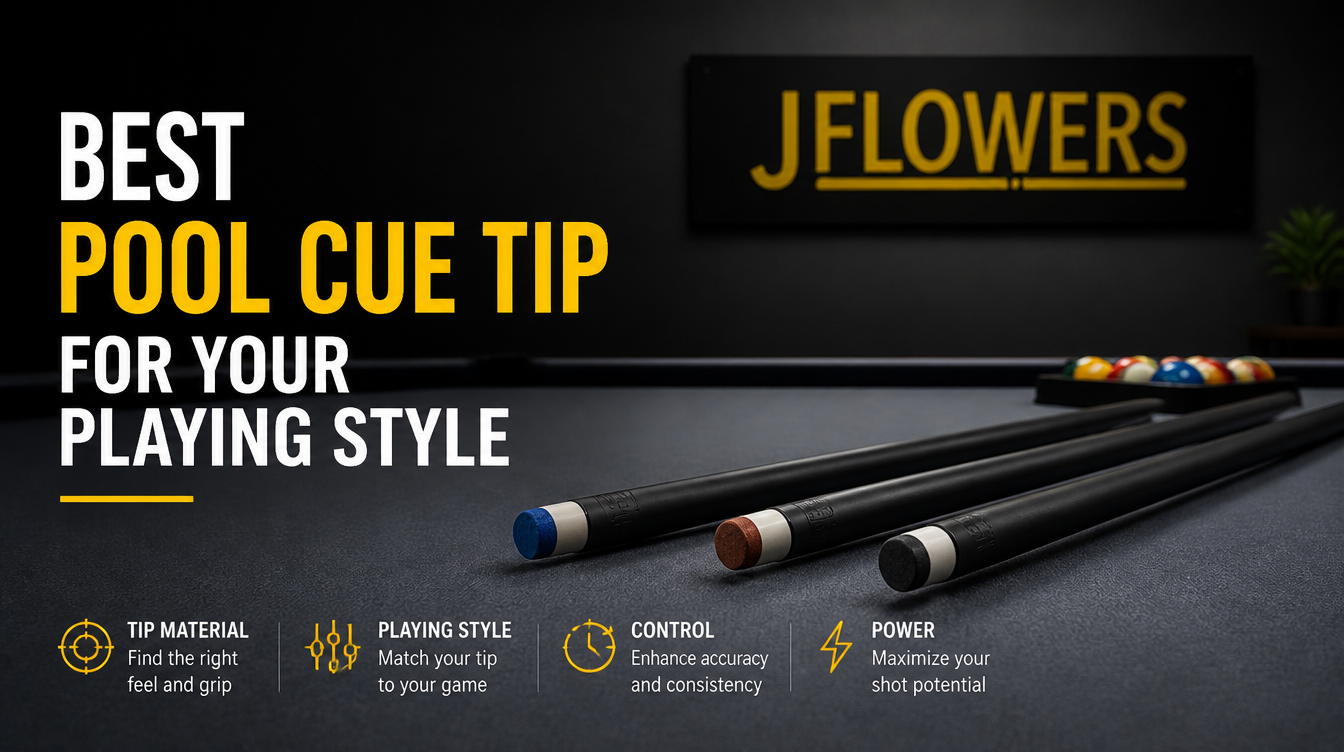
The cue tip is the smallest component of your setup — but it's the only part that actually contacts the cue ball. That makes it, in a real sense, the most performance-critical part of your entire cue. Yet it's consistently the most overlooked variable by players at every level. This guide covers what tip hardness actually does, how to match tip choice to your playing style, the most popular options on the market, and how to maintain your tip so it performs consistently.
Listen to this article
Everything you need to know about tip hardness, diameter, and maintenance
How Tips Work: The Contact Physics
When a cue tip contacts the cue ball, the tip compresses slightly and then springs back. During that brief moment of contact, the tip grips the cue ball and transfers spin. The hardness of the tip affects how long that contact lasts and how much grip is created — which directly affects the amount of spin and english you can generate.
A softer tip compresses more, stays in contact longer, and grips the cue ball more aggressively — more spin potential. A harder tip compresses less, contacts more briefly, and grips less — less spin potential but better durability. This is the core tradeoff that drives every tip choice in pool.
Tip Hardness Categories
Soft Tips Soft tips offer maximum cue ball grip and spin potential. The extended contact time allows the tip to really dig into the cue ball on off-center hits, generating more english, draw, and follow than harder options.
The tradeoff: soft tips mushroom and flatten faster, require more frequent maintenance and shaping, and need replacing more often. They also require better chalk discipline — a soft tip without fresh chalk miscues more easily.
Who should use soft tips: experienced players who rely heavily on english and spin, players with good chalk discipline and tip maintenance habits, players who prioritize maximum spin capability over longevity.
Medium Tips Medium tips are where the majority of players live, and for good reason. They offer a genuine balance of spin capability, control, durability, and forgiveness. They’re capable enough for advanced english shots, durable enough to last a reasonable time without replacement, and forgiving enough for developing players still working on their technique. Medium is the right starting point for most players and the right long-term choice for many. If you’re not sure what hardness you need, start here.
Medium-Hard Tips A step up in durability from medium while retaining good feel. Medium-hard tips are popular among players who want something that lasts longer than medium but doesn’t sacrifice too much spin capability. Often a good choice for league players who play frequently and don’t want to replace tips often.
Hard Tips Hard tips last the longest and produce the most direct, crisper hit feel — but generate less spin and provide less feedback on center-ball hits. They’re excellent for break cues, where repeated impact is the primary concern and spin isn’t the goal. For playing cues, most players find hard tips sacrifice too much performance.
Layered Tips Layered tips — constructed from multiple compressed layers of leather — offer a middle ground that many serious players prefer. They tend to hold their shape better than single-layer tips, maintain consistent hardness, and perform more uniformly over their lifespan. Most premium tip brands (Kamui, Taom) use layered construction.
Most playing cues use tips between 12mm and 13mm in diameter. Shaft diameter at the tip determines the tip size, and it’s not something you usually choose independently of the shaft.
That said, tip diameter does affect play. Smaller diameter tips (12–12.5mm) create a smaller contact area on the cue ball, which allows for more precise placement of english — off-center hits are more deliberate and controlled. This is why many advanced players and many carbon fiber shafts use 12mm tips.
Larger tips (13mm+) offer a slightly more forgiving contact area. Mis-hits are a bit more forgiving, and for beginners especially, the larger contact patch can help with consistency while stroke fundamentals are developing.
Popular Tip Brands and What They’re Known For
Kamui One of the most popular tip brands at the competitive level, particularly Kamui Black in medium and soft. Kamui tips are known for exceptional consistency across their lifespan — they hold their shape well, chalk evenly, and perform reliably. The Kamui Black soft is widely used by professional players who prioritize maximum spin.
Taom A Finnish brand that has gained significant traction on the professional circuit. Taom tips are known for their grip, their consistency, and particularly their performance when using heavy english. The Taom Chalk used with Taom tips is also gaining a following for its reduced chalk mess and better adhesion.
Tiger Tiger tips offer excellent value — quality construction at a lower price point than Kamui or Taom. Widely used in league and competitive play. Their Everest series is a popular choice for players who want good performance without premium pricing.
Triangle A long-time standard in the industry. Triangle tips are affordable, durable, and widely available. They’re a solid medium-hard option that many players use as their everyday tip. Not the highest performance ceiling, but reliable and economical.
Moori A Japanese layered tip brand that was one of the first premium options on the market. Still respected and used by many competitive players. Moori medium is a popular choice for players who want a layered tip with a traditional feel.
Matching Your Tip to Your Playing Style
Power Players and Break-Focused Play For your playing cue: medium to medium-hard. For your break cue: hard or phenolic. Power generation in pool comes primarily from technique, and a harder tip on the break protects against the repeated impact and miscue risk of aggressive breaking.
English and Spin-Heavy Players Medium-soft to soft. If your game depends heavily on side spin, draw, and follow for position play, a softer tip gives you the grip and spin capability that your style demands. Be prepared to replace tips more frequently and maintain them more consistently.
Precision and Control Players Medium to medium-hard. Control-oriented players who use precise center-ball and near-center play often prefer a harder tip for the direct feedback it provides. The tradeoff in spin capability is acceptable because the game style doesn’t rely on it as heavily.
All-Around Players Medium. The most versatile option that handles everything from precision position play to moderate spin shots without being optimized for either extreme. This is the right choice for most players.
Tip Maintenance: What You Need to Do
Shaping Tips need to be kept rounded — specifically domed to roughly the curve of a nickel or dime. A flat tip increases miscue risk and reduces spin transfer. As tips wear down and flatten, reshaping with a tip tool restores the dome and performance.
Scuffing Periodically roughing up the tip surface with a tip pick or scuffer helps chalk adhere better and improves grip on the cue ball. Don’t overdo it — scuffing too aggressively can shorten tip life. Light scuffing every few sessions is typically enough.
Chalking Chalk before every shot, not just when you think you need it. Light, even application — not grinding chalk into the tip. Good chalk discipline is especially important with softer tips.
When to Replace Replace your tip when it’s worn down to approximately 6–7mm in height, when it’s mushroomed beyond the ferrule and can’t be reshaped well, or when it starts miscuing consistently despite good chalk application.
Frequently Asked Questions
How often should I replace my pool cue tip? Depends on tip hardness and how frequently you play. Soft tips may need replacing every few months for frequent players. Medium tips typically last 6–12 months. Hard tips can go well over a year. Replace based on performance rather than a fixed schedule.
What tip do most professional players use? Most professionals play on medium to medium-soft layered tips. Kamui Black medium and Taom are among the most commonly seen on the professional circuit, though preferences vary significantly by player.
Can I replace a cue tip myself? Yes — tip replacement is a learnable skill and tip tools are affordable. That said, having a cue technician or experienced player do it the first few times is recommended to ensure proper installation and shaping.
Does the tip brand matter more than hardness? Both matter. Hardness sets the fundamental performance profile. Brand quality determines how consistently the tip performs across its lifespan. A medium Kamui and a medium Triangle are both medium tips, but the Kamui will perform more consistently and last better.
Should I upgrade the tip that comes with a new cue? In many cases, yes. Stock tips on production cues are often generic and not the best performance option. Budgeting $20–$40 for a tip upgrade from a quality brand when you get a new cue is often worth it.
What’s the difference between a layered tip and a single leather tip? Layered tips are constructed from multiple compressed layers of leather, which helps them hold their shape better and perform more consistently over their lifespan. Single leather tips are simpler construction — they can perform well but often need more frequent maintenance.
Final Thoughts
The cue tip is where your game meets the cue ball — and it deserves more attention than most players give it. Start with medium if you’re not sure. Pay attention to how your tip performs over time and whether you wish you had more spin capability or more durability. Maintain it consistently. And replace it before it starts costing you shots. A quality tip on an average shaft will often outperform a mediocre tip on a great shaft. Don’t overlook it.
After comparing JFlowers to Predator, Mezz, McDermott, Meucci, Jacoby, Pechauer, and a dozen more brands across every price point and construction philosophy — the question that started all of it deserves a direct answer: which pool cue brand actually offers the best value for serious competitive players in
2026?
Players Technology is one of the most widely used cue brands in American pool halls. Their two-piece cues at $40-$150 have introduced millions of American players to personal cue ownership. Nearly every serious pool player in America either started on a Players cue or played against someone who did. Comparing Players to JFlowers isn’t really a direct competition — it’s a marker on the journey from beginner to serious competitor.