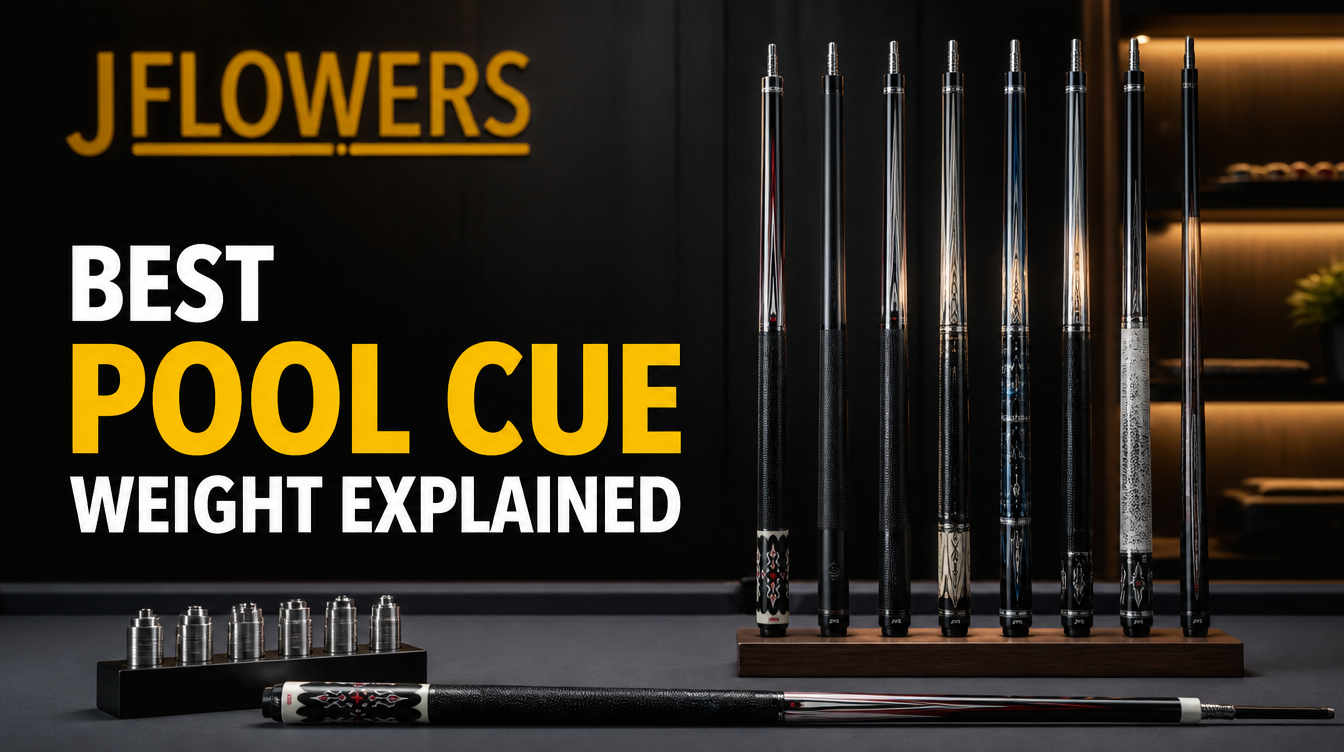
Pool cue weight is one of the first specs new players look at — and one of the most misunderstood variables in equipment selection. You'll hear advice ranging from "heavier hits harder" to "lighter lets you shoot faster," and most of it is oversimplified or flat-out wrong. Here's what cue weight actually does, what it doesn't do, and how to figure out the right weight for your game.
Listen to this article
What the numbers actually mean and how to find the right weight for your game
The Standard Range
Most pool cues are manufactured between 17 and 21 ounces. The overwhelming majority of players — recreational through professional — use cues in the 18–20 oz range, with 19 oz being by far the most common single weight at every skill level.
Quick Answer: If you don’t know your weight preference yet, start at 19 oz. It’s the most versatile, most tested weight in the game — and what most players land on when they’ve played long enough to develop a clear preference.
The Biggest Myth: More Weight = More Power
Let’s clear this up directly. A heavier cue does not automatically generate more power. Power in pool comes from stroke mechanics — acceleration through the ball, timing, follow-through, and technique. A player with excellent mechanics and an 18 oz cue will generate more power than the same player swinging a 21 oz cue with poor technique.
In fact, a cue that’s too heavy for your frame and stroke often produces the opposite of what you’re hoping for. It slows your acceleration, causes fatigue during longer sessions, and can create habits around compensating for the extra weight that are difficult to correct later. The exception is break shots — we’ll cover that below.
What Weight Actually Affects
Feel and Feedback Through the Stroke Weight affects the tactile experience of stroking through a shot. Heavier cues feel more substantial and planted at the cue ball — some players find this reassuring and easier to keep on the shot line. Lighter cues feel snappier and easier to accelerate — some players find this more natural and less fatiguing.
Neither feel is objectively better. It’s personal, and it often takes time playing on different weights to develop a clear preference.
Touch and Control on Soft Shots Lighter cues can offer better touch on delicate shots — precise stop shots, gentle draw, soft position play. The reduced mass means less energy transfer on a gentle stroke, which some players find gives them more feel and control at the soft end of their shot speed range. Heavier cues can feel harder to “hold back” on very gentle shots because there’s more mass moving through the stroke.
Fatigue During Long Sessions This is a real and underappreciated factor. If you play for three or four hours — a typical tournament or long practice session — the cumulative fatigue from repeatedly stroking a heavier cue adds up. Many players who switch from a 20+ oz cue to something in the 18.5–19 oz range report noticeably less fatigue during long sessions.
Break Shot Performance Break shots are the one area where slightly more weight has a legitimate performance argument. On the break, you’re trying to transfer maximum energy into the rack — and a slightly heavier cue (20–21 oz) can help with that energy transfer, particularly for players who have good break mechanics.
This is why many serious players use a dedicated break cue at a slightly higher weight than their playing cue. The break is a special-purpose shot that rewards different equipment characteristics.
Weight vs. Balance Point — An Important Distinction
Weight and balance are related but not the same thing. Two cues that both weigh exactly 19 oz can feel dramatically different depending on where that weight is distributed along the cue.
Forward Balance A forward-balanced cue has more mass toward the tip end. It feels heavier through the stroke — more substantial at the contact point. Some players prefer this for a planted, stable feeling on the shot. Many players find it easier to maintain a straight stroke line with a forward-balanced cue.
Rear Balance A rear-balanced cue has more mass toward the butt. It feels lighter and snappier during the swing and acceleration phase. This is preferred by players who like to feel the acceleration of the stroke more distinctly and find forward-balanced cues feel sluggish or heavy.
Neutral Balance A neutrally balanced cue is… neutral. The weight is distributed relatively evenly. This is where most all-around playing cues land, and it’s a great starting point for players who haven’t yet developed a strong preference.
When you’re testing cues, pay as much attention to balance feel as to total weight. A 19 oz forward-balanced cue and a 19 oz rear-balanced cue are completely different playing experiences.
Beginners Start at 19 oz. It’s the most versatile weight and gives you a reliable starting point. Don’t go above 20 oz as a beginner — the extra weight creates bad habits more than it helps anything.
Intermediate Players You’ve probably started to develop a feel preference by now. Experiment within the 18–20 oz range based on what feels natural in your stroke. Many intermediate players find they prefer something slightly lighter than they started with as their technique improves.
Advanced and Tournament Players Most advanced players have very specific preferences and know them well. The majority land in the 18.5–19.5 oz range for their playing cue. Some professionals play as light as 17–18 oz — particularly those with very refined, precise strokes where feel and touch are paramount.
Break Specialists A dedicated break cue in the 20–21 oz range is common at the competitive level. The extra mass aids energy transfer on the break shot specifically. Jump cues go the opposite direction — typically 11–14 oz with a short shaft for the quick, sharp stroke needed to jump the cue ball.
How to Find Your Ideal Weight The best way is simply to play on different weights. If you have friends with different cue weights, try them. If you’re shopping at a dealer or pool supply store, ask to hit with different options. Pay attention to:
How the cue feels during your natural stroke — not forced, just natural.
How it feels on soft shots and precise positioning — does it give you feel?
How it feels after an hour of play — does it start to feel heavy or fatiguing?
How your stroke looks and feels on your best shots — does the weight support or fight your mechanics?
Most players develop a clear preference within a few sessions on a different weight. Trust what feels natural rather than what you’ve read you should prefer.
Adjustable Weight Systems
Many quality cues feature weight adjustment systems — typically removable weight bolts in the butt that allow you to add or remove small increments of weight. If you’re not sure exactly where you want to land, a cue with an adjustable weight system gives you flexibility to experiment without buying multiple cues.
Adjusting weight also slightly shifts the balance point, so experimenting with weight bolts lets you explore both variables simultaneously.
Frequently Asked Questions
What weight pool cue do professional players use? The majority of professional players use cues in the 18.5–19.5 oz range. 19 oz is the most common single weight at the professional level. Some players go lighter, very few go heavier for their playing cue.
Does cue weight affect the break? Yes — slightly heavier cues can help with energy transfer on break shots. Many competitive players use a dedicated break cue at 20–21 oz for this reason. For playing cues, lighter is generally better.
Can I change the weight of my cue? If your cue has an adjustable weight system, yes — easily. If not, a cue technician can potentially add weight to the butt of some cue designs, though this is less common. Switching to a different shaft (carbon fiber vs maple) also shifts the effective feel of the cue’s weight distribution.
Is a lighter or heavier cue better for beginners? Start at 19 oz. Don’t go too heavy — the extra weight creates fatigue and bad habits. Don’t go too light — you need enough mass to develop a consistent stroke feel. 19 oz is the right default for beginners.
Does the weight of a carbon fiber shaft differ from maple? Yes — carbon fiber shafts are generally lighter than comparable maple shafts. This shifts the total cue weight and balance point slightly. If you switch from a maple shaft to carbon fiber, the cue will likely feel slightly lighter and more rear-balanced, which is something to account for in how you set your weight bolts.
What weight is best for jump shots? Jump shots are much easier with lighter equipment. Dedicated jump cues are typically 11–14 oz and have short shafts. If you’re attempting jump shots with your playing cue, a lighter weight (18 oz or below) is much more manageable.
Final Thoughts
Weight is one of the more personal variables in pool cue selection. The right weight for you is the one that feels natural in your stroke — comfortable to swing through, manageable over a long session, and supportive of your mechanics rather than fighting against them.
Start at 19 oz. Play with it. If something feels consistently off — too heavy, too light — adjust. Your stroke will tell you what it needs once you’ve played long enough to develop one.
After comparing JFlowers to Predator, Mezz, McDermott, Meucci, Jacoby, Pechauer, and a dozen more brands across every price point and construction philosophy — the question that started all of it deserves a direct answer: which pool cue brand actually offers the best value for serious competitive players in
2026?
Players Technology is one of the most widely used cue brands in American pool halls. Their two-piece cues at $40-$150 have introduced millions of American players to personal cue ownership. Nearly every serious pool player in America either started on a Players cue or played against someone who did. Comparing Players to JFlowers isn’t really a direct competition — it’s a marker on the journey from beginner to serious competitor.