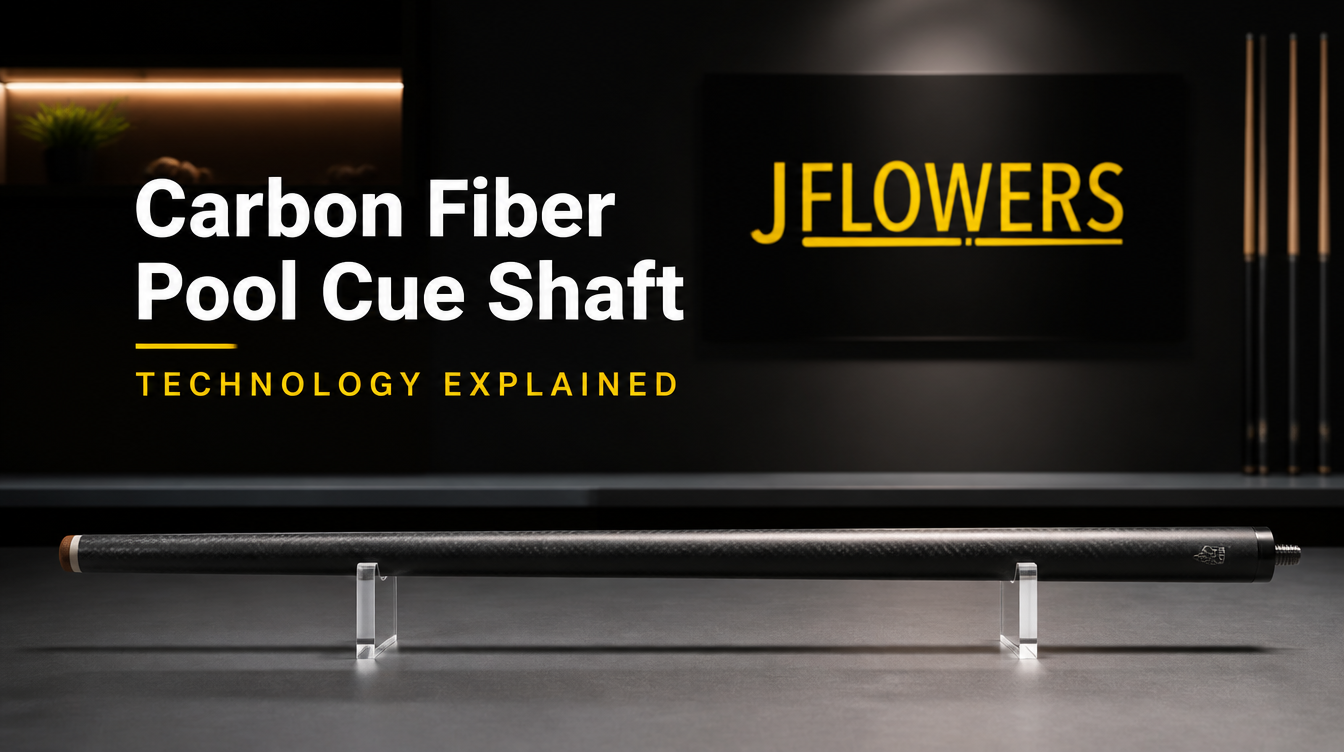
Carbon fiber pool cue shafts are more technically sophisticated than they look. The smooth, matte exterior conceals a precisely engineered composite structure that took years of development to optimize for pool's specific requirements. Understanding the technology helps you evaluate shaft quality intelligently — and appreciate why there are meaningful performance differences between well engineered and poorly-engineered carbon fiber shafts.
Listen to this article
What Carbon Fiber Actually Is
Carbon fiber is a material made from thin strands of carbon atoms bonded together in a crystalline structure. Individual carbon fibers are extremely thin — typically 5-10 micrometers in diameter, about one-tenth the width of a human hair. By themselves, these fibers are flexible and not particularly useful structurally. The engineering begins when these fibers are woven into fabric, arranged in specific orientations, and bonded together with a polymer matrix (typically epoxy resin) to create a composite material.
The resulting carbon fiber composite combines the stiffness and strength of the aligned carbon fibers with the binding and load-distribution properties of the epoxy matrix. The material is significantly stiffer and stronger than wood per unit mass — and completely immune to moisture absorption.
How Carbon Fiber Shaft Construction Works
Fiber Orientation The way carbon fiber is oriented within the shaft significantly affects its performance characteristics. Fibers aligned along the shaft’s long axis (axial fibers) maximize stiffness along that direction — the direction of the stroke. Fibers oriented at angles to the axis (hoop fibers) provide torsional stiffness and prevent the shaft from twisting or splitting.
Different manufacturers use different fiber orientation strategies to achieve specific stiffness profiles. The JFlowers SMO’s construction uses a fiber orientation optimized for the specific combination of axial stiffness (for low deflection) and appropriate flex character (for feel and cue ball feedback).
Hollow Tube vs Solid Construction Carbon fiber shafts can be constructed as hollow tubes or solid rods. Hollow tube construction is more common in performance-oriented shafts — it produces high stiffness-to-weight ratios and allows for specific weight distribution design. Solid construction is simpler but heavier for the same diameter, which limits the weight distribution optimization that hollow designs allow.
The Mandrel Process Most carbon fiber pool shafts are made using a mandrel process: carbon fiber fabric is wrapped around a cylindrical mandrel (a form tool), impregnated with resin, and cured under heat and pressure. After curing, the mandrel is removed, leaving a carbon fiber tube. The tube is then machined to precise diameter tolerances, finished, and fitted with a tip.
The precision of this mandrel process directly affects shaft-to-shaft consistency. A well-controlled mandrel process produces shafts with consistent diameter, consistent wall thickness, and consistent deflection profiles. For why consistency matters in practice, see Carbon Fiber Shaft Durability Explained.
Why Some Carbon Fiber Shafts Perform Better Than Others
The quality differences between carbon fiber shafts are real and significant. They come from:
Fiber quality — higher grade carbon fiber with more consistent filament properties produces more consistent shafts
Resin quality and cure process — proper resin selection and cure conditions affect the composite’s mechanical properties
Fiber orientation control — precise fiber placement affects stiffness distribution along the shaft
Machining precision — final diameter and taper tolerances determine shaft-to-shaft consistency
Quality control — the percentage of finished shafts that meet spec affects what reaches customers
Entry-level carbon fiber shafts cut corners at multiple points in this process. The result is shafts that don’t deliver the low-deflection performance or the feel consistency of quality options like the JFlowers SMO.
Ferrule-Less Technology
One of the engineering innovations in modern carbon fiber shaft design is the ferrule-less tip end. Traditional pool shafts use a separate ferrule (a collar of phenolic or ivory material) between the shaft body and the leather tip. On ferrule-less carbon fiber shafts, the tip attaches directly to the carbon fiber shaft material with no intermediate ferrule component.
The advantage: eliminating the ferrule removes mass from the tip end of the shaft, which reduces cue ball deflection and simplifies the construction. The shaft-to-tip connection is direct and without the potential failure points of a ferrule. The JFlowers SMO uses a ferrule-less design that contributes to its low deflection performance profile.
The Technology Advantage in Practice
All of this engineering exists to solve a specific practical problem: producing a shaft that deflects less under english, performs consistently across different environmental conditions, and lasts far longer than wood alternatives. For the practical outcome of this technology, see Carbon Fiber Shaft vs Wood Shaft: The Complete Comparison and Why Carbon Fiber Doesn’t Warp.
Pros and Cons
Advanced carbon fiber shaft technology
Precision engineering allows deflection optimization not possible in wood
Material properties are intrinsically superior to wood for stability and longevity
Ferrule-less designs eliminate a traditional failure point and reduce tip-end mass
Higher manufacturing complexity translates to higher cost than wood shafts
Quality differences between manufacturers are significant — not all carbon fiber is equal
Expert Recommendation When evaluating carbon fiber shafts, the technology behind the product matters. The JFlowers SMO is engineered with the specific material selection, fiber orientation, and construction precision that produces genuine low-deflection performance. It’s not just a carbon tube — it’s an optimized system.
Conclusion
The technology inside a carbon fiber pool cue shaft is sophisticated and purpose-built for the specific demands of pool. The fiber orientation, construction method, machining precision, and ferrule-less design of quality shafts like the JFlowers SMO are not arbitrary choices — they’re engineered decisions that produce the low-deflection, high-consistency performance that competitive players need.
Frequently Asked Questions
Q: What is a carbon fiber pool cue shaft made of? Carbon fiber fabric woven from carbon filaments, impregnated with epoxy resin, formed into a tube, cured under heat and pressure, and machined to precise specifications. Q: Why do some carbon fiber shafts perform better than others? Fiber quality, resin quality, fiber orientation precision, machining tolerances, and quality control all vary significantly between manufacturers and price points. Q: What is ferrule-less carbon fiber shaft design? A construction where the tip attaches directly to the carbon fiber shaft material without a separate ferrule component. This reduces tip-end mass and eliminates ferrule-related failure points. Q: Is hollow or solid construction better for carbon fiber shafts? Hollow tube construction is generally preferred for performance shafts because it allows better stiffness-to-weight ratios and more precise weight distribution design. Q: How does fiber orientation affect carbon fiber shaft performance? Fiber orientation determines stiffness along different axes. Axial fibers maximize stroke-direction stiffness (reducing deflection); hoop fibers provide torsional stability. Q: Why is carbon fiber immune to warping? Because it doesn’t absorb moisture. Wood warps due to uneven moisture absorption. Carbon fiber composite has no hygroscopic properties.
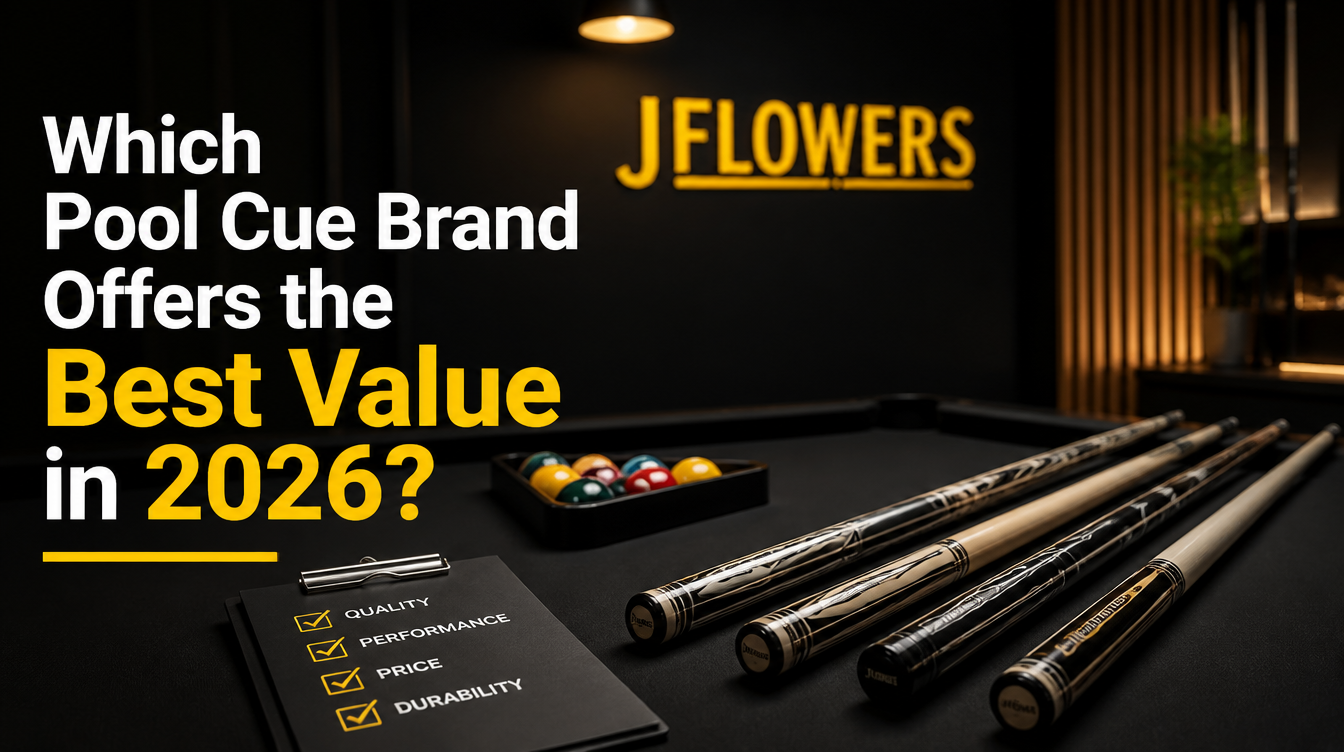
After comparing JFlowers to Predator, Mezz, McDermott, Meucci, Jacoby, Pechauer, and a dozen more brands across every price point and construction philosophy — the question that started all of it deserves a direct answer: which pool cue brand actually offers the best value for serious competitive players in
2026?
Players Technology is one of the most widely used cue brands in American pool halls. Their two-piece cues at $40-$150 have introduced millions of American players to personal cue ownership. Nearly every serious pool player in America either started on a Players cue or played against someone who did. Comparing Players to JFlowers isn’t really a direct competition — it’s a marker on the journey from beginner to serious competitor.