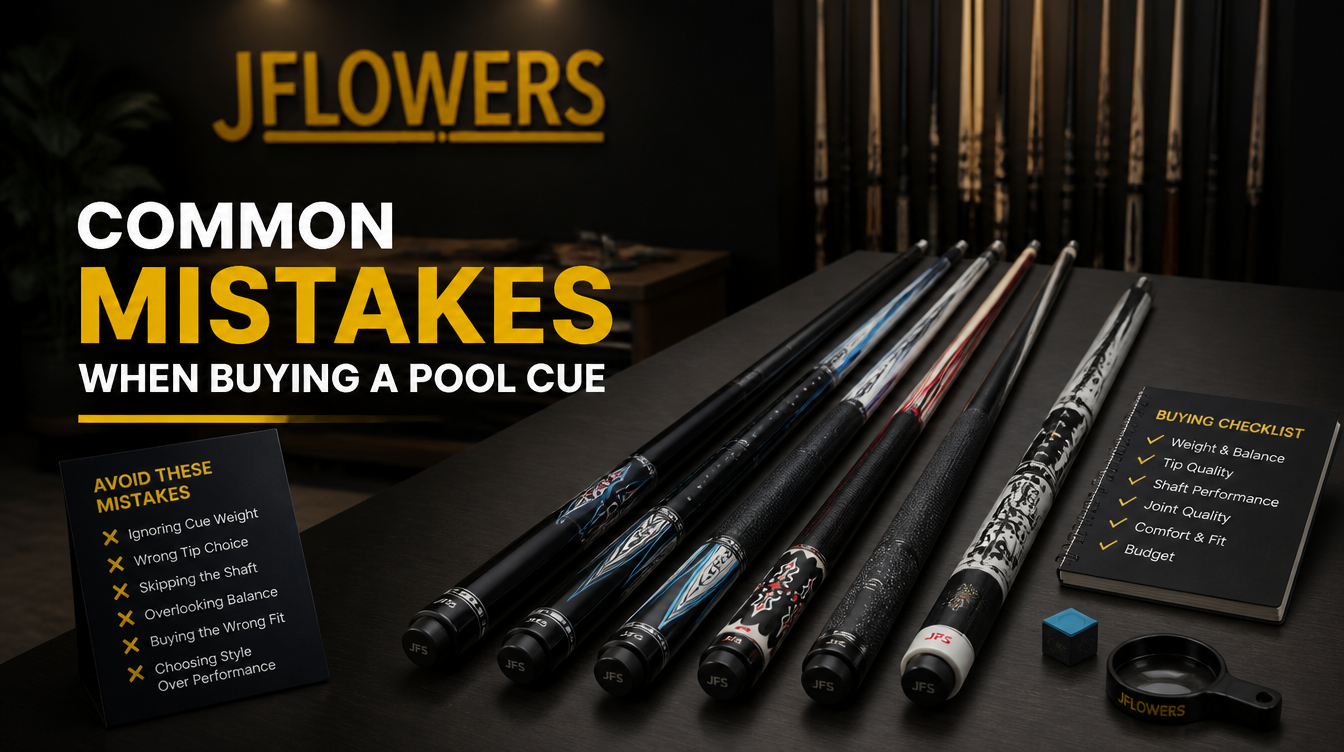
Pool cue shopping has a lot of traps. Marketing language, flashy aesthetics, bad advice from well-meaning people at the pool hall — these things combine to send a lot of buyers in the wrong direction. Here's a detailed breakdown of the most common mistakes, why they happen, and what to do instead.
Listen to this article
The errors most buyers make — and how to avoid them
Mistake 1: Buying Based on Appearance
This is the most common mistake and it happens at every price point. A cue with elaborate inlays, exotic wood veneers, intricate design work, and a premium presentation looks impressive. It can feel like the better cue. It often isn’t.
Decorative work — inlays, rings, stained wood patterns — doesn’t affect how the cue plays. What affects play is shaft quality, joint construction, tip hardness, and weight/balance. A plain, simple-looking cue with an excellent shaft will beat a beautifully decorated cue with a mediocre shaft on every single shot.
Rule: evaluate performance first, aesthetics second. Choose the cue that plays best in your budget range, then among the options that play equally well, choose the one that looks best.
Trying to save money by buying a $50–$80 cue is almost always a false economy. In this range, quality control is inconsistent — shafts may have minor warps from the factory, ferrules are often soft and dent quickly, and tips are generic materials that don’t chalk properly or transfer spin well.
These cues will technically get you playing. But they introduce inconsistencies that work against you as a developing player, and they require replacement much sooner than a slightly more expensive option. The money you save up front is often spent twice when you replace the cue within a year.
The floor for a genuinely quality cue is $150–$200 from a brand with a real reputation. Below that, the compromises in construction usually outweigh the savings.
“Heavier is more powerful” is one of the most persistent myths in pool. It’s wrong. Power comes from stroke mechanics — acceleration, timing, technique — not from the mass of the cue. A cue that’s too heavy for your frame and stroke often produces the opposite of what you’re hoping for: slower acceleration, fatigue during long sessions, and habits compensating for the extra weight that become difficult to break.
The majority of players — recreational through professional — use cues in the 18.5–19.5 oz range. If you find yourself reaching for a 21 oz cue because you want more power, the answer is almost certainly better technique, not more weight.
Mistake 4: Ignoring the Shaft
Players often spend the majority of their attention on the look of the butt — the decorative work, the wrap color, the overall aesthetic — and give almost no thought to the shaft. This is backwards.
The shaft is the performance engine of the cue. It’s what contacts the cue ball (via the tip), it’s where deflection characteristics live, and it’s what determines how consistently the cue plays over time. A quality shaft on a simple butt will outperform a mediocre shaft on a beautiful butt every time.
Before evaluating anything else, ask: what shaft does this cue come with? What is the taper? Is it low deflection? Carbon fiber or maple? Then evaluate the butt.
A cue that looks perfect on spec — right weight, right shaft technology, good reviews — can still feel wrong in your hand. The feel of a cue is personal, and reading about it is not a substitute for actually stroking through some shots with it.
Whenever possible, try a cue before committing. Visit a pool supply shop. Borrow a friend’s cue with the same shaft. Ask if demo models are available. The 20 minutes you spend testing will either confirm you’re making the right choice or save you from making an expensive mistake.
If buying online, prioritize brands and retailers with clear return policies. The ability to return a cue that doesn’t feel right protects your investment.
Mistake 6: Constant Equipment Changes
Some players go through three cues in their first year of playing seriously. Each time, the logic is some version of “this new cue will fix the problem.” Usually it doesn’t — and usually the problem isn’t the equipment.
Your game improves through practice and good coaching, not through equipment changes. Switching cues constantly resets your adaptation period — you’re always adjusting to new equipment rather than building skill on consistent equipment.
Choose a quality cue in the right budget range and commit to it. Play with it long enough to actually learn it — ideally at least three to six months of regular sessions. If you then have a clear, specific reason the cue isn’t working for your game, upgrade. Not before.
Mistake 7: Skipping the Case
Buying a quality cue and then transporting or storing it without proper protection is one of the most expensive mistakes you can make. A cue stored improperly — leaned against a wall, left in a hot car without a case, thrown in a bag without protection — can develop a warp, damage the joint, or break a tip.
A basic hard-sided two-piece case is not optional — it’s part of the investment. Budget at least $40–$80 for a quality case when you buy your cue. Soft-sided cases work for light occasional use; hard-sided cases are what you want for regular transport.
Mistake 8: Neglecting Tip Maintenance
A great shaft and a neglected tip is a waste of a great shaft. The tip is where your cue meets the cue ball — its condition directly affects every shot you play. Yet many players never shape, scuff, or maintain their tip until it’s obviously degraded.
Chalk before every shot. Shape the tip periodically to maintain the dome (flat tips miscue and transfer less spin). Scuff lightly every few sessions to help chalk adhere. Replace the tip before it starts costing you shots — not after.
Mistake 9: Buying a Cue That’s Too Advanced
Beginners sometimes buy high-end tournament cues thinking it will accelerate their development. Usually it doesn’t. Advanced equipment often has characteristics — very low deflection, very soft tips — that are harder to control for players who are still developing their fundamental stroke.
Match your equipment to your skill level. A $400 mid-range cue serves a developing player better than an $800 tournament cue in many cases, not because the $800 cue is worse, but because its performance characteristics are designed for a more refined stroke than the beginner has yet developed.
Mistake 10: Buying From the Wrong Place
Not every pool cue seller is equally trustworthy. Big-box sporting goods stores often carry entry-level cues with minimal quality control at prices that don’t reflect the value. Generic online marketplaces have counterfeit or heavily misrepresented products. And some “pool supply” shops sell overpriced, underperforming equipment to uninformed buyers.
Buy from brands with real reputations, backed by real player reviews. Buy from retailers with clear return policies. Buy from sources where the people selling the product understand what they’re selling.
Mistake 11: Ignoring Budget for Accessories
The cue isn’t the only thing you need to budget for. A quality case ($40–$100), decent chalk ($5–$15 for quality chalk like Master or Kamui), and tip maintenance tools ($15–$30 for a basic tip kit) should all be part of your initial budget. These aren’t optional extras — they’re what keeps your cue performing properly.
Frequently Asked Questions
What’s the single biggest mistake first-time buyers make? Buying based on appearance. Almost universally, first-time buyers prioritize aesthetics over performance — and most regret it within the first six months when the fancy inlays haven’t helped their game at all. Focus on shaft quality and construction.
Is it a mistake to buy a cue online without trying it? Not necessarily — if you’ve done your research on the specific model and brand, online purchasing is perfectly reasonable. The key is buying from a retailer with a solid return policy so you’re not stuck with something that doesn’t work for you.
How do I know if I’m making a mistake with my current cue? If your cue is inconsistent on shots where your technique is solid, if the tip performs poorly despite good maintenance, or if the shaft has developed a warp — these are legitimate reasons to evaluate an upgrade. If your shots are inconsistent and your technique is still developing, the equipment is probably not the primary issue.
Should I get advice from people at the pool hall? Carefully. Pool hall advice is well-intentioned but often based on personal experience and preference rather than broad expertise. The advice you get often reflects what that player likes — which may or may not match what’s right for your game. Use it as one input among many, not as the final word.
Is buying a used cue a mistake? Not if you know what to check. Inspect the shaft carefully for straightness, check the joint for wobble, and evaluate tip condition. A quality used cue from a reputable brand can offer excellent value. The risk is buying a used cue with hidden damage or poor storage history — buy from sources you can trust.
Final Thoughts
Most pool cue buying mistakes come down to the same root cause: prioritizing the wrong things. Looks over performance. Brand name over actual shaft technology. Price savings over construction quality. Or conversely, spending more than your skill level justifies because someone told you better equipment would fix your game.
Get your priorities right: shaft quality first, joint construction second, weight and balance third, tip appropriateness fourth. Everything else — aesthetics, brand, wrap color — comes after.
Do that, buy from a reputable source, protect your investment with a quality case, and you’ll make a decision you’re happy with.
After comparing JFlowers to Predator, Mezz, McDermott, Meucci, Jacoby, Pechauer, and a dozen more brands across every price point and construction philosophy — the question that started all of it deserves a direct answer: which pool cue brand actually offers the best value for serious competitive players in
2026?
Players Technology is one of the most widely used cue brands in American pool halls. Their two-piece cues at $40-$150 have introduced millions of American players to personal cue ownership. Nearly every serious pool player in America either started on a Players cue or played against someone who did. Comparing Players to JFlowers isn’t really a direct competition — it’s a marker on the journey from beginner to serious competitor.