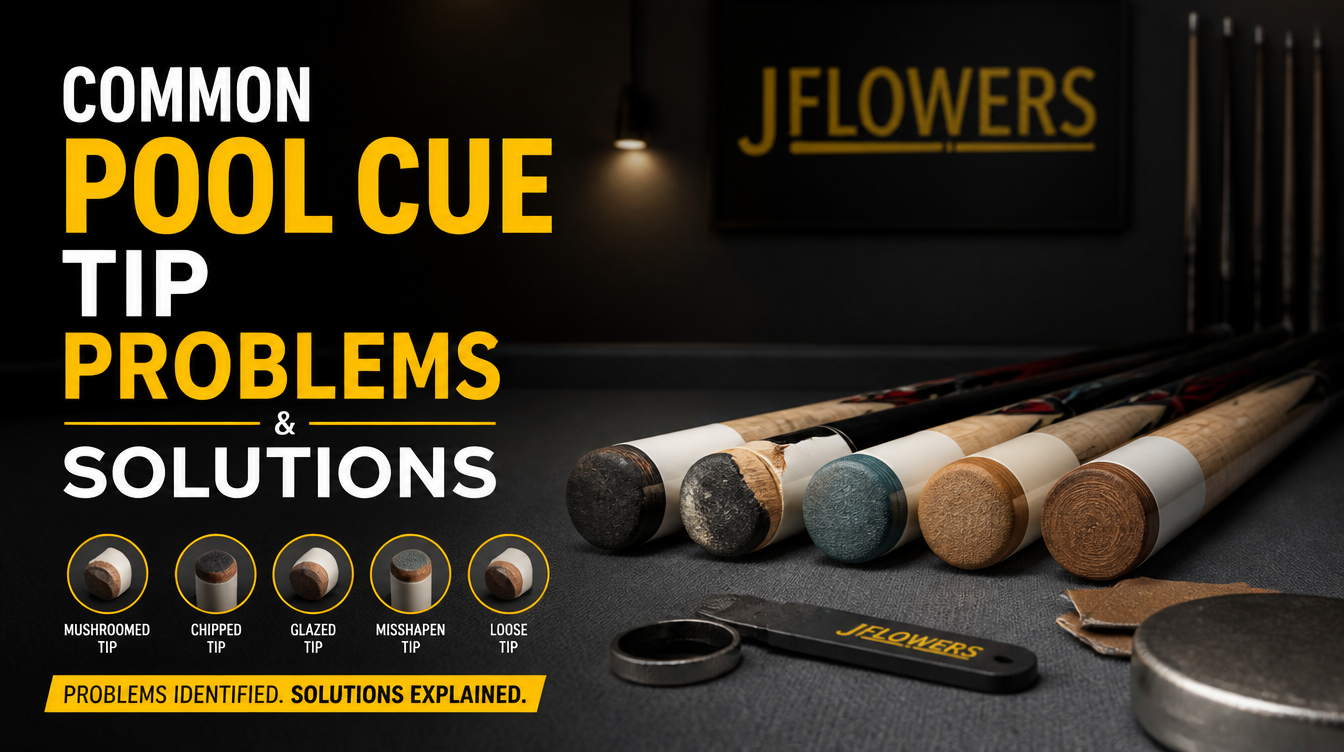
Most pool tip problems have straightforward causes and straightforward fixes. The frustrating part is that players often blame their mechanics or their aim when the actual problem is 30 seconds of tip maintenance away from being solved.
Listen to this article
This guide covers the most common tip problems — what causes them, how to diagnose them, and exactly what to do about each one.
Problem 1: Miscues
Symptom: the tip slides off the cue ball on off-center shots, producing a scraping sound and a wildly misdirected cue ball. Most common causes:
Insufficient chalk — the most common cause by a wide margin. If the tip isn’t chalked, it slides. Chalk before every shot, including every break.
Flat tip — a flat tip contacts the cue ball at increasingly poor angles on off-center shots, dramatically raising miscue risk. Check your tip shape from the side — it should dome clearly.
Smooth tip surface — if the tip hasn’t been scuffed recently, the surface is too smooth to hold chalk effectively. Scuff and rechalk.
Extreme english beyond the tip’s grip range — if you’re applying maximum english with insufficient chalk, any tip will slip. Add chalk, reduce contact eccentricity, or increase stroke commitment.
Fix: chalk before every shot. Shape the tip to nickel radius. Scuff the surface. In that order. If miscues continue after these fixes, evaluate stroke mechanics. For the shape maintenance guide, see How Often Should You Shape a Cue Tip?.
Problem 2: Mushrooming
Symptom: the tip leather spreads beyond the shaft’s diameter, creating a shelf-like overhang around the tip’s edge. Causes:
Normal wear under repeated impact — all tips mushroom eventually
Soft tip + heavy use — softest tips mushroom fastest
Neglected maintenance — tips that never get trimmed or reshaped mushroom much faster
Fix: trim the overhang with a sharp blade held at the shaft’s edge, then reshape to nickel radius and burnish the sides. For the full mushrooming guide, see Why Cue Tips Mushroom.
If mushrooming returns rapidly after trimming: the tip material has fatigued. Time to replace rather than maintain.
Problem 3: Tip Won’t Hold Chalk
Symptom: chalk slides off the tip, doesn’t stay on between shots, or the tip appears glazed and smooth. Causes:
Over-polished surface — too much burnishing or rubbing on the contact face has created a smooth, chalk-resistant surface
Never scuffed — new tips or tips that haven’t been scuffed lack the micro-texture chalk needs to bond
Wrong chalk — low-quality house chalk doesn’t bond well to quality tip surfaces
Fix: scuff the tip surface with a scuffer tool to create micro-texture. Apply Taom chalk to the fresh surface. Avoid rubbing the contact face smooth during play — use the scuffer side of your tip tool, not the flat face.
Problem 4: Tip Feels Hard / Performance Has Changed
Symptom: a previously comfortable tip feels firmer or more dead than it used to. Contact feels different. Causes:
Natural tip hardening from play — leather compresses and hardens over time under repeated impact
Tip has aged past its performance peak — quality tips have a lifespan, and a tip past its prime feels harder and less responsive
Environmental drying — tips in very low humidity become harder and less pliable
Fix: check tip age and condition. If the tip has been installed more than 12-18 months and is showing signs of degradation, replace it. For indicators, see Signs Your Cue Tip Needs Replacing.
Problem 5: Tip Is Loose or Falling Off
Symptom: the tip moves slightly on the shaft, or detaches during play. Causes:
Poor original installation — wrong adhesive, insufficient surface preparation, or contaminated bonding surfaces
Tip adhesive failure from heat — cues stored in hot cars can experience adhesive softening, loosening the tip bond
Moisture — extreme humidity exposure can compromise some tip adhesive systems
Tip past its thickness limit — very thin tips are more prone to detachment under impact
Fix: carefully remove the remaining tip, clean the bonding surface thoroughly, and reinstall with appropriate adhesive. For ferrule-less carbon fiber shafts, have a shop do this if you’re unfamiliar with the process. Don’t play on a loose tip — it can fully detach mid-shot, potentially damaging the shaft end.
Problem 6: Tip Cracks or Splits
Symptom: visible cracks in the tip leather, either on the contact face or on the sides. Causes:
Old, dry leather — tips that have been on the shaft for a long time dry out and crack
Environmental drying without conditioning — very low humidity accelerates leather cracking
Mechanical damage from impact or mishandling
Fix: replace the tip. A cracked tip cannot be reliably repaired and will continue to deteriorate. Prevent future cracking by replacing tips before they age past their useful life and by proper storage in appropriate humidity.
Problem 7: Inconsistent English From Shot to Shot
Symptom: the same english shot produces different results on different shots, even with similar stroke. Causes:
Partially mushroomed tip with irregular surface — inconsistent contact geometry shot to shot
Tip dome has flattened but unevenly — one side of the dome lower than the other
Fix: check the tip shape carefully and reshape to true nickel radius. Chalk consistently before every shot. If the tip’s surface has developed uneven wear patterns that shaping doesn’t fix, replace the tip.
Pros and Cons
Preventing tip problems through maintenance
Regular shaping, scuffing, and chalking prevent most common tip problems Proactive replacement prevents playing on a degraded tip Quality layered tips (Taom, Kamui) develop problems significantly more slowly Requires a tip tool and deliberate maintenance habits Even well-maintained tips eventually need replacement
Expert Recommendation Most tip problems have a simple fix: shape, scuff, chalk. These three habits, applied consistently, prevent the most common issues before they become performance problems. When a tip has genuinely reached end of life, replace it with a Taom or Kamui medium — don’t try to squeeze more play from a degraded tip.
Conclusion
Most cue tip problems are maintenance problems, not equipment problems. Shape, scuff, chalk — this triad addresses the majority of common tip issues before they become performance problems. When you’ve genuinely worn out a tip, replace it with a quality layered option from Taom or Kamui and start fresh with the proper maintenance routine. Your contact game will immediately reflect the difference.
Frequently Asked Questions
Q: Why does my cue keep miscuing? Most commonly: insufficient chalk. Chalk before every shot. If miscues continue, check tip shape (should dome clearly) and scuff the surface. Q: How do I fix a mushroomed pool cue tip? Trim the overhang flush with the shaft edge, reshape to nickel radius, burnish the sides. If mushrooming returns quickly, replace the tip. Q: Why won’t my cue tip hold chalk? The surface is too smooth — scuff it with a tip scuffer to create micro-texture. Also switch to quality chalk (Taom) if you’re using house chalk. Q: How do I know when to replace my cue tip? Replace when the tip is under 4mm thick, mushrooming returns rapidly, the feel has changed significantly, or the tip is cracked or loose. Q: Can a cue tip be repaired? Mushrooming can be trimmed. Loose tips can be re-glued. Cracked tips should be replaced — cracks don’t repair effectively. Q: Why does my tip feel different than it used to? Tips harden and lose performance over time. If the tip has been on more than 12-18 months and shows degradation, replace it rather than trying to restore it. Q: What causes a tip to pop off during play? Usually adhesive failure from heat (car storage), poor original installation, or very old, thin tip. Clean the bonding surface thoroughly and reinstall with appropriate adhesive. Q: Does tip material affect how often problems occur? Yes. Premium layered tips (Taom, Kamui) develop problems significantly more slowly than single-layer economy tips.
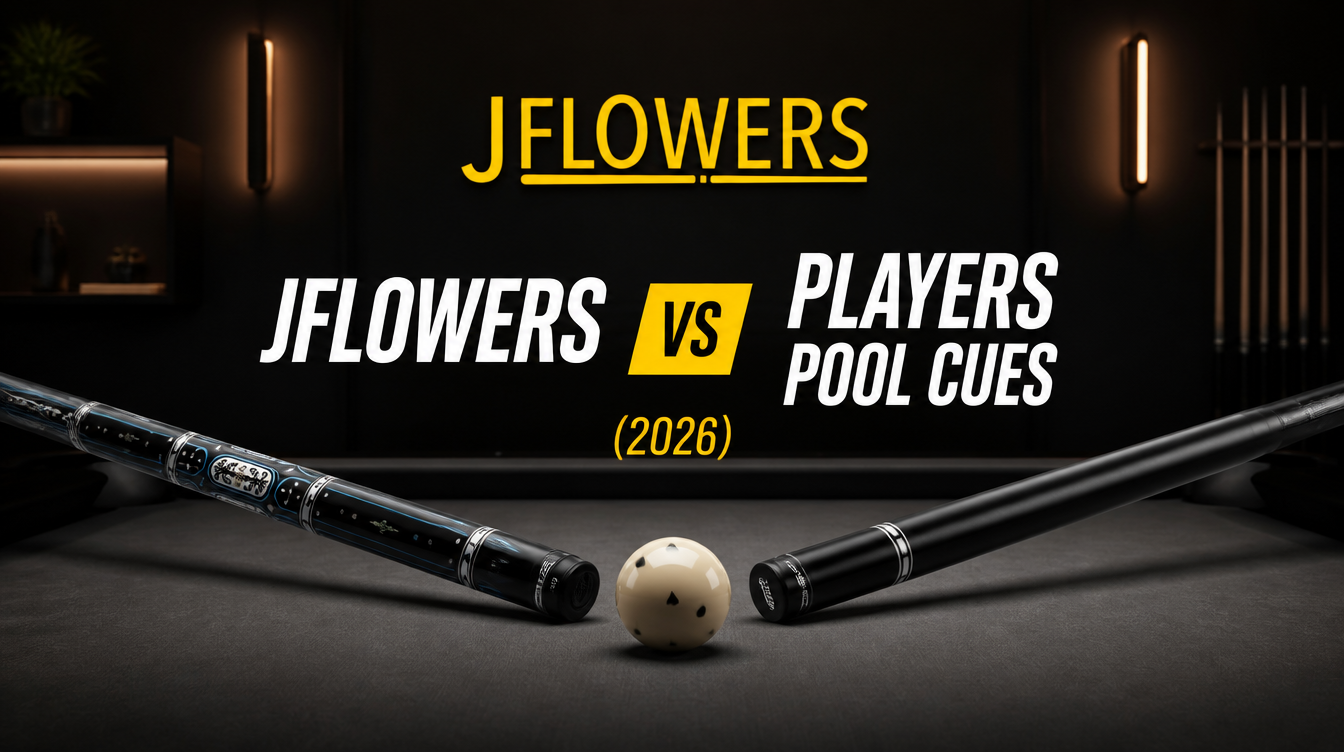
After comparing JFlowers to Predator, Mezz, McDermott, Meucci, Jacoby, Pechauer, and a dozen more brands across every price point and construction philosophy — the question that started all of it deserves a direct answer: which pool cue brand actually offers the best value for serious competitive players in
2026?
Players Technology is one of the most widely used cue brands in American pool halls. Their two-piece cues at $40-$150 have introduced millions of American players to personal cue ownership. Nearly every serious pool player in America either started on a Players cue or played against someone who did. Comparing Players to JFlowers isn’t really a direct competition — it’s a marker on the journey from beginner to serious competitor.