The tip is the only part of your cue that touches the cue ball. Everything else — the shaft, the joint, the wrap — affects how you deliver the stroke. The tip determines what actually happens at contact. It affects
your ability to apply spin, control speed, and execute precise position. It's a $15-$30 purchase that has more impact on your game than a $200 shaft upgrade if your current tip is worn out or poorly matched to your style.
Listen to this article
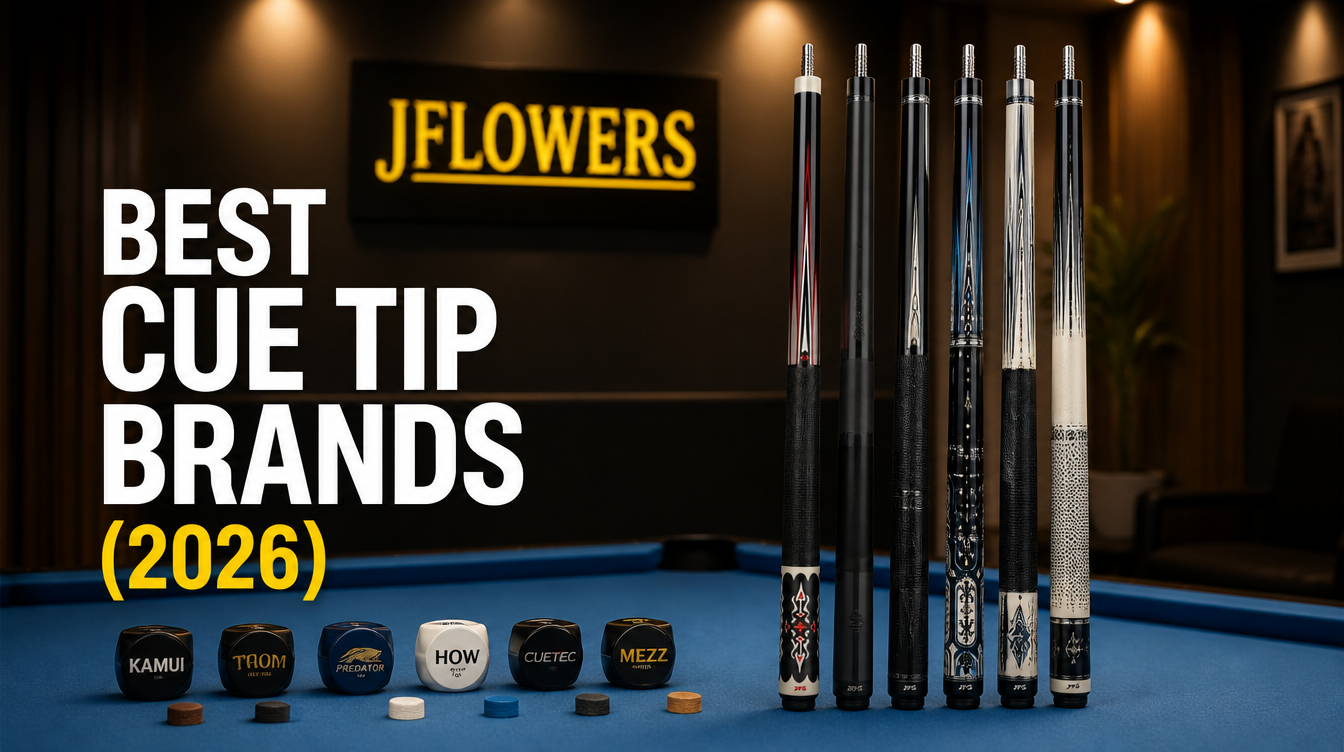
This guide covers the major cue tip brands in 2026 — what each one offers, who they suit, and how to choose. The tip market is crowded with options, and the differences between them are real and worth understanding.
What Makes a Good Cue Tip Brand
Before comparing brands, it’s worth establishing what actually separates a quality tip from a mediocre one:
Consistency — every tip in the box behaves the same way
Shape retention — the tip holds its radius under repeated impacts without mushrooming quickly
Chalk retention — the tip surface holds chalk effectively without requiring frequent re-chalking
Durability — the tip maintains its properties through a reasonable lifespan of competitive play
Feel — the tip transmits feedback from the cue ball clearly and consistently
These criteria apply regardless of tip hardness or construction type. For the full context of how tip choice affects your game, see Choosing the Right Pool Cue Tip.
Taom
Taom is a Finnish brand that has become one of the most respected names in premium cue tips over the past decade. Taom tips are known for exceptional consistency, outstanding chalk retention, and a feel that many competitive players describe as the best available.
Taom produces both chalk and tips, and the combination is particularly well-regarded — the Taom chalk is formulated to work especially well with Taom tips, producing clean contact with minimal chalk buildup on the cue ball.
Available in soft, medium-soft, medium, medium-hard, and hard. Layered construction throughout the range. Price: $15-$25 per tip. Our primary recommendation for competitive players at every level.
Kamui
Kamui is a Japanese brand that produces some of the most technically sophisticated layered tips on the market. The Kamui Original series has been a tour-level standard for years, and the Black series is among the most consistent tips available in the hardest grades.
Kamui tips are known for exceptional chalk retention and very good shape retention. The layered construction is extremely consistent across batches. They’re available in a wide range of hardnesses from 0.98 (extra soft) to hard.
Price point: $20-$35 per tip, slightly higher than Taom. Excellent choice for competitive players, particularly for those who use significant english and want maximum chalk grip. For the head-to-head with Taom, see Kamui vs Taom Cue Tips.
Tiger
Tiger produces a wide range of layered tips at different price points, making them one of the most accessible quality tip options. The Sniper series is particularly popular among competitive players for its consistency and performance relative to price.
Tiger tips are available in a very wide hardness range and multiple construction types. Quality is solid and consistent. Price: $10-$20 per tip. A good entry into quality layered tips without the premium pricing of Kamui or Taom.
Moori
Moori is a Japanese brand with a long history of producing layered tips for the competitive market. Moori Medium and Moori Hard are staples in the competitive pool community. Quality is excellent and the tips are known for good longevity.
Moori tips are somewhat less easy to find than Kamui or Taom, but dedicated billiards retailers carry them. Price: $20-$30 per tip. Excellent choice for players who have been using Moori historically and are happy with the brand.
Predator
Predator produces their own tips designed to work with their shafts, particularly the REVO carbon fiber shaft. The Victory and War tips are solid performers. Available at billiards retailers and online.
Predator tips are specifically engineered for compatibility with their shafts’ ferrule-less design, which is worth noting if you’re using a REVO. For other shafts, Taom or Kamui often offer better value.
Elk Master and Economy Tips
Elk Master is the standard for economy single-layer leather tips — you’ve almost certainly played on one on a house cue. At $2-$5 per tip, they’re affordable but mushroom quickly, have poor chalk retention compared to layered alternatives, and need replacement far more often.
Economy tips have their place: house cues, practice tables, beginners testing equipment before investing. For any serious play, the upgrade to layered tips is one of the best value improvements you can make.
Tips for Carbon Fiber Shafts
If you’re using a carbon fiber shaft like the JFlowers SMO, tip selection involves one additional consideration: the tip bonds to the carbon fiber material directly (on ferrule-less designs) rather than to a traditional ferrule. Taom and Kamui tips work well on ferrule-less carbon fiber shafts and provide the chalk retention and consistency that carbon fiber players benefit from. See Soft vs Medium vs Hard Pool Cue Tips for hardness matching to your playing style.
Pros and Cons
Premium layered tips (Taom, Kamui, Tiger)
Consistent performance within and across batches
Significantly better chalk retention than economy tips
Better shape retention — hold their radius longer
Longer lifespan than single-layer options
Higher upfront cost — $15-$35 per tip
More involved installation for ferrule-less carbon fiber designs
Economy single-layer tips
Very low cost
Widely available
Mushroom quickly — require frequent replacement
Poor chalk retention compared to layered alternatives
Expert Recommendation Taom is our primary recommendation for competitive players at every level. The consistency, chalk retention, and feel of Taom tips are best-in-class, and the price is accessible without being budget. For players on the JFlowers SMO Carbon Fiber Shaft, Taom medium provides the ideal combination of chalk grip and cue ball control for competitive play.
Conclusion
The tip is the single cheapest upgrade with the biggest per-dollar impact on your performance. If you’re still playing on a house cue-quality single-layer leather tip, a $20 Taom or Kamui replacement will transform your cue ball control more than a $400 shaft upgrade on a dead tip. Start with the tip. Get it right. Then build from there.
Frequently Asked Questions
Q: What is the best pool cue tip brand? Taom and Kamui are widely considered the top two premium tip brands in 2026. Taom is our primary recommendation for most players due to consistency, chalk retention, and accessible pricing. Q: Are Taom tips good? Yes — Taom tips are among the best available. Exceptional chalk retention, consistent feel, good shape retention, and available in a wide range of hardnesses. Q: Are Kamui tips worth the price? Yes, for competitive players who want top-tier performance. Kamui tips are excellent, particularly in harder grades for players who use significant english. Q: What tips do professional players use? Taom and Kamui are the most common professional choices. Both appear regularly at major tournaments. Q: How long do premium tips last? With proper maintenance, a quality Taom or Kamui tip can last 6-18 months of regular competitive play before needing replacement. Q: Are layered tips better than single-layer? Yes, for competitive play. Layered tips provide better shape retention, chalk retention, and consistency than single-layer options. Q: What tip hardness should I choose? Medium is the most popular choice for recreational and league players. See our dedicated guide at https://jflowerscues.com/pool-cue-reviews-buying-guides-expert-advice/soft-vs-medium-vs-hard-pool-cue-ti ps/ for a full breakdown. Q: Can I use Taom tips on a carbon fiber shaft? Yes. Taom tips work well on both traditional ferruled and ferrule-less carbon fiber shaft designs. Q: What are the cheapest quality cue tips? Tiger tips offer the best quality-to-price ratio at the lower end of the premium market, around $10-$20 per tip. Q: How often should I replace my cue tip? When it becomes flat, hard, mushroomed, or fails to hold chalk — typically every 6-18 months depending on play volume. See https://jflowerscues.com/pool-cue-reviews-buying-guides-expert-advice /signs-your-cue-tip-needs-replacing/ for specific indicators.
After comparing JFlowers to Predator, Mezz, McDermott, Meucci, Jacoby, Pechauer, and a dozen more brands across every price point and construction philosophy — the question that started all of it deserves a direct answer: which pool cue brand actually offers the best value for serious competitive players in
2026?
Players Technology is one of the most widely used cue brands in American pool halls. Their two-piece cues at $40-$150 have introduced millions of American players to personal cue ownership. Nearly every serious pool player in America either started on a Players cue or played against someone who did. Comparing Players to JFlowers isn’t really a direct competition — it’s a marker on the journey from beginner to serious competitor.