Ask most pool players what weight cue they use and they'll tell you instantly. Ask them where the balance point is — and most will have no idea. Yet two cues with the exact same weight can feel completely different in your hand and during your stroke, entirely because of how that weight is distributed. Balance is one of the most underappreciated variables in cue selection, and understanding it properly can change how you shop for equipment and how you evaluate what you currently play with.
Listen to this article
Why balance point matters as much as weight — and how to find what works for your stroke
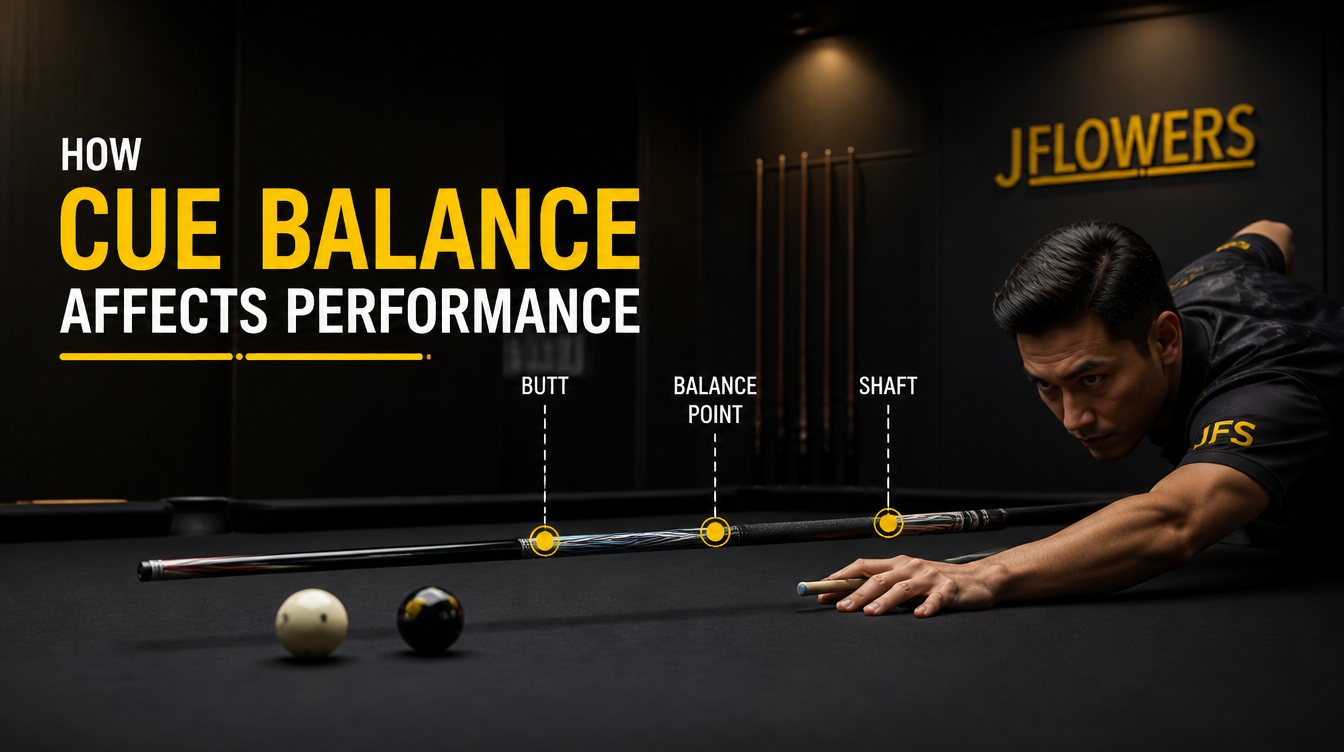
What Is Cue Balance Point?
The balance point is the spot along the length of the cue where, if you rested the cue horizontally on a single fingertip, it would be perfectly balanced — neither the butt end nor the tip end falling. For a standard 58-inch two-piece pool cue, the balance point typically falls somewhere between 17 and 22 inches from the butt end.
The position of this balance point is determined by how mass is distributed across the full length of the cue — the density and weight of the shaft, the joint hardware, the butt material, the wrap, and any weight bolts installed. Changing any of these components shifts the balance point.
Quick test: lay your cue across one finger and slide your finger until the cue balances. Where your finger lands is the balance point. Try this with a few different cues and you’ll immediately feel how different balance profiles translate to different stroke feel.
How Balance Affects the Stroke
The balance point affects how the cue feels during every phase of your stroke — address, backswing, delivery, and follow-through. These effects are subtle enough that many players don’t consciously notice them, but significant enough to affect stroke consistency and comfort over a long session.
During Address and Setup A forward-balanced cue (balance point closer to the tip) feels heavier in the forward half when you’re setting up your bridge and address. Some players find this grounding — the extra forward weight feels stable and planted. Others find it tiring to support over the course of a long session.
A rear-balanced cue (balance point closer to the butt) feels lighter in the forward section during setup. Many players describe this as easier to hold steady over the ball for extended alignment.
During the Stroke This is where balance makes its most noticeable impact. On the delivery phase — the forward acceleration through the cue ball — a forward-balanced cue feels more planted and connected at the contact point. The extra forward mass creates a feeling of more substance at the hit.
A rear-balanced cue feels snappier and easier to accelerate through. The stroke feels less like pushing a weighted object and more like swinging a balanced one. Some players find this makes their stroke feel more fluid and less forced.
During Follow-Through Follow-through feel is also affected by balance. Forward-balanced cues tend to continue forward naturally after contact — the momentum of the forward mass carries the cue through. Rear-balanced cues can feel like they want to stop at contact, which some players compensate for by consciously extending their follow-through.
Neither is objectively better. The right balance point is the one that feels most natural in your stroke and supports the way you play. That said, there are patterns in player preference based on playing style:
Power players and break-focused players often prefer forward balance — the extra forward mass aids energy transfer.
Control and finesse players often prefer neutral to rear balance — easier touch on delicate shots.
Players with longer bridges often prefer more forward balance — the extended reach makes forward mass feel more stable.
Players with shorter bridges often prefer neutral to rear balance — easier to manage the cue over shorter distances.
These are tendencies, not rules. The only reliable way to know what works for you is to play with different balance profiles and pay attention to what feels natural and what feels like you’re fighting the cue.
Balance vs. Weight: Understanding the Difference
Weight and balance are related but absolutely not the same thing. A cue that weighs 19 oz with a forward balance point feels dramatically different from a cue that weighs 19 oz with a rear balance point.
Many players who think they prefer a heavier cue actually prefer a forward-balanced cue — it’s the balance creating the feeling of more substance, not the total weight. Recognizing this can save you from going heavier than your stroke benefits from, when what you actually want is different balance.
The reverse is also true: players who find their current cue too heavy might actually be reacting to an unpleasant balance profile. Adjusting the balance — through weight bolt changes or shaft swaps — sometimes solves a “the cue is too heavy” complaint without reducing total weight at all.
Switching from a maple shaft to a carbon fiber shaft changes the balance of your cue — sometimes significantly. Carbon fiber shafts are typically lighter than comparable maple shafts, which shifts mass away from the front of the cue and moves the balance point toward the rear.
This balance shift is one of the things players notice when they first pick up a carbon fiber-equipped cue. The cue feels lighter in the front and more rear-weighted than the same butt with a maple shaft. For players who prefer forward balance, this can be an adjustment.
If your cue has adjustable weight bolts in the butt, you can compensate for the balance shift by adding weight — which moves the balance point back toward the front. This is worth doing if you’ve switched to carbon fiber and the rearward balance shift feels wrong for your stroke.
Adjustable Weight Systems and Balance Tuning
Many quality cues include adjustable weight systems — removable weight bolts in the butt end that let you fine-tune both total weight and balance point. These systems are one of the most useful features available in modern cue design, giving you real flexibility to optimize the feel of your cue for your specific stroke.
Adding weight bolts increases total weight and shifts the balance point slightly rearward (toward the butt). Removing bolts decreases total weight and shifts the balance point slightly forward. The shifts are small but noticeable — which is the point. Small balance adjustments can meaningfully change how a cue feels in your stroke.
If you’re not sure where you want your balance, a cue with an adjustable weight system lets you experiment over several sessions and settle into a preference based on actual play rather than guesswork.
Frequently Asked Questions
What balance point do most professional players prefer? Most professional players prefer a balance point in the 18–20 inch range from the butt — oughly neutral to slightly rear-balanced. But this varies significantly by player, stroke style, and personal preference. There’s no universal answer.
Does balance affect accuracy? Indirectly. A cue that feels balanced and natural for your stroke allows you to execute more consistently — which translates to better accuracy. A cue with a balance profile that fights your natural stroke creates tension and compensation that affects accuracy negatively.
How do I know if my balance is wrong for my game? Signs of a poor balance match: fatigue during long sessions that feels disproportionate to total cue weight; feeling like you’re pushing or fighting the cue on the delivery; inconsistency on touch shots that feels equipment-related rather than technique-related.
Can I add weight to shift my balance point without buying a new cue? If your cue has a weight bolt system, yes — relatively easily. If it doesn’t, a cue technician can sometimes add weight to the butt, though the options are more limited. Switching shaft materials (maple to carbon fiber or vice versa) also shifts the balance.
Is balance different for break cues? Yes — most dedicated break cues are forward-balanced intentionally. The extra forward mass aids energy transfer through the rack on the break. Playing cues typically run more neutral or rear-balanced for finesse and control.
Final Thoughts
Balance is one of the most consistently overlooked variables in cue selection — and one of the most worth paying attention to. Two cues at the same weight can play completely differently. Once you develop an understanding of what balance feels right in your stroke, you’ll never evaluate a cue again without checking it.
Test different balance profiles when you get the chance. Pay attention during play to whether the cue feels like it’s helping or fighting your stroke. And if your current cue has adjustable weight bolts, experiment — you might find that a small balance adjustment makes a cue you already own feel significantly better.
After comparing JFlowers to Predator, Mezz, McDermott, Meucci, Jacoby, Pechauer, and a dozen more brands across every price point and construction philosophy — the question that started all of it deserves a direct answer: which pool cue brand actually offers the best value for serious competitive players in
2026?
Players Technology is one of the most widely used cue brands in American pool halls. Their two-piece cues at $40-$150 have introduced millions of American players to personal cue ownership. Nearly every serious pool player in America either started on a Players cue or played against someone who did. Comparing Players to JFlowers isn’t really a direct competition — it’s a marker on the journey from beginner to serious competitor.