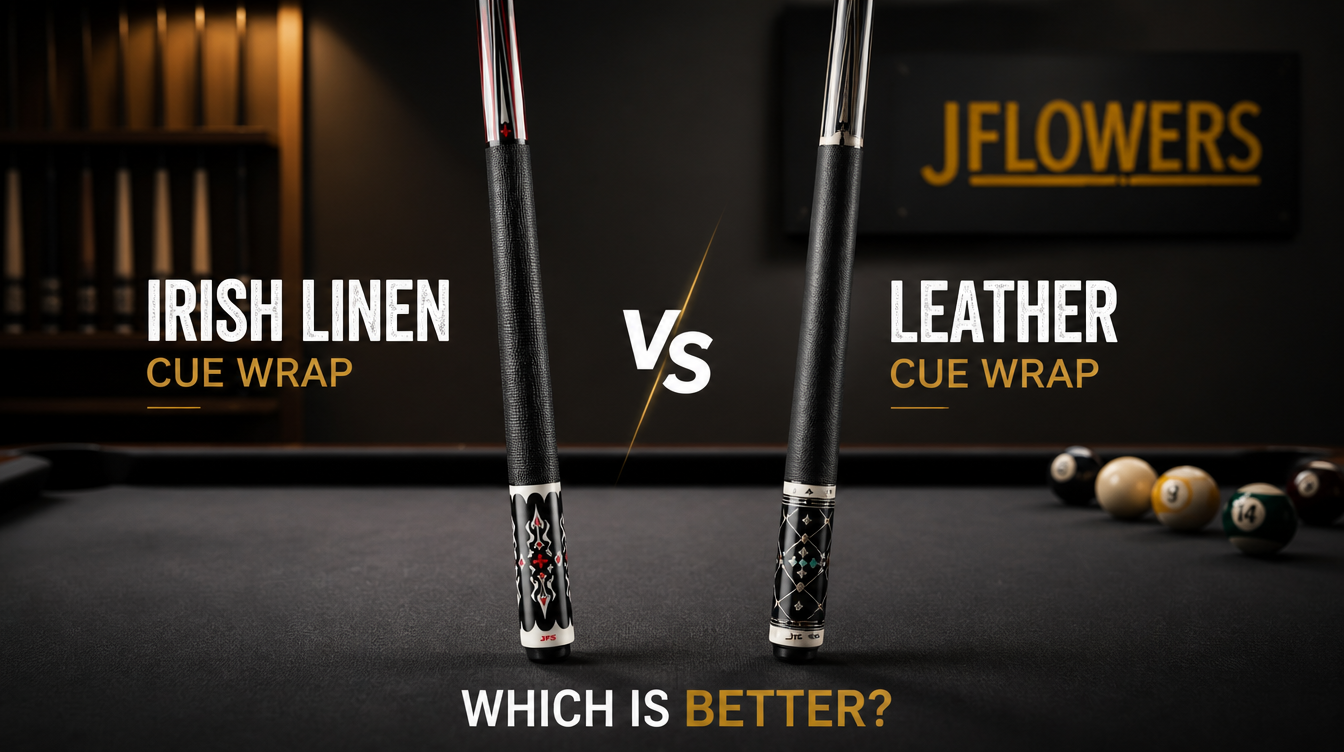
Walk through any serious pool hall and you'll see the linen vs leather debate playing out in real time. Some players swear by the traditional grip of Irish linen. Others won't touch anything but smooth leather. Both have legitimate cases — and neither is universally right.
Listen to this article
This guide gets specific about what actually separates Irish linen from leather in real-world playing conditions: how they feel during long sessions, how they handle moisture, how they wear over time, and which one suits which type of player. If you want the three-way comparison including wrapless, see Wrapless vs Linen vs Leather Wrap for the full picture.
What Is Irish Linen?
Irish linen cue wrap is made from flax fibers traditionally sourced from Ireland, wound tightly in a cross-hatch pattern onto the grip section of the cue butt. The result is a firm, slightly textured surface that provides grip without stickiness. Irish linen has been the dominant wrap material for competitive pool players for generations. The reason it’s survived as the standard isn’t tradition — it’s performance. Linen handles moisture better than any alternative, provides consistent grip across different hand positions, and holds up under the kind of heavy weekly use that competitive players demand.
What Is Leather Wrap?
Leather cue wrap is made from genuine hide — full-grain leather on quality cues, bonded leather on lower-end options. It’s wrapped onto the grip section and produces a smooth, refined feel that’s distinct from linen’s texture.
High-quality leather on a premium cue feels substantial and controlled. It’s a material associated with premium equipment across many sports, and for good reason: genuine leather is durable, ages well, and feels excellent in the hand of a player whose hands stay dry.
The critical distinction: not all leather is the same. Bonded leather (pressed scraps bound with adhesive) looks similar in photos but peels, cracks, and wears unevenly. On a premium JFlowers playing cue, you get genuine material — it’s the difference between something that lasts years and something that fails in months.
The Moisture Test — The Real Deciding Factor
If there’s one factor that separates linen and leather for most players, it’s moisture handling. And it’s not close.
Irish linen absorbs moisture from your hand. As your grip perspires during play — especially during long sessions, high-stakes matches, or warm room conditions — linen pulls that moisture into its fibers and maintains grip. The texture of the linen gives your hand something to hold against even as it gets damp.
Leather does the opposite. It does not absorb moisture. When your hands sweat on a leather wrap, the surface becomes progressively more slippery. Players with naturally moist hands often report genuine grip failure on leather wraps during intense competitive play.
This is why the majority of competitive players at the APA, BCA, and professional level use Irish linen. Tournament conditions create exactly the kind of pressure that triggers hand moisture — and linen is the wrap that handles it.
Feel and Stroke Preference
This is where leather wins for its fans. Players who prefer leather aren’t wrong about what they experience — the smooth, clean feel of quality leather during the stroke is genuinely different from linen’s texture, and for players with dry hands, it can feel more controlled and refined.
Linen’s texture provides more tactile feedback on hand position. Some players find this helpful — it lets them feel small positional adjustments during setup. Others find it distracting, especially if they’re sensitive to texture variations in the wrap.
Leather’s smooth consistency means there’s nothing to feel across the wrap surface — the grip is uniform from edge to edge. Some players describe this as a cleaner stroke.
Durability and Long-Term Wear
Irish Linen Quality linen wrapped tightly will last years under heavy play. The main failure modes are edge unwrapping (where the linen starts to lift at the top or bottom edge) and contamination (chalk, hand oils, and grime soaking into the fibers over time). Both are manageable with regular maintenance and eventual re-wrapping. Our full maintenance guide at Pool Cue Maintenance Checklist covers how to extend the life of your wrap.
Leather Genuine leather ages well with proper care. It develops a slight patina over time and, with occasional conditioning, maintains its feel and appearance for years. The failure mode for leather is cracking — typically from drying out without maintenance or from exposure to extreme temperature changes. Regular leather conditioning (a small dab of quality leather conditioner every few months) prevents this entirely.
Bonded leather doesn’t age — it fails. Peeling and cracking usually start within a year of heavy use. If you’re buying a leather-wrapped cue, make sure you know what grade of leather is on it.
Cleaning Your Wrap
Both linen and leather benefit from a quick wipe-down after every session. For linen, a dry cloth removes surface chalk and oils without damaging the fibers. For deeper cleaning of linen, a slightly damp cloth followed by air drying works well. For leather, wipe with a dry or very lightly damp cloth — never soak. More detail on cue cleaning at How to Clean a Pool Cue and Best Products for Pool Cue Care.
Cost and Re-Wrap
Re-wrapping a cue with Irish linen costs $20-$40 at most billiards shops and is a common, quick service. Leather re-wrap is slightly more involved and may cost $40-$70 depending on the shop and leather quality.
If your current wrap is worn and you’re considering switching materials, a re-wrap is a low-cost experiment. Try linen if you’re currently on leather and struggle with moisture. Try leather if you’re currently on linen and find the texture distracting with dry hands.
Pros and Cons
Irish linen
Best moisture management of any wrap material
Consistent grip under competitive pressure and long sessions
Proven choice among the majority of competitive players
Easy and affordable to re-wrap when worn
Texture may feel rough to players with sensitive or dry hands
Accumulates chalk dust and oils over time — needs regular wiping
Leather wrap
Smooth, refined feel for players with dry hands
Premium aesthetic on quality cues
Ages well with proper conditioning
Poor moisture handling — becomes slippery when hands sweat
Quality varies enormously between genuine and bonded leather
More expensive to re-wrap
Expert Recommendation The data strongly favors Irish linen for most competitive players — particularly anyone whose hands perspire during play or under pressure. Leather is a legitimate choice for players who have dry hands consistently, have tested both materials, and genuinely prefer the smooth feel. If you’re not sure, start with linen. It’s the competitive standard for a reason, and you can always switch if you find it doesn’t suit your hand type.
Conclusion
Irish linen vs leather is ultimately a hand-type decision more than a quality decision. If your hands sweat — even slightly, even only under pressure — Irish linen is the clear choice. If your hands genuinely stay dry in all playing conditions and you prefer a smooth, refined feel, quality leather is excellent. The worst outcome is buying a cue with a wrap that fights your hand conditions every session. Test before you commit, and don’t be afraid to re-wrap if the original choice turns out to be wrong for you.
Frequently Asked Questions
Q: Is Irish linen or leather better for pool cues? For most players — especially those with moist hands or who play long sessions — Irish linen performs better. It handles moisture significantly better than leather and maintains grip under competitive pressure. Q: Why do most pro players use Irish linen? Moisture management. Tournament conditions trigger hand perspiration, and linen absorbs moisture while maintaining grip. Leather becomes slippery under the same conditions. Q: Is leather wrap good on a pool cue? Yes, for players with consistently dry hands who prefer a smooth grip feel. Genuine full-grain leather on a quality cue feels excellent. The problem is moisture — leather doesn’t absorb perspiration. Q: How do you clean an Irish linen cue wrap? Wipe down with a dry cloth after every session to remove chalk and oils. For deeper cleaning, a lightly damp cloth followed by thorough air drying. Avoid soaking or harsh chemicals. Q: How do you condition a leather cue wrap? Apply a small amount of quality leather conditioner every few months to prevent drying and cracking. Wipe off excess. Do not use petroleum-based products. Q: How much does it cost to re-wrap a pool cue? Irish linen re-wrap typically costs $20-$40 at a billiards shop. Leather re-wrap is slightly more, around $40-$70 depending on leather quality and the shop. Q: Can I switch from leather to linen on my cue? Yes. A cue repairman can remove the existing wrap and re-wrap with Irish linen. It’s a relatively quick and affordable service. Q: Does wrap type affect a cue’s balance? Very slightly. The weight of the wrap material contributes to balance point, but the effect is minimal. Linen and leather are close in weight. Removing wrap entirely (going wrapless) has a more noticeable effect. Q: What is the difference between genuine leather and bonded leather on a cue? Genuine leather is from a single continuous hide — durable, ages well, and feels excellent. Bonded leather is scraps compressed with adhesive — looks similar in photos, but peels and cracks quickly under heavy use.
After comparing JFlowers to Predator, Mezz, McDermott, Meucci, Jacoby, Pechauer, and a dozen more brands across every price point and construction philosophy — the question that started all of it deserves a direct answer: which pool cue brand actually offers the best value for serious competitive players in
2026?
Players Technology is one of the most widely used cue brands in American pool halls. Their two-piece cues at $40-$150 have introduced millions of American players to personal cue ownership. Nearly every serious pool player in America either started on a Players cue or played against someone who did. Comparing Players to JFlowers isn’t really a direct competition — it’s a marker on the journey from beginner to serious competitor.