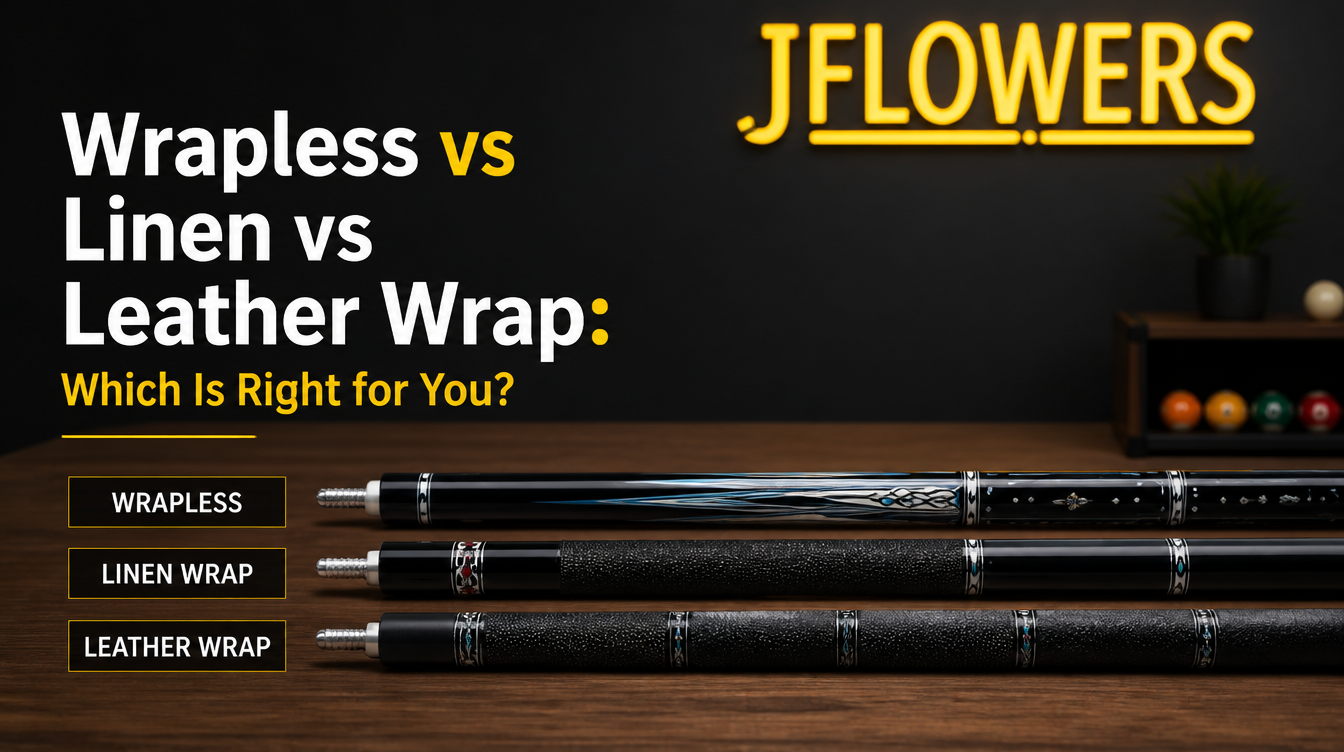
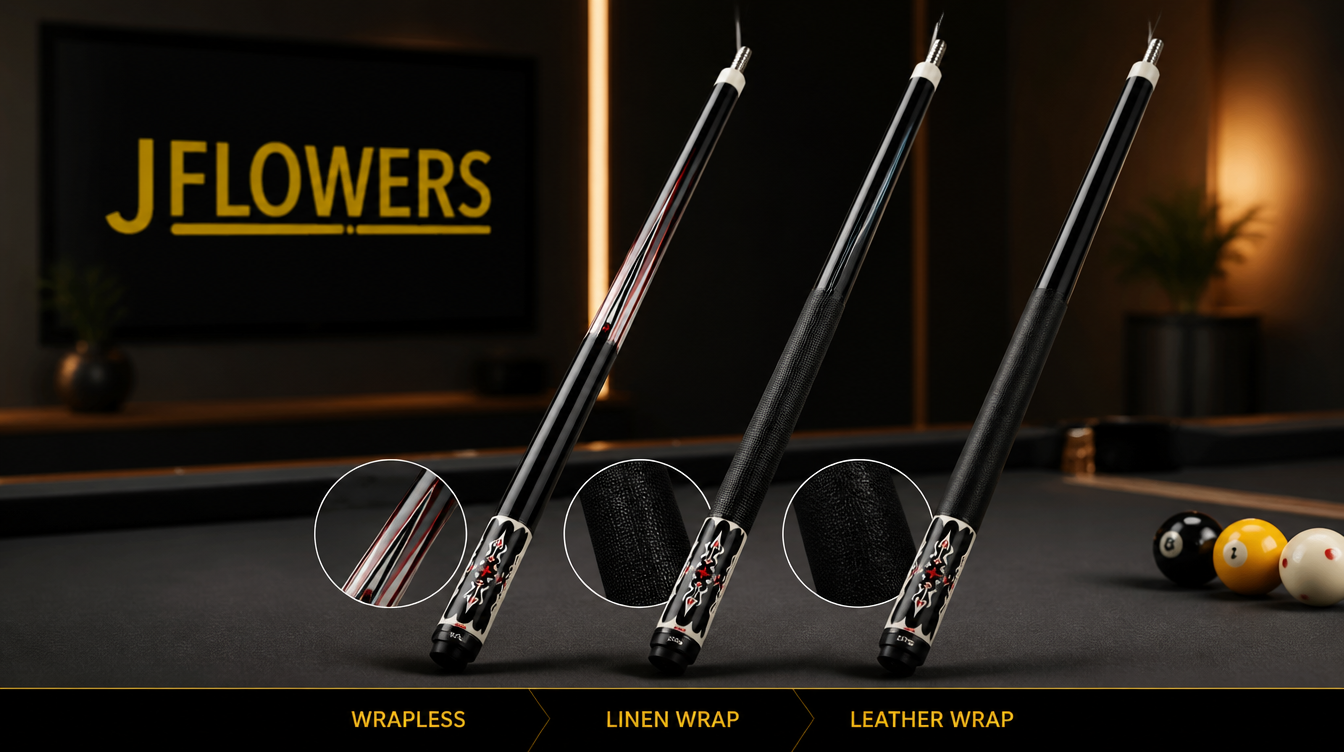
Wrapless vs Linen vs Leather Wrap: Which Is Right for You?
JFlowers Cues
The wrap on a pool cue is the section your back hand grips during every shot. It affects grip security,
moisture management, comfort during long sessions, and — for some players — the overall feel of the
stroke. It's a preference-driven choice, but it's not arbitrary.
Listen to this article
The three main options are Irish linen, leather, and wrapless. Each has a distinct feel, different maintenance requirements, and suits different playing styles and hand types. This guide breaks down all three so you can choose with confidence rather than guessing. For the context of where wrap fits in the overall picture of cue quality, see What Makes a Premium Pool Cue?.
Irish Linen Wrap
Irish linen is the most popular wrap choice among competitive pool players worldwide. It’s a tightly wound textile wrap that provides consistent grip, absorbs moisture from your hand, and holds up well over years of heavy play.
What It Feels Like Linen has a slightly textured, firm feel with just enough grip without being sticky. It’s forgiving across different hand positions and doesn’t punish a slightly open or closed grip during the stroke. The texture also makes it easier to feel small positional adjustments in your bridge hand’s grip.
How It Handles Sweat One of linen’s biggest advantages is moisture management. The textile fibers absorb perspiration without becoming slippery. Players with naturally moist hands often find linen significantly better than smooth alternatives. It’s one of the reasons linen has remained the standard on competition cues for decades.
Maintenance Linen wraps accumulate chalk dust, hand oils, and grime over time. Regular wiping with a dry cloth keeps it performing. Deep cleaning requires more care — avoid soaking or harsh chemicals. A worn linen wrap eventually unravels at the edges or develops gaps, at which point it can be re-wrapped by a cue repairman for around $20-$30.
Who It’s For Players who sweat during play, players who prefer a traditional feel, and most competitive league and tournament players. If you’re not sure which wrap to choose, linen is the default recommendation for good reason.
Leather Wrap
Leather wraps offer a smoother, firmer feel than linen with a more refined, polished aesthetic. High quality genuine leather on a premium cue feels excellent in hand — substantial and responsive.
What It Feels Like Smooth leather provides less texture than linen, which some players prefer for its clean, consistent slide feel during the stroke. Players with dry hands often find leather ideal. The feel is closer to the grip on a high-end sports equipment handle.
The Moisture Problem This is leather’s main limitation: it does not absorb moisture well. Players with moist or sweaty hands will find leather becomes slippery under pressure, especially during long sessions or under tournament nerves. If this is you, linen is the better choice regardless of how much you like the look of leather.
Quality Matters More With Leather Bonded leather (leather scraps compressed and glued together) looks fine in photos but cracks, peels, and wears unevenly. Genuine full-grain leather on a quality cue is a completely different product. On a premium JFlowers cue, the leather wrap quality reflects the same standard as the rest of the build.
Maintenance Leather benefits from occasional conditioning to prevent cracking and drying. Avoid soaking. Wipe down after every session to remove hand oils. With proper care, a quality leather wrap lasts for years.
Who It’s For Players with dry hands who prefer a smooth, firm feel. Players who prioritize the aesthetic refinement of leather. Advanced players who know their hand conditions and have tested both materials. One of linen’s biggest advantages is moisture management. The textile fibers absorb perspiration without becoming slippery. Players with naturally moist hands often find linen significantly better than smooth alternatives. It’s one of the reasons linen has remained the standard on competition cues for decades.
Wrapless
Wrapless cues have no textile or leather covering on the grip section — just the bare butt material, usually finished with a smooth coating, a micro-texture, or an Irish linen-style imprinted pattern in the lacquer.
What It Feels Like Wrapless cues have a clean, direct feel that’s become increasingly popular, especially paired with carbon fiber shafts. Many players describe it as feeling more connected to the cue — there’s less material between your hand and the wood. The feel varies significantly between different wrapless finishes: a rough-textured wrapless can feel similar to linen, while a smooth-gloss wrapless is closer to leather.
Moisture and Grip Wrapless cues without texture can be problematic for players with moist hands. The smooth surface becomes slippery under perspiration with nothing to absorb or channel it. Textured wrapless finishes handle this better. Some players use a Cue Armour glove to offset the grip issues on a smooth wrapless cue — providing consistent friction regardless of hand condition. For cue weight and balance effects of going wrapless, see How Cue Weight Affects Your Stroke.
Maintenance Wrapless cues are the easiest to maintain — wipe down with a soft cloth after play. No re-wrapping, no conditioning. The finish can scratch or scuff over time, but this is cosmetic rather than functional.
Who It’s For Players who prefer a minimalist feel, particularly those using carbon fiber shafts where the whole setup has a modern performance character. Players who want zero maintenance on the grip section. Players with dry hands.
Side-by-Side Comparison
Irish linen — Grip: textured / Moisture: excellent / Maintenance: moderate / Best for: most competitive players
Wrapless — Grip: varies by finish / Moisture: poor (smooth) to fair (textured) / Maintenance: easy / Best for: modern/CF setup players
Does Wrap Type Affect Performance?
Directly, no — wrap type doesn’t change how the cue ball moves. But indirectly, yes: grip security affects stroke consistency. A grip that slips or requires compensation during the stroke introduces variables in your delivery. A wrap that suits your hand type gives you one less thing to manage during play.
Wrap also contributes slightly to balance point — the weight of a linen or leather wrap pushes the balance point very slightly butt-ward compared to a wrapless design. For players sensitive to balance, this is worth knowing. More at How Cue Balance Affects Performance.
Can You Change a Cue’s Wrap?
Yes. Linen and leather wraps can be re-done by a cue repairman or experienced player. Wrapless conversion requires refinishing, which is more involved. If you’re unhappy with your current wrap, the easiest upgrade is a linen re-wrap — it’s affordable and dramatically changes the feel of the grip section.
Pros and Cons
Irish linen
Best moisture management of any wrap type
Proven choice among competitive players worldwide
Easy to re-wrap when worn
Accumulates chalk and oils over time
Can feel rough to players with sensitive hands
Leather
Premium feel and appearance
Smooth, refined grip for dry-handed players
Poor moisture management — slippery when wet
Quality varies enormously — cheap leather is worse than linen
Wrapless
Easiest maintenance — just wipe down
Clean, modern feel popular with CF shaft setups
No wrap material to wear out or re-wrap
Smooth wrapless can be slippery without gloves
Feel varies a lot between different wrapless finishes
Expert Recommendation For most competitive players: Irish linen is the default right answer. It handles moisture, provides consistent grip, and holds up over heavy use. If you play with dry hands and prefer a smooth, refined feel — leather is worth trying. If you’re building a modern carbon fiber setup and want a clean, minimal feel — wrapless is worth considering, ideally with a Cue Armour glove to manage grip consistency regardless of hand condition.
Conclusion
Wrap choice is personal — but it’s not arbitrary. Irish linen suits the most players, handles the widest range of hand conditions, and has earned its status as the competitive standard for good reason. If your hands stay dry and you prefer a smooth feel, leather is worth a try. If you’re building a modern setup with a carbon fiber shaft and want a clean, minimal feel, wrapless has a strong case. Test if you can before committing. Most players don’t discover their real preference until they’ve played on two or three different wrap types.
Frequently Asked Questions
Q: What is the best cue wrap for sweaty hands? Irish linen. It absorbs moisture and maintains grip even under heavy play conditions. Leather and smooth wrapless become slippery when your hands sweat. Q: What is a wrapless pool cue? A wrapless cue has no textile or leather wrap on the grip section — just the bare butt material, usually finished with a smooth coating or texture. Popular on modern carbon fiber setups. Q: Does cue wrap affect performance? Not directly, but grip security affects stroke consistency. The right wrap for your hand type means one fewer variable to manage during play. Q: How long does an Irish linen wrap last? With regular maintenance, Irish linen can last many years. Heavy use will wear the edges and eventually cause unwrapping. Re-wrapping costs around $20-$30 at a cue repair shop. Q: Can I change my cue’s wrap? Yes. Linen and leather wraps can be re-done by a cue repairman. Wrapless conversion is more involved and requires refinishing. Q: What wrap does JFlowers use on their cues? JFlowers playing cues feature high-quality Irish linen wrap on their standard lineup, reflecting the competitive player preference for moisture management and consistent grip. Q: Is leather wrap good for pool cues? Yes, for players with dry hands who prefer a smooth feel. Genuine full-grain leather on a quality cue feels excellent. Bonded leather alternatives are significantly inferior. Q: Do professional pool players prefer linen or leather? The majority of competitive pool players use Irish linen. It’s the dominant choice on the professional circuit due to its moisture management and grip consistency. Q: What is Irish linen made of? Irish linen cue wrap is made from flax fibers, traditionally sourced from Ireland. It’s tightly woven and wound onto the grip section of the cue butt.
After comparing JFlowers to Predator, Mezz, McDermott, Meucci, Jacoby, Pechauer, and a dozen more brands across every price point and construction philosophy — the question that started all of it deserves a direct answer: which pool cue brand actually offers the best value for serious competitive players in
2026?
Players Technology is one of the most widely used cue brands in American pool halls. Their two-piece cues at $40-$150 have introduced millions of American players to personal cue ownership. Nearly every serious pool player in America either started on a Players cue or played against someone who did. Comparing Players to JFlowers isn’t really a direct competition — it’s a marker on the journey from beginner to serious competitor.