Most players talk about cue weight when they're shopping. Almost no one talks about balance — even though two cues with the exact same weight can feel completely different depending on where that weight sits. Understanding balance gives you a more sophisticated way to evaluate cues, and it often explains why a cue you picked up felt "off" even though the specs looked right.
Listen to this article
Why balance matters as much as weight — and how to find yours
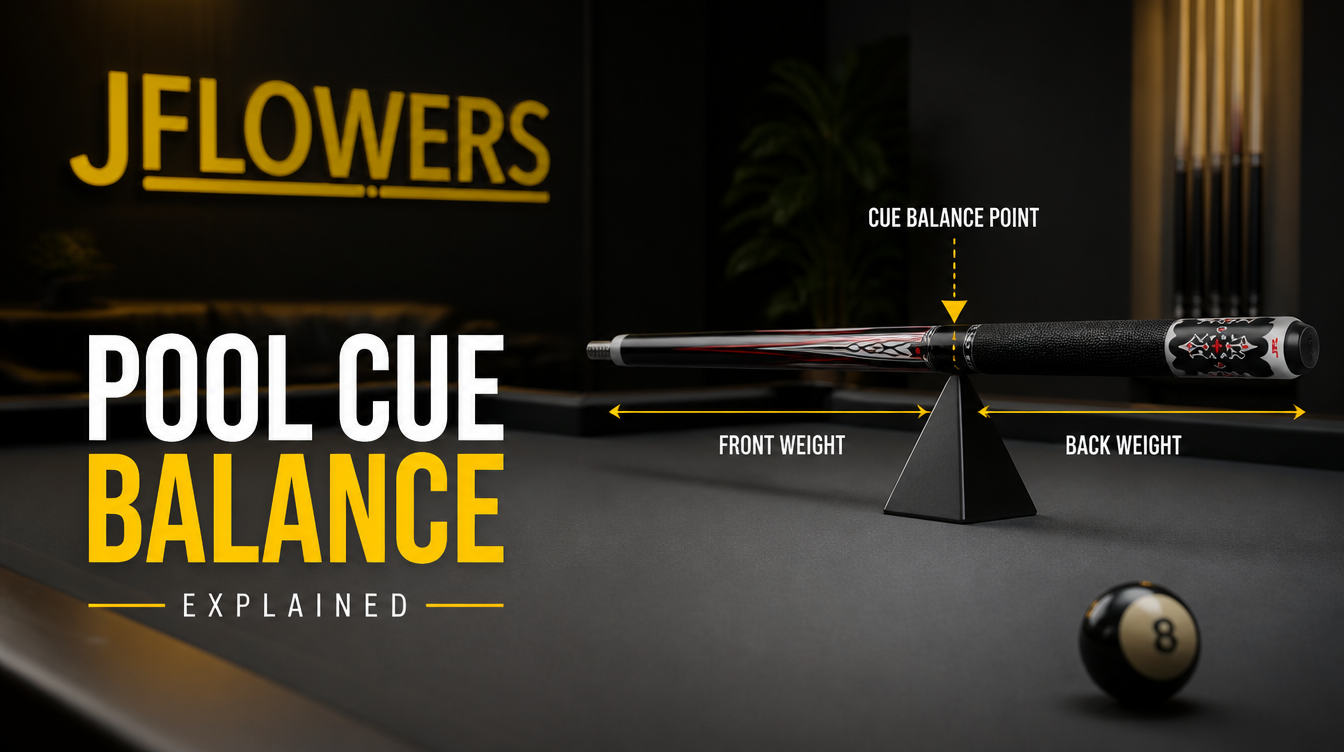
What Is Balance Point?
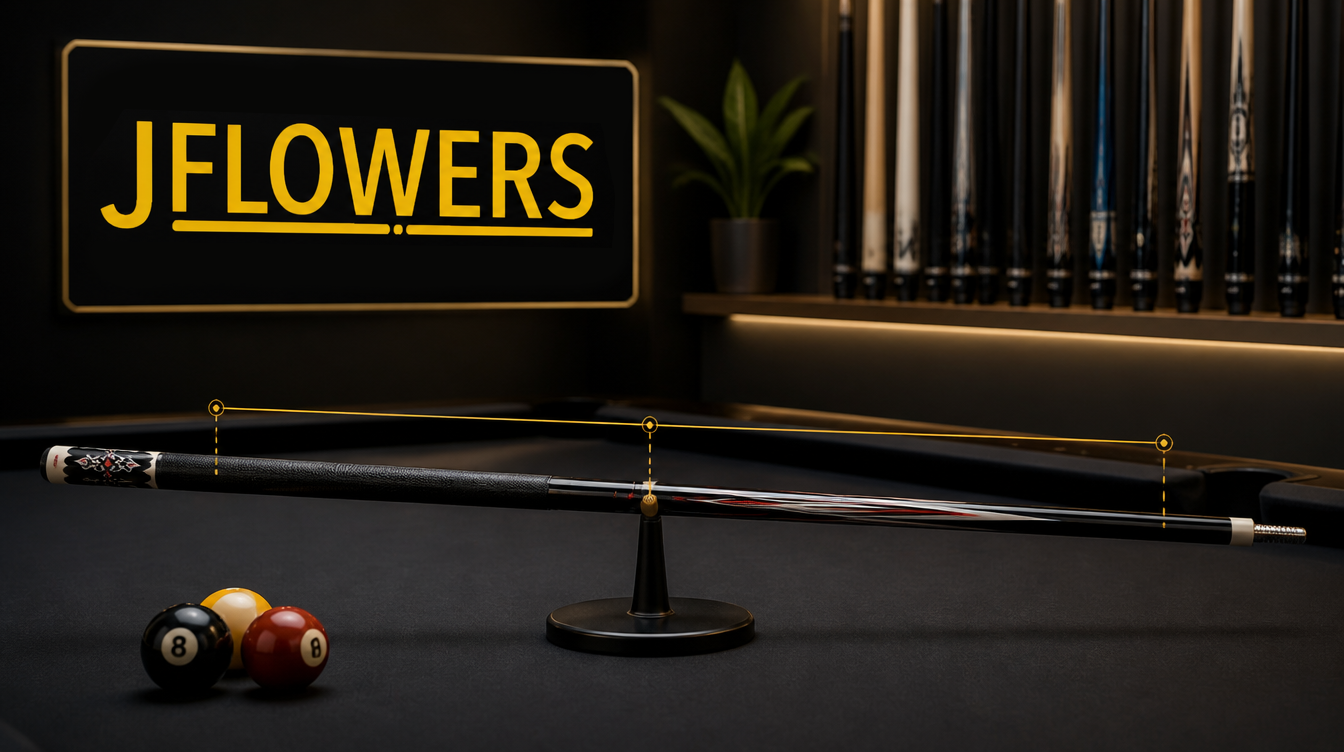
The balance point of a pool cue is the spot where the cue, resting horizontally on a single point of support, would be perfectly balanced — neither the butt nor the tip falling. This is typically measured in inches from the butt end of the cue.
Most production cues have a balance point somewhere between 17 and 21 inches from the butt end. The balance point varies based on the density of materials used in the shaft vs. the butt, the weight of the joint hardware, and any weight adjustment bolts in the butt.
Quick Test: Lay your cue across one finger and slide your finger until the cue balances. Where your finger is when the cue balances is your balance point. Try this with a few different cues and you’ll immediately feel how different balance profiles feel in the hand.
Forward Balance vs. Rear Balance
Forward Balanced (Balance Point Closer to Tip) A forward-balanced cue has more mass distributed toward the front — toward the tip and shaft. When you stroke through a shot, a forward-balanced cue feels heavier and more planted at the cue ball. Some players describe it as feeling “connected” to the contact point.
Many players find forward balance helps them maintain a straight stroke line because the front-weighted feel keeps them from lifting the cue prematurely. Break cues are often forward-balanced specifically to maximize energy transfer through the rack.
Rear Balanced (Balance Point Closer to Butt) A rear-balanced cue has more mass toward the butt. It feels lighter and more nimble during the swing and acceleration phase of the stroke. Players who prefer rear balance often describe their stroke as feeling faster and more natural — the cue swings through rather than being pushed.
Rear balance can also make the cue feel lighter overall even when the total weight is the same as a forward-balanced option. For players who feel fatigued by heavier cues, trying a rear-balanced option at the same total weight is worth exploring.
Neutral Balance A neutrally balanced cue falls roughly in the middle of the typical balance point range. Most all-around playing cues aim for a neutral balance that works well across different shot types and playing styles. If you haven’t developed a strong preference yet, neutral balance is where you should start.
How Balance Affects Different Shot Types
Power Shots and Break Forward balance can help with power shots and the break by putting more mass moving through the cue ball at contact. Many dedicated break cues are designed with a forward balance specifically for this reason.
Soft Shots and Position Play Rear balance often gives players better touch on delicate shots. The lighter feel during the stroke makes it easier to control speed on stop shots, gentle draws, and precise position shots where too much energy transfer is the problem.
Jump Shots Jump shots require a short, sharp downward stroke — and rear balance (or a shorter, lighter cue specifically designed for jumping) makes this much easier. Forward-balanced cues tend to feel cumbersome for jump shots.
General All-Around Play For most players on most shots, neutral to slightly rear balance is the most versatile choice. It doesn’t sacrifice any shot type at the extremes.
Carbon Fiber Shafts and Balance
Switching from a maple shaft to a carbon fiber shaft affects the balance of your cue because carbon fiber shafts are typically lighter than comparable maple shafts. This shifts the balance point slightly toward the rear — making the cue feel slightly lighter in the front.
For players accustomed to a forward-balanced maple setup, adding a carbon fiber shaft can make the cue feel noticeably different — not necessarily better or worse, just different. If you have weight adjustment bolts in your butt, you can compensate by adding weight to bring the balance point forward.
Adjustable Weight Systems and Balance
Many quality cues include adjustable weight systems — removable weight bolts in the butt end that allow you to add or remove small weight increments. These systems let you tune both total weight and balance point simultaneously.
Adding weight bolts to the butt increases total weight and shifts the balance point slightly toward the rear. Removing bolts decreases total weight and shifts the balance point slightly forward (relative to the butt). This gives you meaningful flexibility to tune the cue’s feel without buying a different stick.
If you’re not sure what balance works for your game, a cue with an adjustable weight system lets you experiment over time and settle into a preference based on actual play experience rather than guesswork.
How to Find Your Ideal Balance
The best way is hands-on testing. When you have the chance to play with different cues — at a friend’s house, at a pool supply shop, trying demo cues — pay as much attention to balance feel as to total weight. A few things to notice:
How does the cue feel during your bridge and stroke setup — planted or light?
On soft shots, does the cue feel easy to control or hard to hold back?
After an hour of play, does the cue feel heavy or fatiguing?
On your best shots — the ones where everything clicks — how does the cue feel in your hand?
Over time, most players develop a clear preference for their balance point. It’s a more subtle variable than weight, but once you know what you prefer, you’ll notice it every time you pick up a cue.
Frequently Asked Questions
What balance point do most professional players prefer? Most professional players prefer neutral to slightly rear balance — roughly 18–20 inches from the butt end. But this varies based on stroke style, bridge length, and personal preference. There’s no universal right answer at the professional level.
Can I change the balance of my cue after purchasing? Yes — if your cue has an adjustable weight system, adding or removing weight bolts shifts the balance. Switching shaft materials (maple to carbon fiber or vice versa) also changes balance. A cue technician can sometimes add weight to a butt to shift balance, though options are more limited.
Does balance matter for beginners? It matters less at the beginner level than at the intermediate and advanced levels. Focus on basic weight preference first (19 oz is the safe starting point), and pay more attention to balance as your stroke develops and you become more sensitive to how the cue feels.
Is there a standard balance point for pool cues? Not a fixed standard, but most production cues aim for something in the 18–20 inch from butt range as a general neutral balance. Custom cue makers often work with players to dial in specific balance points based on individual preferences.
Final Thoughts
Balance is one of the most underappreciated factors in pool cue selection. Two cues with the same weight can feel completely different in your hand and during your stroke because of how that weight is distributed. Pay attention to it when testing cues, experiment with weight adjustment systems if available, and develop a sense of what feels natural as your game matures.
After comparing JFlowers to Predator, Mezz, McDermott, Meucci, Jacoby, Pechauer, and a dozen more brands across every price point and construction philosophy — the question that started all of it deserves a direct answer: which pool cue brand actually offers the best value for serious competitive players in
2026?
Players Technology is one of the most widely used cue brands in American pool halls. Their two-piece cues at $40-$150 have introduced millions of American players to personal cue ownership. Nearly every serious pool player in America either started on a Players cue or played against someone who did. Comparing Players to JFlowers isn’t really a direct competition — it’s a marker on the journey from beginner to serious competitor.