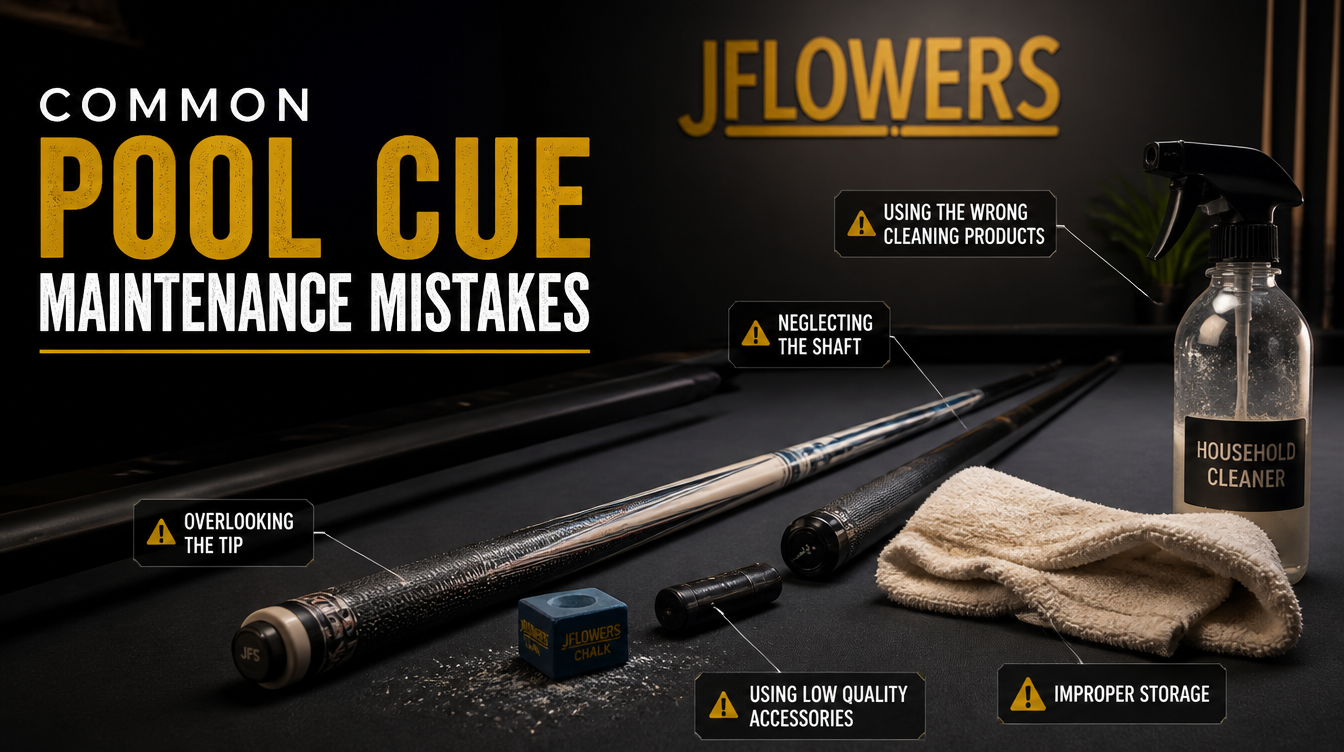
The errors that damage cues, shorten equipment life, and cost players money. Most cue maintenance mistakes fall into two categories: doing things that actively damage the cue, and not doing the things that protect it. Both are common. Both are avoidable.
Listen to this article
Here are the most common mistakes players make with their pool cue care — explained clearly, so you know not just what to avoid, but why.
Mistake 1: Not Using a Case
This is the single most common and most costly cue maintenance mistake. Players leave cues leaned against walls, propped in corners, laid across tables, or stored in soft bags without rigid protection. Every time a cue is out of a proper hard-sided case, it’s exposed to risks that a case eliminates.
The risks of caseless storage: humidity swings that warp maple shafts, falls that crack ferrules or damage joint hardware, physical impacts from being knocked over or against, and UV exposure from sunlight that degrades finishes. A $60 hard case prevents all of these for a cue that cost several hundred dollars.
Build the habit: cue goes in the case every single time, without exception.
Players often apply products to their cue that aren’t appropriate for the materials involved — sometimes because they’re working from habit, sometimes because they grabbed whatever cleaner was nearby.
Using maple shaft cleaner on carbon fiber: Not appropriate. The solvents and conditioners in maple shaft cleaners can damage carbon fiber surface finishes.
Using household cleaners on any cue component: Products like glass cleaner, all-purpose spray, or furniture polish aren’t designed for pool cue materials and can damage surfaces, affect finishes, and create residue problems.
Using abrasive products on the ferrule: Steel wool, abrasive pads, or rough cloths on a ferrule can scratch and change its dimensions — affecting tip fit and feel.
Applying lubricants to the joint: Cue joints should be dry and clean. Lubricants attract debris, accelerate thread wear, and can interfere with the mechanical connection.
This mistake usually comes from a player used to maintaining maple shafts, where very light sanding (1500-2000 grit) is occasionally used to smooth a rough surface. Applying the same logic to carbon fiber causes permanent damage.
Carbon fiber shaft surfaces cannot be sanded — you’re not dealing with wood fiber that can be smoothed. Sanding removes the protective surface coating and can damage the underlying composite material. The result is a permanently scratched surface that can’t be restored to factory condition.
If a carbon fiber shaft surface feels rough, try a clean damp cloth first. If something is embedded in the surface, consult the manufacturer before doing anything abrasive.
Mistake 4: Leaving a Maple Shaft in a Hot Car
This one is responsible for more warped shafts than almost any other single factor. A car parked in the sun reaches interior temperatures that are genuinely damaging to maple — particularly in combination with summer humidity.
The scenario: player drives to a tournament, parks in the sun to run an errand, comes back two hours later. The cue spent two hours in a 140°F car interior with high ambient humidity. The warp may not be immediately visible — but the process has started.
For maple shaft players: take the cue inside. Always. For carbon fiber players: this is a non-issue — but bring the cue in anyway to protect the case and the butt.
Mistake 5: Ignoring the Tip Until It’s Causing Problems
Most players replace their tip reactively — when miscues are frequent and obvious, when the tip has fallen off, or when a cue technician tells them it’s gone. By that point, the tip has been quietly degrading performance for weeks.
Tip degradation is gradual. A tip that’s slightly flat, slightly glazed, or slightly worn doesn’t immediately cause obvious problems — it slowly introduces inconsistency into english shots, requires more chalk, and reduces feedback. Players often blame their stroke for this inconsistency when the tip is the actual cause.
The fix: know your replacement schedule and replace proactively. Replace before the tip fails, not after. And check the tip regularly — a quick visual inspection after every session takes five seconds.
The opposite of neglect is over-maintenance, which causes its own problems. Some players:
Apply shaft conditioner or wax every session — too much product buildup creates the tacky feel they’re trying to prevent
Burnish too aggressively and too often — removes wood fiber that shouldn’t be removed and can affect shaft dimensions over time
Sand their shaft regularly thinking it keeps it smooth — gradually removes material and can affect the taper profile
Apply multiple different products without understanding what each does — conflicting products create unpredictable results
More maintenance is not always better. Follow a simple, consistent routine with appropriate products, and apply conditioners sparingly. A clean, well-maintained shaft doesn’t need product applied constantly — it needs to be kept clean.
Mistake 7: Not Cleaning the Joint
The joint — where the shaft screws into the butt — gets ignored by most players until it starts causing problems. Chalk dust and debris accumulate in the thread grooves over time, affecting how the cue assembles and accelerating thread wear.
The fix is simple: use a dry soft brush or compressed air to clear the joint threads monthly. It takes two minutes and prevents the gradual thread degradation that eventually means the joint doesn’t seat as securely as it once did.
And never use water or lubricants in the joint. The threads should be dry and clean — not lubricated.
Using your playing cue for every break shot is one of the fastest ways to shorten tip life and introduce stroke inconsistency into your game. The break shot puts extreme force through the tip — the repeated impact is dramatically more severe than normal shot play.
Over a season of regular league play, breaking with your playing cue noticeably accelerates tip wear and can gradually affect how the tip sits on the ferrule. A dedicated break cue in the $100-200 range protects your playing cue’s tip and shaft from this impact.
If you play regularly in league or competition, a break cue is not a luxury — it’s simple math: a $150 break cue that saves you from frequent tip replacements and potential shaft issues on your $400+ playing cue is an obvious investment.
Mistake 9: Storing Maple Cues in Basements or Garages
Basements without dehumidifiers can reach very high humidity levels in summer — often 70-80% or higher. Garages without climate control experience extreme temperature and humidity swings year-round. Both are among the worst environments for maple shaft storage.
If your cue storage space is a basement or garage, either invest in a dehumidifier for the space, move the cue storage to a climate-controlled room, or switch to carbon fiber — which is genuinely immune to these conditions.
Mistake 10: Buying a Cue Without Budgeting for
Maintenance A player who buys a quality cue and then uses cheap generic chalk, never replaces the stock tip, and doesn’t have a tip tool in their case is leaving performance on the table from day one. The cue itself is only part of the equation.
Budget the complete setup: quality chalk, a tip tool, a few replacement tips from a name brand, and a cloth. This adds $40-60 to the initial cost of any cue — and it’s the difference between a cue that performs consistently and one that performs below its potential from the first session.
What’s the single biggest maintenance mistake players make? Not using a case. Everything else on this list is secondary. A cue in a proper hard-sided case consistently is protected from almost all the maintenance problems that damage cues. It’s the foundational habit everything else builds on.
Can maintenance mistakes permanently damage a cue? Yes. Warping from bad storage can permanently deform a maple shaft. Sanding a carbon fiber shaft permanently damages the surface. A badly installed tip can damage the ferrule. These aren’t recoverable with cleaning — they require professional repair or component replacement.
How do I know if I’ve been over-maintaining my shaft? Signs of over-maintenance: the shaft feels tacky or greasy rather than smooth and clean, the surface looks dull or uneven, or you can see visible product buildup that doesn’t wipe off easily. Strip back to a clean shaft with a proper deep clean and restart with a simpler routine.
Is it too late to start proper maintenance on an older cue? Rarely. A deep clean on a neglected maple shaft can often restore it significantly. A ferrule replacement can refresh the tip end. Joint cleaning can restore smooth assembly. Start good habits now and the cue will benefit — even if the perfect window was some time ago.
Final Thoughts
Most cue maintenance mistakes come from either inattention (not cleaning, not casing, not watching the tip) or misapplied effort (using wrong products, over-maintaining, ignoring the joint). The right routine is simple: consistent basics applied correctly, with appropriate products for the specific materials you’re working with.
Follow the maintenance checklist, avoid the mistakes above, and your cue will perform consistently and last significantly longer than one that’s casually maintained or actively mistreated.
After comparing JFlowers to Predator, Mezz, McDermott, Meucci, Jacoby, Pechauer, and a dozen more brands across every price point and construction philosophy — the question that started all of it deserves a direct answer: which pool cue brand actually offers the best value for serious competitive players in
2026?
Players Technology is one of the most widely used cue brands in American pool halls. Their two-piece cues at $40-$150 have introduced millions of American players to personal cue ownership. Nearly every serious pool player in America either started on a Players cue or played against someone who did. Comparing Players to JFlowers isn’t really a direct competition — it’s a marker on the journey from beginner to serious competitor.