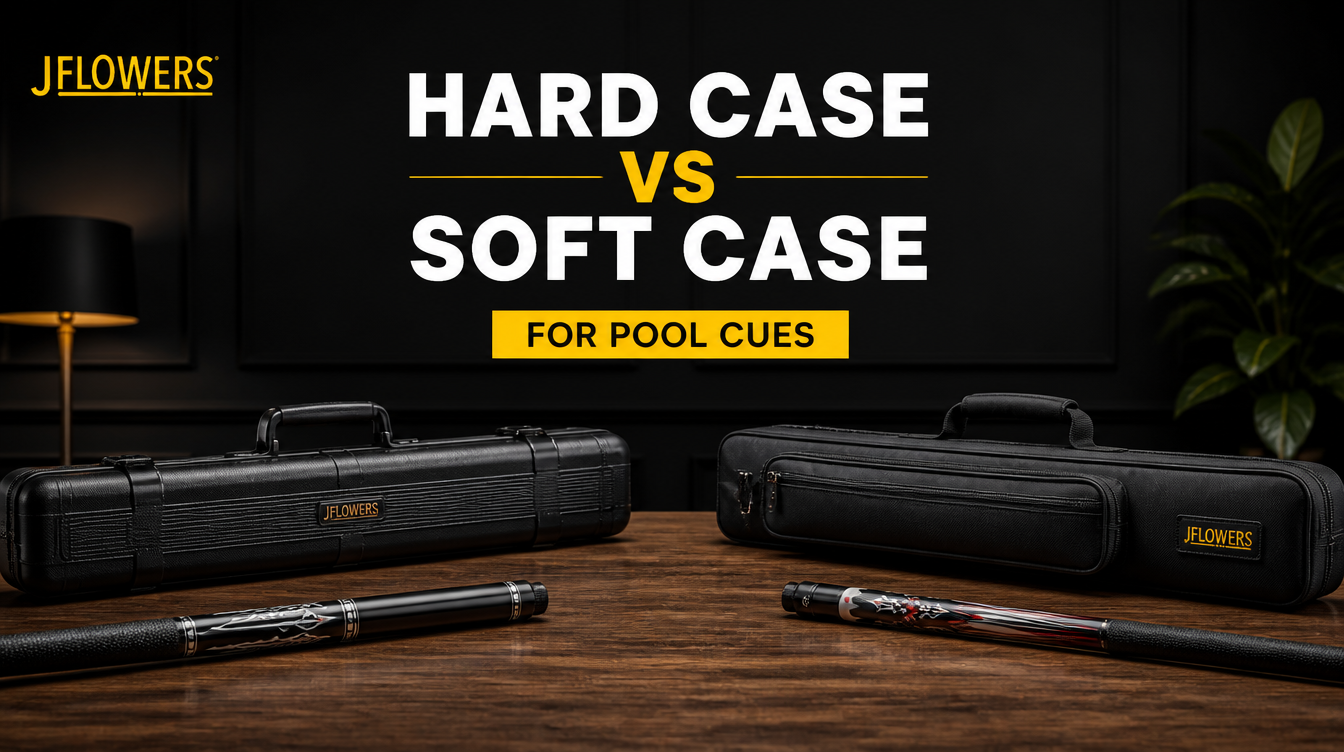
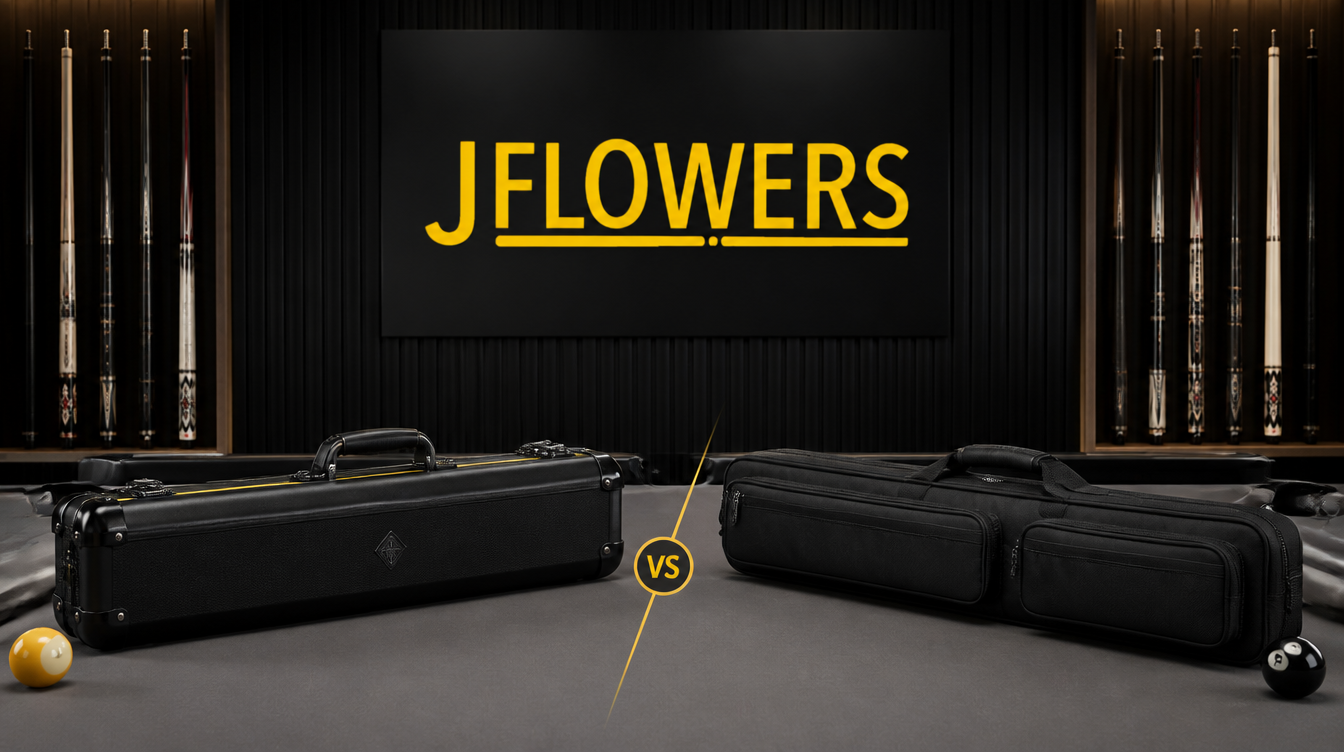
Walk into any pool hall and you'll see both. Hard cases sitting on the rail, soft tubes leaned against the wall. Both carry pool cues. Both get used by serious players. But they are not equivalent forms of protection, and choosing the wrong one for your situation can result in damage to a cue you paid good money for.
Listen to this article
An honest comparison — what each protects against and when one matters more than the other
This guide gives you the honest, detailed comparison — what each case type actually protects against, where the real protection gap is, and which one you should be using given how you actually play and travel.
What a Soft Case Actually Protects Against
Soft cases — fabric or synthetic exterior over foam or padded interior — provide two things: scratch protection and minor cushioning against light contact. If someone brushes past your case leaning against the wall, the cue inside is protected from surface scratches. If the case falls over from a standing position onto a carpeted floor, the cue survives.
That’s genuinely useful in a pool room environment. But the limitations of a soft case become clear the moment the case faces any significant impact or compression.
What Soft Cases Don’t Protect Against
Compression from weight being placed on top of the case — the padding compresses and the force reaches the cue
Significant lateral impact — a hard knock against a wall, a fall from height onto a hard floor, or being thrown into a luggage compartment
Sustained environmental exposure — a soft case doesn’t meaningfully insulate the cue against heat or humidity the way a hard case does
The kind of handling that happens in car trunks, airline cargo holds, or any setting where the case might be stacked under other items
A hard case with a rigid shell — aluminum, hard ABS plastic, or hard composite — provides structural protection. The shell doesn’t compress under impact the way padding does. It distributes and absorbs force before it reaches the cue inside.
This is what makes hard cases fundamentally different from soft cases: they protect the space inside, not just the cue directly. The cue is inside a protective structure, not just wrapped in material. What Hard Cases Protect Against
Physical impact — drops, knocks, falls from height onto hard surfaces
Compression — items stacked on top in car trunks, luggage storage, or equipment rooms
Airline cargo handling — the throwing, stacking, and conveyor belt travel that checked luggage experiences
Environmental exposure — the rigid shell and sealed interior provide meaningful insulation against rapid temperature and humidity changes
Theft deterrence — a locked hard case is significantly harder to access than a soft case
Scenario 1: Driving to League Night The cue goes in the car trunk for 20 minutes each way. Soft case: acceptable for this use case if the drive is short and the trunk isn’t hot. Hard case: genuinely better protection even for this simple scenario, particularly if other items end up in the trunk.
Scenario 2: Playing at Multiple Venues in a Weekend The cue goes in and out of the car multiple times, may get bumped at the venue, and sits unattended for periods. Hard case is the clear choice — more handling means more opportunities for impact and compression.
Scenario 3: Air Travel to a Tournament If the cue is carried on: a compact hard case in an overhead bin is the safest option. If the cue is checked: a hard aluminum travel case is not optional — it’s the only real protection against cargo handling. A soft case in checked luggage is an actively bad idea.
Scenario 4: Walking Into the Pool Hall and Playing Carrying the case from your car to a table 50 feet away and then it sits on a rack or the floor for the evening: a soft case is fine for this and only this. The moment transport becomes involved, soft cases start showing their limitations.
Weight and Convenience: The Soft Case Argument
The honest argument for soft cases is practical: they’re lighter and easier to carry. A quality hard case can weigh 3-5 lbs before the cue goes in. A soft tube case weighs almost nothing. For players who walk significant distances with their case — at a tournament venue, across a large facility, using public transit — weight matters. This is where the soft case’s advantage is real.
The response: many quality hard cases now use materials and designs that keep weight reasonable without sacrificing protection. A well-designed hard case at 3-4 lbs is a manageable carry. And the protection it provides is worth the extra weight for any serious player.
When Soft Cases Are Appropriate
As a secondary carry for walking short distances within a venue where a hard case is already at the table
For storing a backup shaft inside a larger hard case as a sleeve
For casual players who play only at one local room and never transport their cue in a car
As an inexpensive temporary solution while saving for a quality hard case In every other situation, a hard case is the correct choice.
The Price Reality
The entry-level price difference between a soft case and a hard case is smaller than most players assume. A basic soft case runs $15-30. A basic hard case runs $35-70. For $20-40 more, the protection improvement is enormous.
When you consider that the cue inside may have cost $300-600 or more, spending an extra $30 to get a hard case instead of a soft case is a trivially easy decision in terms of value for money.
Cue Armour case designs are built around the same philosophy as the rest of the Cue Armour performance line: equipment built to protect and perform at the level serious players actually need. Hard shell construction, purpose-designed interior, and the build quality that holds up to real-world transport demands — not just the walk from the parking lot to the table.
Frequently Asked Questions
Is a hard case overkill for casual players? No. Even casual players transport their cue. Even casual players have invested $150-300+ in a decent cue. The hard case is appropriate at every level where the player cares about their cue arriving at the table in the same condition it left home.
My cue is carbon fiber — does it still need a hard case? Yes. Carbon fiber doesn’t warp, but it can crack or chip from impact. The hard case protects against the impact damage that is the primary risk for CF shafts. CF eliminates warping risk; the case addresses impact risk.
Are all hard cases the same quality? Absolutely not. Hard case quality varies enormously by shell material, interior design, closure quality, and strap construction. An $40 entry-level hard case provides basic protection. A $150 quality hard case provides substantially better protection and lasts years longer.
Can I use a soft case inside a hard case for extra protection? Some players do this — they use a soft sleeve around each cue piece inside the hard case. It’s not necessary if the hard case interior fits the cue securely, but it doesn’t hurt anything either.
Final Thoughts
Hard case or soft case is not actually a difficult decision for most players once you understand what each one protects against. Soft cases have a specific, limited use case. Hard cases protect properly. If your cue goes in a car, on a plane, or to any environment outside your immediate control — use a hard case.
After comparing JFlowers to Predator, Mezz, McDermott, Meucci, Jacoby, Pechauer, and a dozen more brands across every price point and construction philosophy — the question that started all of it deserves a direct answer: which pool cue brand actually offers the best value for serious competitive players in
2026?
Players Technology is one of the most widely used cue brands in American pool halls. Their two-piece cues at $40-$150 have introduced millions of American players to personal cue ownership. Nearly every serious pool player in America either started on a Players cue or played against someone who did. Comparing Players to JFlowers isn’t really a direct competition — it’s a marker on the journey from beginner to serious competitor.