Pool players flying to tournaments often wonder exactly what TSA allows and what will get them held up at security. The good news: pool cues are not prohibited items. The nuance: how you pack them, where they're stowed, and what individual officers decide in the moment all affect the experience.
Listen to this article
This guide covers the current TSA rules for pool cue travel, how to pack to minimize delays, and what to realistically expect at security checkpoints.
TSA Official Position on Pool Cues
As of 2026, the TSA classifies pool cues as sports equipment. They are:
Permitted in checked baggage — no restrictions
Subject to officer discretion in carry-on — TSA officers can deny carry-on access to any item they determine could be used as a weapon
The TSA website lists pool cues as “allowed” in both carry-on and checked baggage, but adds the standard caveat that the final determination rests with the security officer at the checkpoint. In practice, this means checked baggage is the reliable approach and carry-on is subject to variability.
Checked Baggage: No Issues
Pool cues in checked baggage — particularly in a hard case — go through without restriction. There is no prohibition on pool cues in checked baggage. The case will go through the standard baggage X-ray process.
If TSA needs to inspect the contents of a locked case, they will. Use TSA-approved locks (look for the TSA Travel Sentry logo) — these allow TSA agents to open, inspect, and relock the case with a master key rather than cutting your lock. If you use a non-TSA lock and TSA needs to inspect, the lock will be cut.
TSA’s official position permits pool cues in carry-on if the case fits within size requirements. The practical reality is more variable:
Most pool cue cases are longer than standard carry-on limits (22-24 inches)
Individual TSA officers have discretion on whether a pool cue could be used as a weapon — opinions vary
Some players report no issues with carry-on pool cues; others report being asked to check them
If you want to attempt carry-on: use the smallest possible case (1×1 compact case if it fits your cue), be prepared for additional screening, and have a plan B in case the officer denies the carry-on. Missing your connection because your cue got held at security is not a good way to start a tournament trip.
What Security Screening Looks Like
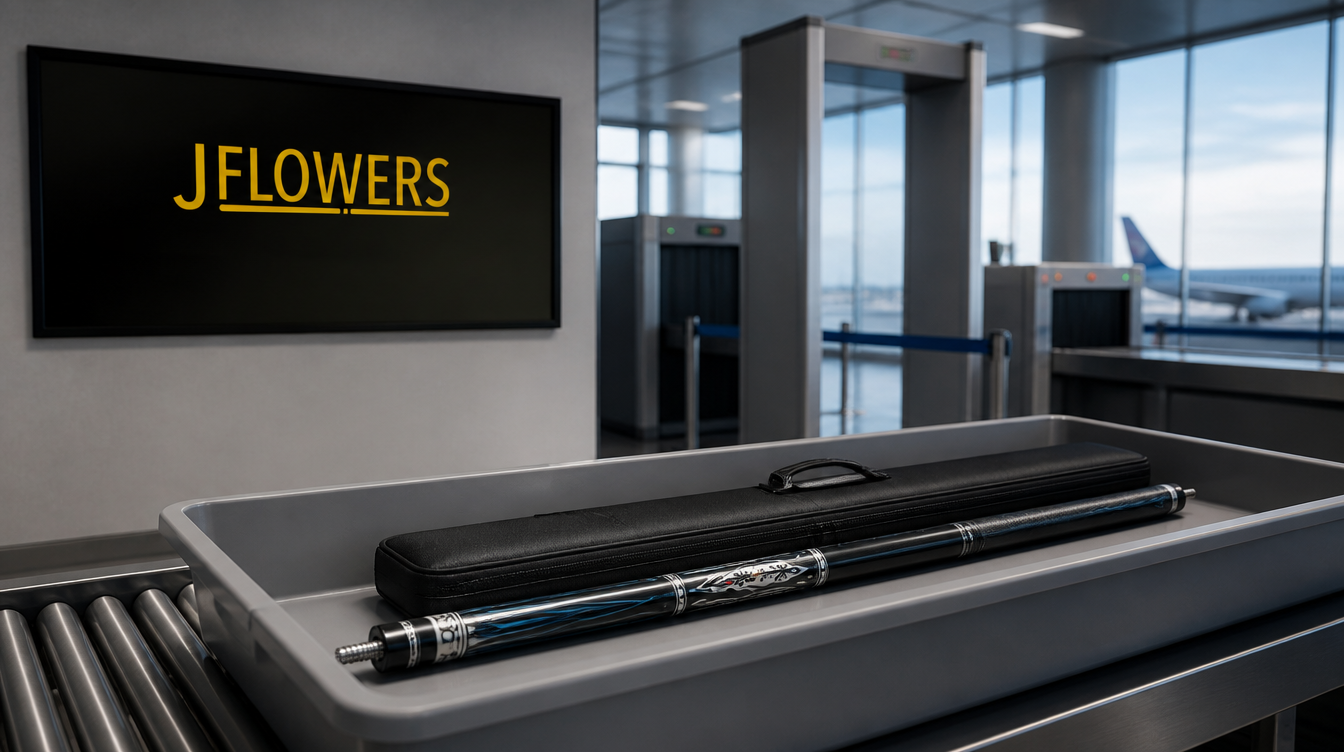
A pool cue case going through an X-ray machine shows:
Long cylindrical objects (shafts and butts)
Metal components (joint pins, weight bolts, ferrule components)
Any accessories in pockets (chalk, tip tools, etc.)
Metal-dense accessories can flag the X-ray and lead to a manual inspection. Tip tools with metal components, weight bolt systems, and joint protectors all show up clearly. This isn’t a problem — it just means additional inspection time. Keep all metal accessories in clearly visible, easily accessible pockets within the case.
How to Pack for the Smoothest Security Experience
Use TSA-approved locks on a hard case
Separate cue components from accessories — cue in tubes, accessories in pockets
Don’t pack anything prohibited elsewhere in the case (this sounds obvious but is worth checking)
For carry-on attempts: be polite, have your cue case outside of larger baggage for easy inspection
Allow extra time — unexpected screenings happen at the worst moments
International Travel
International airports outside the US have their own security procedures. Most permit pool cues in checked baggage without issue. Carry-on rules are more variable internationally — some airports are more restrictive than US TSA checkpoints. For international tournament travel, always check the destination airport’s rules as well as the US departure rules.
Pros and Cons
Flying with pool cues under TSA rules
Checked baggage is reliable and problem-free with proper packing
TSA permits pool cues by policy
Carry-on is subject to officer discretion and size limits
Non-TSA locks may be cut during inspection
International airport rules vary — research required
Expert Recommendation Always check your cue. The carry-on route has too many variables — size limits, officer discretion, and the risk of being forced to check the case last-minute without proper packing. Check it, use a hard case with TSA-approved locks, pack properly, and arrive knowing your cue will be there when you land.
Conclusion
TSA rules for pool cues are not restrictive — pool cues are permitted equipment. The practical approach: check the cue in a hard case with TSA-approved locks, pack to make any inspection easy, and don’t rely on carry-on for anything you can’t afford to lose.
Frequently Asked Questions
Q: Are pool cues allowed on planes? Yes — in checked baggage without restriction, and technically in carry-on subject to size limits and officer discretion. Q: Will TSA stop me for a pool cue? In checked baggage, no. In carry-on, they may depending on the officer’s discretion and whether your case meets size requirements. Q: What kind of lock should I use on my cue case for flying? TSA-approved Travel Sentry locks — these allow TSA to inspect and relock without cutting the lock. Q: Can I carry my pool cue on as cabin baggage? Technically yes if the case fits within carry-on size limits, but it’s subject to officer discretion. Checked baggage is the reliable approach. Q: What happens if TSA opens my locked cue case? They inspect the contents and relock it if you’re using a TSA-approved lock. They leave a notice in the case indicating it was inspected. Q: Do metal cue components cause problems at TSA? They show up on X-rays and may result in additional manual inspection. This isn’t a problem — just a delay. Keep accessories accessible for easy inspection.
After comparing JFlowers to Predator, Mezz, McDermott, Meucci, Jacoby, Pechauer, and a dozen more brands across every price point and construction philosophy — the question that started all of it deserves a direct answer: which pool cue brand actually offers the best value for serious competitive players in
2026?
Players Technology is one of the most widely used cue brands in American pool halls. Their two-piece cues at $40-$150 have introduced millions of American players to personal cue ownership. Nearly every serious pool player in America either started on a Players cue or played against someone who did. Comparing Players to JFlowers isn’t really a direct competition — it’s a marker on the journey from beginner to serious competitor.