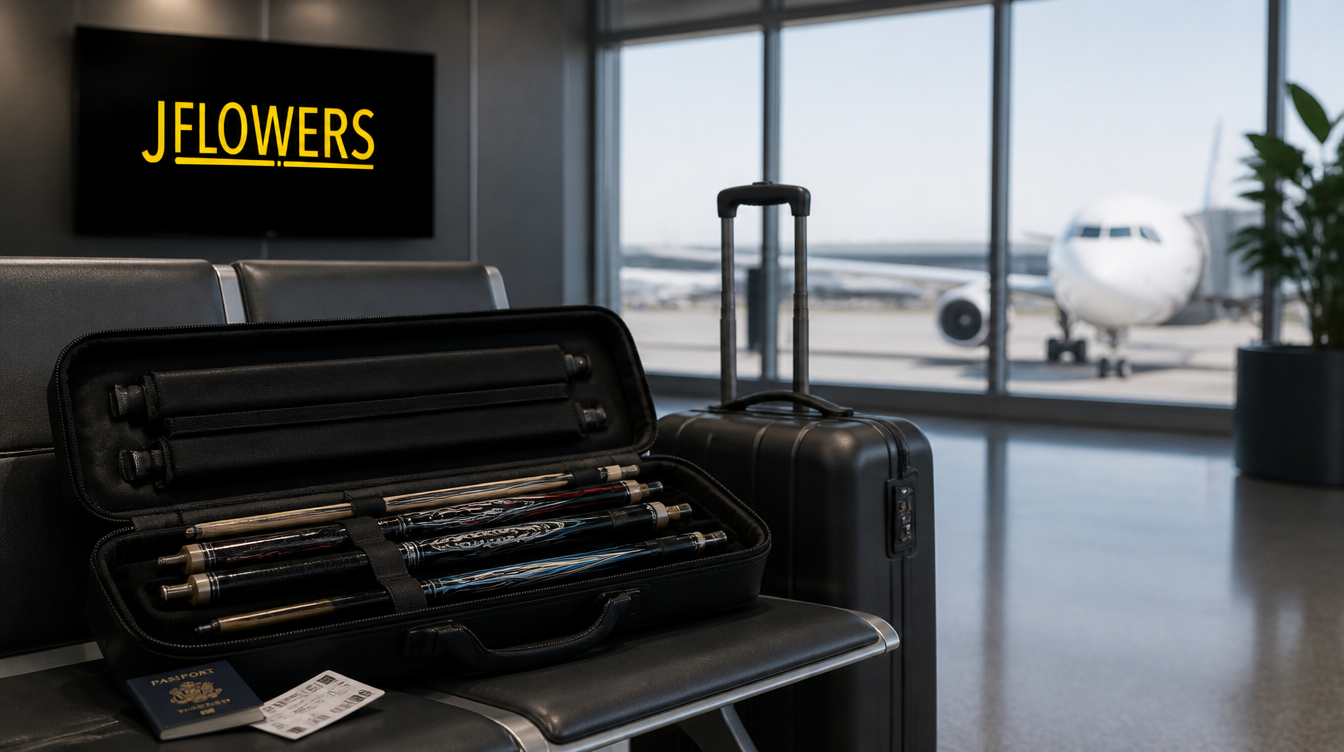
Flying to a tournament with your pool cue involves navigating airline policies, security procedures, and the genuinely harsh environment of checked baggage handling. Do it right and your cue arrives exactly as it left. Do it wrong and you're playing a tournament on whatever house cues the venue has available.
Listen to this article
This guide covers everything about airline travel with pool cues: checked baggage vs carry-on, case requirements, airline policies, how to pack, and what to do if something goes wrong.
Checked Baggage vs Carry-On
Carry-On Pool cue cases are long — typically 30-36 inches for a standard two-piece cue case. Most airline carry-on size limits are around 22-24 inches in length, which means most cue cases don’t qualify as carry-on luggage by size.
Some players use short travel cases or break-down their cue to individual components in a compact case that meets carry-on dimensions. This is only viable for very short cases (1×1 or compact 2×2 designs) that\ fall within the airline’s size limits.
Even if the case fits the size requirements, individual security officers have discretion. Pool cue joints and\ components can be flagged. What’s permitted at one checkpoint may not be at another.
Checked Baggage: The Standard Approach Checking a pool cue case as oversized or regular checked baggage is the standard approach for most flying pool players. The case needs to be hard-shell to survive baggage handling — soft cases are not appropriate for checked baggage.
Oversized baggage fees apply when the case exceeds the airline’s standard dimensions (typically 62 linear inches total: length + width + height). Many pool cue cases exceed this, so expect a fee — typically $50-$200 depending on the airline and route.
Airline-Specific Policies
Airline policies vary and change. Before every flight, check the specific policy for the airline and route you’re flying. Key points to confirm:
Whether pool cues/sports equipment are explicitly permitted
The oversized/overweight baggage fee schedule
Whether the cue needs to be declared as sports equipment at check-in
International routes may have different rules from domestic
Most major airlines (American, Delta, United, Southwest) permit pool cues as checked sporting goods. Budget carriers may have stricter policies. Always confirm before arriving at the airport with your case.
The Right Case for Airline Travel
Standard recommendation for airline checked pool cue travel: a tactical hard case with foam interior and lockable latches. The foam interior immobilizes the cue completely — no rattling, no movement under any handling condition. Lockable latches prevent accidental opening. A rubber gasket seal provides moisture protection in cargo holds.
Pelican cases and comparable tactical cases are the professional standard. They’re sized to fit pool cues, they’re TSA-approved for locks, and they’re built to withstand handling that would destroy lesser cases. Cost: $150-$350 depending on size. For the full hard case breakdown, see Hard Cue Cases Explained and Tactical Cue Cases Explained.
How to Pack the Cue for Flight
Disassemble the cue — shaft off the butt, stored separately in their respective tubes
Wrap the tip end of the shaft with additional padding — foam pipe insulation works well for extra tip protection
Fill any void space in the case with additional padding (t-shirts, foam) — the cue should not move inside the case at all
Keep accessories (chalk, tips, tools) in padded compartments, not loose where they can rattle against the cue
Do not over-tighten any retaining straps inside the case — firm but not stressed
The goal is zero movement inside the case. If the case is shaken hard, nothing inside should move.
TSA and Security
Pool cue components going through carry-on security may be subject to additional screening. The joint pins can flag metal detectors, and long cylindrical objects sometimes attract attention. If carrying as carry-on, be prepared for additional screening. For the full TSA rules guide, see TSA Rules for Traveling With Pool Cues.
For checked baggage: TSA may open and inspect a locked case. Use TSA-approved locks — these allow TSA to open and relock the case without cutting the lock. Non-TSA locks may be cut if TSA needs to inspect the case.
Insurance and Liability
Airlines have limited liability for sports equipment damage. If a valuable cue is damaged in checked baggage, the airline’s standard reimbursement may not cover replacement cost. Options:
Declare the value at check-in — excess valuation fees apply but increase the liability limit
Check your homeowner’s or renter’s insurance policy — some policies cover personal property during travel
Consider travel insurance that covers sports equipment for significant tournament travel
When Your Cue Arrives Damaged
Report damage before leaving the airport — at the baggage claim area, not later. File a Property Irregularity Report (PIR) immediately with airline staff. Photograph the damage. Keep all receipts for repair or replacement. Airlines are more cooperative when damage is reported immediately rather than days later.
Pros and Cons
Flying with your cue
Play with your own equipment at distant tournaments
Eliminates equipment variability of house cues or rental cues
Oversized baggage fees add trip cost
Small risk of damage even in quality cases
Requires tactical case investment for adequate protection
Expert Recommendation For any tournament that matters: fly with your cue, use a tactical hard case, pack carefully, use TSA-approved locks, and declare the value at check-in if it’s a significant investment. The equipment consistency advantage of playing with your own cue is worth the logistical effort.
Conclusion
Flying with your pool cue is manageable with the right preparation. Tactical hard case, careful packing with zero interior movement, TSA-approved locks, and confirmation of the airline’s policy before you get to the airport. The effort is worth it — playing with your own equipment at a major tournament is a meaningful advantage over adapting to whatever’s available on-site.
Frequently Asked Questions
Q: Can you fly with a pool cue? Yes — as checked baggage in most cases. Some pool cue cases meet carry-on size requirements, but checked baggage is the standard approach. Q: What case should I use to fly with my pool cue? A tactical hard case with foam interior, lockable latches, and ideally a rubber gasket seal. Q: Do airlines charge extra for pool cues? Oversized baggage fees typically apply — $50-$200 depending on the airline and route. Q: Can pool cues go through airport security? Pool cue components in carry-on luggage may be subject to additional screening. Checked baggage is the recommended approach. Q: Should I use TSA-approved locks on my cue case? Yes — non-TSA locks may be cut if TSA needs to inspect the case. TSA-approved locks allow inspection without lock damage. Q: What if my pool cue is damaged by the airline? Report at the baggage claim immediately, file a PIR, photograph damage, and contact the airline claims department. Airlines have limited liability — consider excess valuation or travel insurance for valuable cues. Q: Can I carry a pool cue on a plane as carry-on? Only if the case fits within the airline’s carry-on size limits (typically 22x14x9 inches or similar). Most cue cases are longer than these limits. Check the specific airline’s policy.
After comparing JFlowers to Predator, Mezz, McDermott, Meucci, Jacoby, Pechauer, and a dozen more brands across every price point and construction philosophy — the question that started all of it deserves a direct answer: which pool cue brand actually offers the best value for serious competitive players in
2026?
Players Technology is one of the most widely used cue brands in American pool halls. Their two-piece cues at $40-$150 have introduced millions of American players to personal cue ownership. Nearly every serious pool player in America either started on a Players cue or played against someone who did. Comparing Players to JFlowers isn’t really a direct competition — it’s a marker on the journey from beginner to serious competitor.