Shaft diameter is one of those spec numbers that appears on every cue listing — 12mm, 12.5mm, 13mm — but rarely gets explained in any meaningful way. Most players know it's there. Very few understand what it actually does to how a cue plays. This guide fixes that.
Listen to this article
What the numbers mean, how diameter affects your game, and how to choose
What Shaft Diameter Actually Is
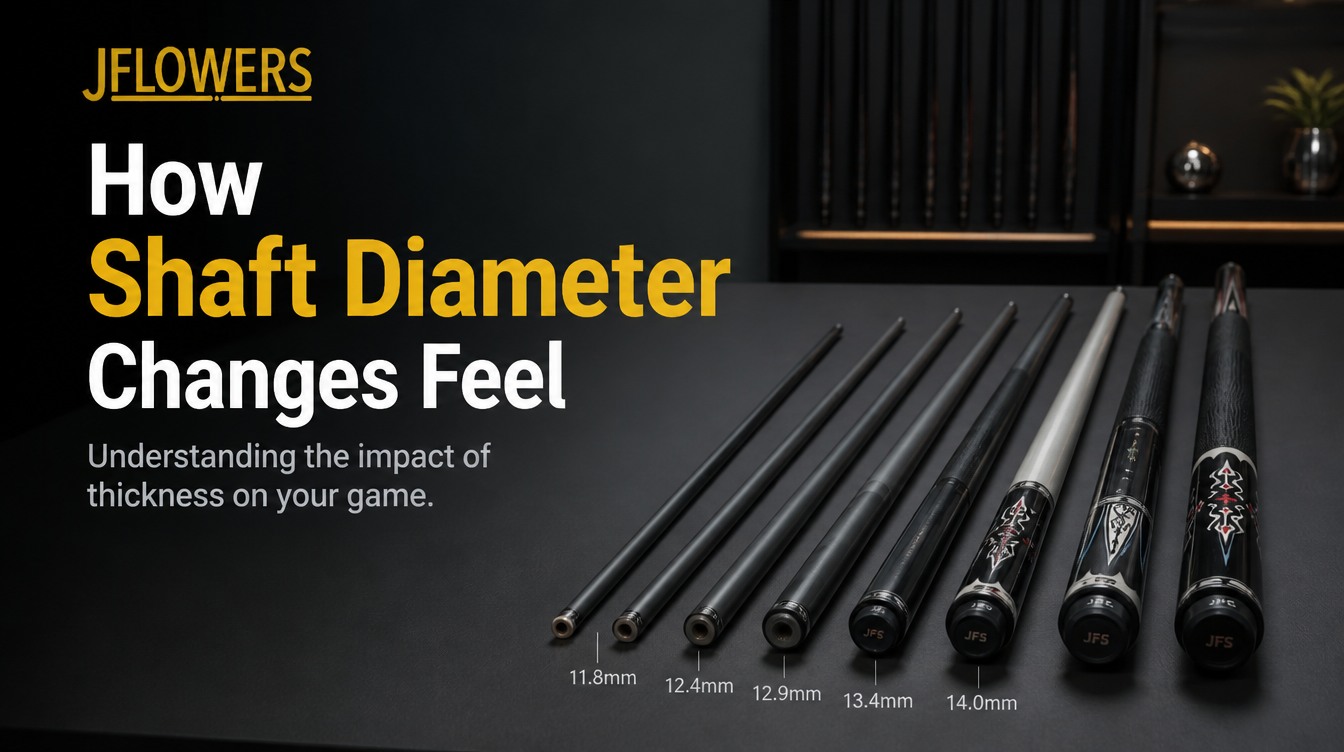
Shaft diameter refers to the diameter of the shaft at the tip end — specifically at the point where the ferrule and tip sit. This is the narrowest point on a tapered shaft, and it’s what people mean when they talk about shaft diameter as a playing characteristic.
The diameter at the joint end of the shaft is larger — usually 28-30mm on most production shafts. The diameter at the tip end is what’s specified and what matters for play. This tip-end diameter determines the contact patch size between tip and cue ball, which has downstream effects on feel, precision, and spin transfer.
Standard range: Most modern playing cues have shaft diameters between 11.75mm and 13mm at the tip. 12mm and 12.5mm are the most common on quality production cues. The old traditional standard was 13mm; modern performance-focused shafts trend smaller.
What a Smaller Diameter Does
More Precise English Placement A smaller tip creates a smaller contact patch on the cue ball. That smaller contact patch allows for more precise placement of the tip when applying english — you can hit closer to the edge of the cue ball more precisely, which gives you access to more extreme side spin without fouling.
This precision is one of the reasons many performance-focused shafts, including most carbon fiber shafts, trend toward 12mm or smaller. Players who use heavy english to control the cue ball precisely benefit from the tighter contact patch.
Less Forgiving on Off-Center Hits The flip side of more precision is less forgiveness. A smaller contact patch means the margin between a good hit and a miscue is smaller. If your stroke isn’t consistently delivering the tip to exactly the intended contact point, a smaller diameter shaft miscues more readily than a larger one.
This is why smaller diameter shafts are generally more appropriate for experienced players with consistent stroke mechanics — they reward precision and punish inconsistency.
Slightly Different Feel Through the Stroke A thinner shaft at the tip end has less mass in that critical area. This contributes to lower deflection — the lighter tip section creates less lateral force on the cue ball during off-center contact. This is one of the technical reasons carbon fiber shafts (which typically run 12mm) are lower deflection than traditional 13mm maple shafts.
More Forgiving Contact A larger contact patch is more forgiving. The margin between a clean hit and a miscue is larger, which means players with developing strokes can execute off-center hits more successfully even when their tip placement isn’t perfectly consistent.
This is why 13mm shafts have historically been considered appropriate for beginners and recreational players — the extra margin for error on contact is genuinely helpful when stroke consistency is still being built.
Traditional Feel 13mm has been the standard diameter in American pool for generations. Players who learned on traditional maple shafts associate 13mm with “normal” feel. There’s nothing wrong with that preference — 13mm shafts from quality manufacturers perform at a high level. But then industry has been trending smaller for the past decade, and for performance-focused reasons.
Slightly Higher Deflection More mass near the tip (from a larger diameter shaft) produces more deflection on off-center contact. This isn’t usually why players choose 13mm — it’s a consequence, not a benefit. Players on 13mm shafts typically compensate for higher deflection through trained aim adjustment.
The Industry Trend Toward Smaller Diameters
Over the past 15-20 years, the pool industry has clearly moved toward smaller shaft diameters. Most quality production shafts and virtually all performance-focused carbon fiber shafts run 12-12.5mm rather than the traditional 13mm.
The reasons are connected: smaller diameters produce lower deflection, allow more precise english placement, and align with modern playing styles that use more spin and more precise cue ball control. Professional players who need maximum precision have driven demand for smaller diameters, and production has followed.
This doesn’t make 13mm wrong. But it does mean that if you’re shopping for a performance shaft in 2026, 12-12.5mm is what you’ll find on most serious options.
Does Diameter Affect Spin?
Yes — indirectly. A smaller tip can be placed closer to the edge of the cue ball, which technically allows for more extreme english. But the spin itself is more directly controlled by tip hardness and the amount of off-center contact than by shaft diameter.
Think of it this way: diameter determines the precision of tip placement; tip hardness determines how much spin is transferred during contact. Both matter — they work together.
Which Diameter Is Right for You?
This is mostly determined by your skill level and the shaft you’re using:
Beginners and developing players: 12.5-13mm. The extra forgiveness is genuinely helpful while stroke consistency is being built.
Intermediate players: 12-12.5mm. Enough precision for developing english work, still reasonably forgiving.
Advanced and competitive players: 12mm or smaller. Maximum precision for players with consistent stroke mechanics.
Players switching to carbon fiber: Most quality CF shafts are 12mm — this will be a natural transition that brings the performance benefits of the smaller diameter along with the material benefits.
Ferrule and Tip Compatibility
When replacing a tip, the tip must match the ferrule diameter of your shaft. If your shaft is 12mm at the tip, you install a 12mm tip. You can’t significantly change the effective diameter just through tip selection — the tip sits on the ferrule, and the ferrule diameter is what determines the contact patch size.
What you can do: if you’re replacing the full ferrule (which a cue technician can do), you have some ability to slightly change the effective tip diameter — though this is typically done for restoration rather than diameter adjustment.
Frequently Asked Questions
What is the most common shaft diameter in professional pool? 12mm has become the dominant standard among professional players, particularly those using performance shafts and carbon fiber. Some players still use 12.5mm and occasionally 13mm, but 12mm is the clear trend at the professional level.
Does a smaller shaft feel different in the bridge hand? Yes — slightly. A thinner shaft at the tip end has a noticeably different feel resting in an open bridge. Players who learned on 13mm shafts sometimes describe 12mm as feeling more precise or more delicate in the bridge hand. Most adapt quickly.
Can I put a 12mm tip on a 13mm ferrule? No — you can’t install a tip significantly smaller than the ferrule diameter. The tip needs to sit flush on the ferrule. Mismatched sizes lead to tip failure and poor performance. Match the tip to the ferrule.
Does shaft diameter affect how much chalk I need? Slightly — a smaller contact patch means a slightly smaller area that needs chalk coverage. But chalk discipline (chalking before every shot) is the most important variable regardless of shaft diameter.
Final Thoughts
Shaft diameter is a meaningful but often overlooked variable in how a cue plays. Smaller diameters offer more precision and lower deflection at the cost of less forgiveness. Larger diameters offer more forgiveness at the cost of precision and slightly higher deflection. Most modern performance cues trend toward 12mm, and for good technical reasons.
Know what your shaft’s diameter is, understand what it means for how you play, and factor it into your equipment decisions when you’re next looking at a shaft upgrade.
After comparing JFlowers to Predator, Mezz, McDermott, Meucci, Jacoby, Pechauer, and a dozen more brands across every price point and construction philosophy — the question that started all of it deserves a direct answer: which pool cue brand actually offers the best value for serious competitive players in
2026?
Players Technology is one of the most widely used cue brands in American pool halls. Their two-piece cues at $40-$150 have introduced millions of American players to personal cue ownership. Nearly every serious pool player in America either started on a Players cue or played against someone who did. Comparing Players to JFlowers isn’t really a direct competition — it’s a marker on the journey from beginner to serious competitor.