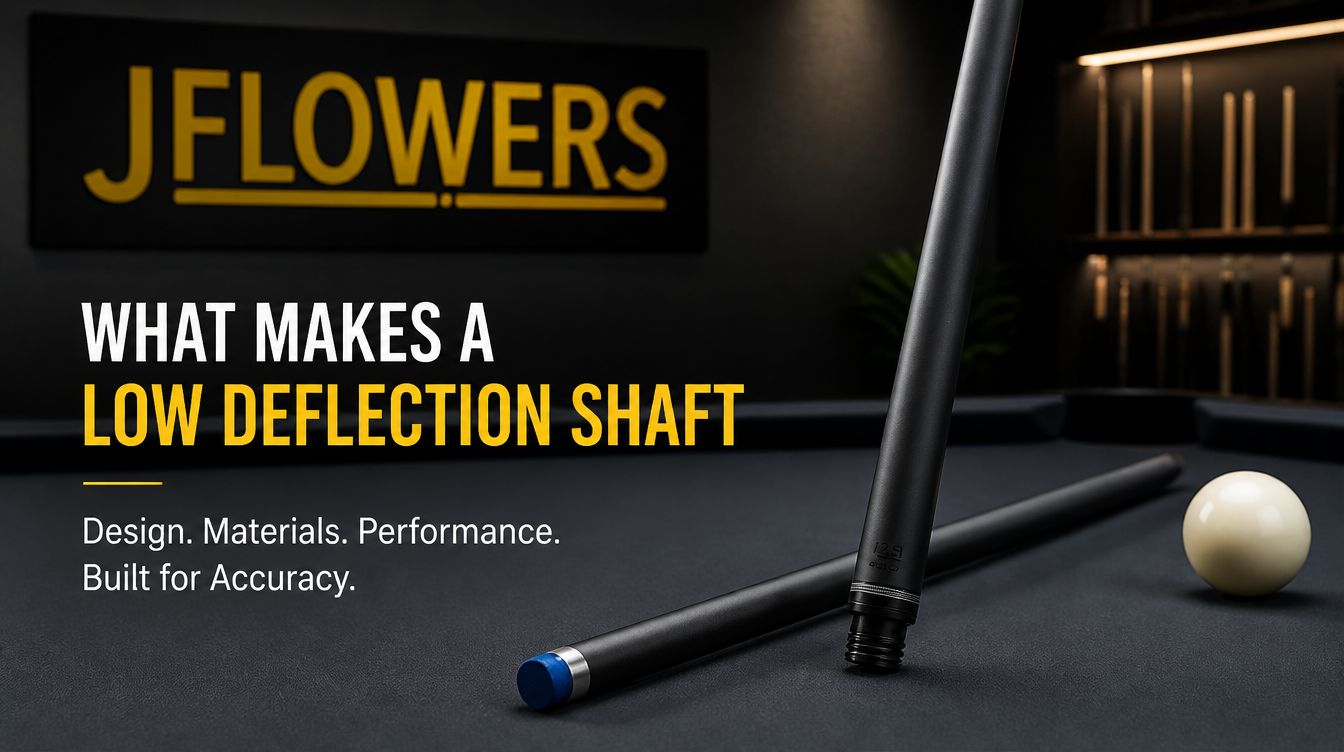
Low deflection is on the spec sheet of almost every serious pool cue shaft being sold today. But what does it actually mean? What causes deflection in the first place? And what specifically makes one shaft lower deflection than another?
Listen to this article
The engineering behind the most talked-about feature in modern pool cue design
This guide gets into the actual physics and engineering — the real explanation of what’s happening when you apply english, why certain shaft designs reduce it, and what that means for how you play.
What Deflection Actually Is
When you strike the cue ball off-center — to apply left or right english — the tip pushes the ball sideways at the moment of contact, in addition to forward. The cue ball doesn’t travel in a perfectly straight line from the contact point. It pushes slightly in the opposite direction of the spin applied.
Here’s the physics: at the moment of contact, the shaft is briefly in contact with a moving ball that’s being struck off its center. The mass of the shaft near the tip creates a lateral force on the cue ball — pushing it sideways relative to your stroke direction. The heavier the tip section of the shaft, the more lateral force is applied, and the more the cue ball deviates from your aim line.
This deviation is deflection (also called squirt). Every shaft has some — the question is how much.
Why Tip-Section Mass Is the Key Variable
The critical insight in low deflection shaft design is that the mass near the tip — specifically in the first few inches of the shaft — is what drives deflection. The rest of the shaft’s mass matters much less.
This is counterintuitive at first. A heavier cue overall doesn’t necessarily produce more deflection — the distribution of that mass matters far more than the total. A shaft that’s heavy overall but has minimal mass in the tip section can still produce very low deflection.
Once engineers understood this, the design direction became clear: reduce mass in the tip section of the shaft without compromising stiffness. That’s the engineering challenge that every low deflection shaft design addresses in one way or another.
How Traditional Maple Shafts Produce High Deflection
A standard maple shaft is a solid taper of wood from ferrule to joint. Maple is dense — a good piece of hard rock maple has consistent density throughout. That means the tip section of a standard maple shaft is relatively heavy, which produces the lateral force on the cue ball that causes significant deflection.
Players on traditional maple shafts learn to compensate — they aim slightly off-center to account for where the cue ball will actually travel after deflection. This compensation becomes muscle memory over time, but it introduces a variable: the compensation has to be precise, and if the shaft changes (different shaft, different conditions), the compensation is wrong.
The Three Approaches to Reducing Deflection in Maple
Hollow Core Design One of the earliest and most effective approaches to reducing deflection in maple shafts. A hollow core removes mass from the interior of the tip section while keeping the exterior dimensions the same. Less mass in the critical area means less lateral force on the cue ball — lower deflection.
The engineering challenge is maintaining stiffness while removing internal mass. A hollow shaft that flexes too much during the stroke creates other performance problems. The best hollow core maple designs solve this by carefully controlling wall thickness and material density.
Lightweight Tip Materials Some low-deflection maple shaft designs use specially engineered ferrule and tip-section materials that are lighter than standard maple while maintaining appropriate stiffness. By replacing the denser wood near the tip with lighter composite materials, mass in the critical area is reduced.
Aggressive Tapering A more aggressively tapered shaft — thinner at the tip, flaring more toward the joint — naturally has less mass in the tip section than a shaft with a gradual, shallow taper. The taper profile is one of the tools available to shaft designers for managing deflection characteristics alongside other feel properties.
Carbon fiber achieves low deflection through the properties of the material itself — not through engineering modifications to reduce mass in the tip section. Carbon fiber is inherently very light relative to its stiffness. A carbon fiber shaft has dramatically less mass in the tip section than any maple shaft, whether standard or engineered for low deflection.
This is why carbon fiber shafts are almost universally low deflection without requiring the specific engineering tricks that maple low-deflection shafts depend on. The material’s light weight in the tip area is a function of what carbon fiber is — not something that requires adding hollow cores or specially engineered materials.
It also means carbon fiber low deflection is consistent regardless of conditions. The material’s properties don’t change with humidity or temperature the way wood’s do, so the deflection profile of a carbon fiber shaft stays the same across all playing conditions.
Stiffness: The Other Half of the Equation
Low deflection shaft design isn’t only about reducing tip-section mass. Stiffness matters too — specifically, the shaft needs to be stiff enough that it doesn’t flex excessively during the stroke, which would introduce a different kind of inconsistency.
The ideal low deflection shaft is both light in the tip section (to minimize the lateral force that causes deflection) and stiff enough throughout (to transmit energy efficiently without excessive flex). This combination is why carbon fiber is so effective — it’s simultaneously light and extremely stiff.
Some engineered low-deflection maple shafts sacrifice some stiffness in the process of reducing tip mass. This produces a softer, more whippy feel that some players prefer and others don’t. The designer’s choices about the stiffness-weight tradeoff significantly affect how the shaft plays.
Deflection Ratings: What the Numbers Mean
Some shaft manufacturers publish deflection data — either absolute measurements or ratings relative to a baseline. These numbers can be useful for comparison within a manufacturer’s lineup but should be treated carefully when comparing across brands, since measurement methods vary.
A more practical approach: research specific shafts in forums and communities where real players at your level discuss actual experience. How a shaft performs in real playing conditions — across different shot types, by players with similar games to yours — tells you more than a single deflection number.
The most important thing is that a shaft’s deflection is consistent and predictable. A moderately low deflection shaft that behaves the same every time is more useful than a theoretically lower-deflection shaft with variable behavior.
Squirt vs. Swerve vs. Deflection: Clarifying the Terms
These three terms are related but refer to different phenomena:
Deflection (squirt): The sideways deviation of the cue ball caused by off-center contact at the moment of impact. This is what shaft design directly affects.
Swerve: The curved path the cue ball travels due to the combination of top/bottom spin and side spin. Affected by cue elevation and how far off-center you strike.
English: The side spin applied to the cue ball. More english = more deflection and more potential swerve.
Low deflection shafts specifically address the squirt/deflection variable — the deviation at the moment of contact. Swerve is a separate phenomenon and is more affected by cue elevation and stroke technique than by shaft design.
Frequently Asked Questions
Is zero deflection possible? No. “Zero deflection” is a marketing claim that’s technically inaccurate. Every shaft produces some deflection when english is applied. The best low-deflection shafts produce significantly less than standard options, but none eliminates it entirely.
Does a lighter cue automatically produce lower deflection? Not necessarily. Total cue weight isn’t the primary driver of deflection — the mass distribution near the tip is. A lighter cue with its mass distributed wrong can still produce high deflection.
How do I know if my current shaft is high deflection? Set up a straight shot to a pocket. Apply a few tips of right-hand english and observe where the cue ball goes versus where you aimed. A significant deviation to the left of your aim line indicates higher deflection. Try the same shot on a known low-deflection shaft if you have access to one and compare.
Does tip hardness affect deflection? Slightly. A softer tip stays in contact with the cue ball slightly longer, which can affect the amount of lateral force transmitted. But the shaft’s mass distribution is the primary driver — tip hardness is a minor variable by comparison.
Can I make my current shaft lower deflection? Not in a meaningful way without replacing it. The deflection profile is built into the shaft’s construction — its mass distribution and stiffness characteristics. A tip upgrade won’t change the shaft’s fundamental deflection profile.
Final Thoughts
Low deflection shaft design is real engineering — not just a marketing term. The physics of what happens when a shaft contacts the cue ball off-center are well understood, and the approaches to managing those physics in shaft design are specific and measurable.
Whether through hollow-core maple engineering or carbon fiber’s inherent material properties, low deflection shafts deliver a real, practical benefit: your aim when using english is more natural, and the cue ball’s behavior is more predictable. For players who use english regularly, that’s one of the most valuable things a shaft upgrade can offer.
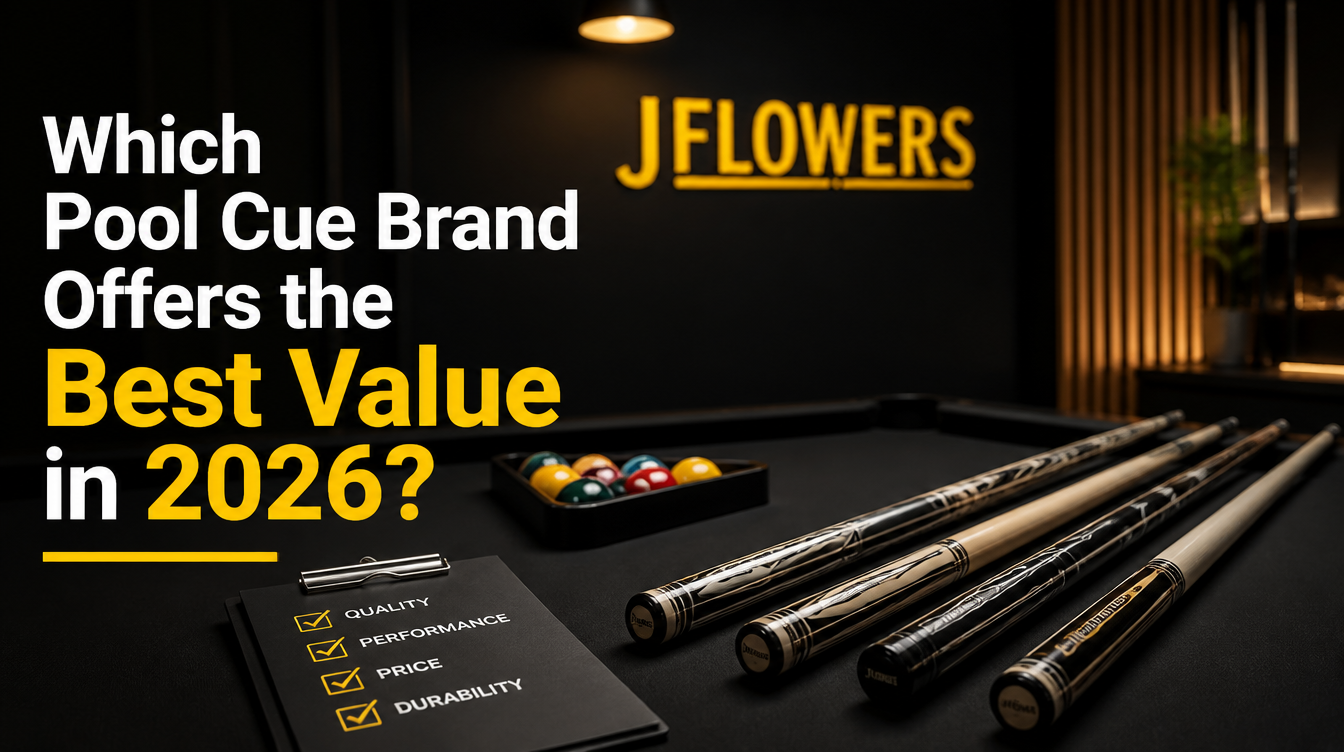
After comparing JFlowers to Predator, Mezz, McDermott, Meucci, Jacoby, Pechauer, and a dozen more brands across every price point and construction philosophy — the question that started all of it deserves a direct answer: which pool cue brand actually offers the best value for serious competitive players in
2026?
Players Technology is one of the most widely used cue brands in American pool halls. Their two-piece cues at $40-$150 have introduced millions of American players to personal cue ownership. Nearly every serious pool player in America either started on a Players cue or played against someone who did. Comparing Players to JFlowers isn’t really a direct competition — it’s a marker on the journey from beginner to serious competitor.