Shaft taper is one of the least talked about variables in pool cue selection — and one of the most misunderstood by players who do talk about it. The word "taper" appears in descriptions of pro-level shafts all the time, but most players couldn't explain what it actually means or why
it matters.
Listen to this article
Understanding shaft taper — pro taper vs. European taper and what the difference means for your game
This guide covers the two main taper styles in pool — pro taper and European (conical) taper — what each one actually does to how a cue feels and plays, and how to think about which one fits your game.
What Is Shaft Taper?
Shaft taper refers to how the diameter of the shaft changes along its length — specifically, how quickly and in what pattern it narrows from the joint end (thicker) down to the tip end (thinner). Every shaft tapers from joint to tip; the question is how that taper is distributed.
The taper profile has a direct effect on how the shaft feels during the stroke, how it flexes, and how stiff or whippy the delivery feels. Two shafts with the exact same tip diameter and total length can play completely differently based on how their taper is designed.
Simple way to see it: hold a shaft at the joint end and sight down toward the tip. Notice how it narrows. Does it narrow gradually and continuously from the back all the way to the tip? Or does it stay relatively consistent for most of its length and then taper toward the front? Those are the two fundamental approaches.
Pro Taper: What It Is and How It Feels
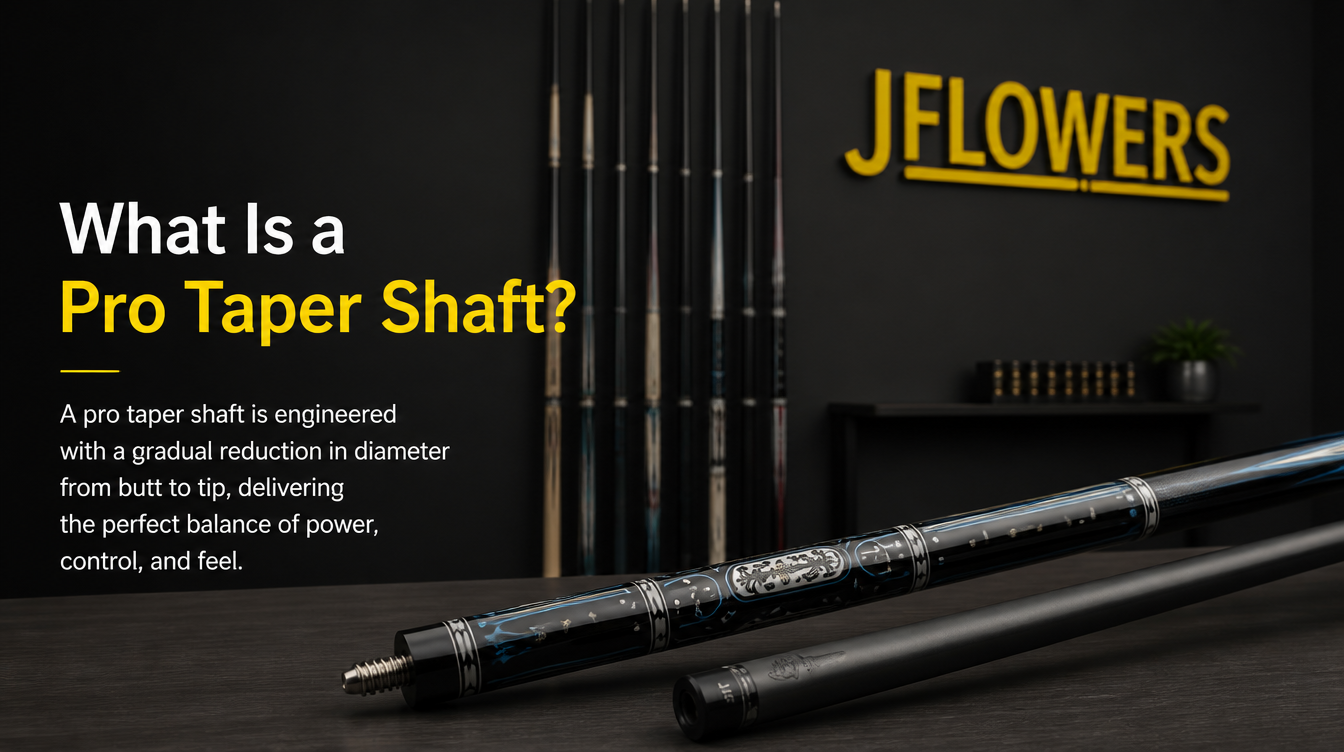
A pro taper (also called an American taper) shaft maintains a relatively consistent diameter for the first 12-15 inches from the joint, before tapering toward the tip. From the back, the shaft is nearly cylindrical — it doesn’t start significantly narrowing until you’re past the midpoint toward the tip.
The Playing Feel A pro taper shaft feels stiffer and more powerful through the stroke. Because the shaft maintains more of its diameter throughout most of its length, it has more consistent mass distribution — there’s more shaft material over more of the length.
Players on pro taper shafts often describe the delivery as feeling more direct and solid. The contact feel is crisp, with clear feedback. The stroke is less “whippy” — the shaft flexes less visibly during the delivery, which many players associate with more precise, predictable performance.
Who Uses Pro Taper Pro taper is the dominant standard in American pool. Most quality production shafts in the United States — including the majority of performance maple shafts and virtually all carbon fiber shafts — use some form of pro taper. The term itself reflects this: it’s the professional standard in American 9-ball, 8-ball, and 10-ball.
Preferred by players who like a stiff, direct stroke feel
Standard in American pool formats
Common on performance and tournament-level shafts
Nearly universal on carbon fiber shafts
European (Conical) Taper: What It Is and How It Feels
A European taper — sometimes called a conical taper — narrows continuously from joint to tip in a smooth, progressive cone shape. There’s no section of the shaft that stays at a consistent diameter; it’s always getting narrower as you move toward the tip.
The Playing Feel A conical taper shaft feels softer and more whippy through the stroke. Because the shaft is narrower earlier in its length, it has less material over more of its length — which produces more visible flex during the delivery. Players often describe this as a livelier or more elastic feel.
The contact feel is softer and more absorbed compared to pro taper — some players find this gives them more feel on delicate shots. The tradeoff is that the extra flex can make the stroke feel less precise on power shots.
Who Uses European Taper European taper is the dominant standard in snooker and English billiards, where the cue ball is smaller and delicate touch shots are paramount. It’s also common in some European pool traditions.
Standard in snooker cues
Common in European pool formats
Preferred by players who like a softer, more elastic stroke feel
Nearly all carbon fiber pool cue shafts use a pro taper design — and this combination has some specific properties worth understanding.
Carbon fiber is inherently very stiff as a material. Combined with a pro taper design, this produces a shaft that’s extremely rigid through the stroke with minimal flex. For players who prefer the direct, solid feel of a pro taper, a carbon fiber shaft amplifies those characteristics.
Some carbon fiber shaft manufacturers have introduced variations in their taper and layup design specifically to moderate the stiffness — producing a shaft that feels slightly less rigid than maximum carbon fiber stiffness would suggest. If pure stiffness bothers you about carbon fiber, look for manufacturers who specifically address this in their design.
How Taper Interacts With Other Variables
Taper and Deflection A more aggressive taper toward the tip (less mass at the front of the shaft) produces lower deflection — there’s less mass in the critical contact area to push the cue ball sideways during off-center contact. Pro taper shafts, by maintaining more diameter over more of their length, can have slightly more tip-end mass than conical designs — though the difference is usually smaller than the shaft material itself (maple vs. carbon fiber).
Taper and Feel Taper is one of the primary contributors to the overall feel of a shaft in the stroke. A stiffer pro taper produces more of the direct feedback that many competitive players prefer. A softer conical taper produces more of the elastic, whippy feel that some players prefer for touch and finesse shots.
Taper and Shaft Stiffness The material and the taper combine to determine overall shaft stiffness. A carbon fiber shaft with a pro taper is very stiff. A maple shaft with a conical taper is softer. Mixing material and taper options gives you a range of stiffness profiles to choose from.
Which taper is better — pro or European? Neither is objectively better. Pro taper is the standard in American pool and suits most players who grew up in that tradition. European taper is standard in snooker. The right choice is whichever feel suits your stroke and playing style.
Can I tell the taper of a shaft just by looking at it? With practice, yes. Sight down the shaft from the joint end toward the tip. A pro taper will look nearly cylindrical for the first half to two-thirds before narrowing. A conical taper will visibly narrow continuously from the moment you look down it.
Does taper affect how long the shaft lasts? Not significantly. Longevity is more about material (carbon fiber vs. maple) and how the shaft is maintained and stored than about taper profile.
What taper do most professional pool players use? The vast majority of professional pool players (as opposed to snooker players) use some form of pro taper. It’s the standard in the American professional game, and most performance shaft manufacturers produce pro taper as their primary or only design.
Does taper affect how the cue bridges? Slightly — a thicker section near the bridge hand on a pro taper shaft feels different than a thinner conical shaft at the same bridge point. But this is a minor tactile difference that players adapt to quickly.
Final Thoughts
Pro taper is the standard in American pool for good reason — it produces the stiff, direct stroke feel that suits the precision demands of the American game. If you’re playing any American pool format and haven’t specifically explored European taper, pro taper is what you should be on.
If you’re curious about the feel difference — and if you have access to a snooker cue or a conical taper shaft — try it. The difference is real and noticeable. Most American pool players who try it once understand quickly why they prefer pro taper for their game.
After comparing JFlowers to Predator, Mezz, McDermott, Meucci, Jacoby, Pechauer, and a dozen more brands across every price point and construction philosophy — the question that started all of it deserves a direct answer: which pool cue brand actually offers the best value for serious competitive players in
2026?
Players Technology is one of the most widely used cue brands in American pool halls. Their two-piece cues at $40-$150 have introduced millions of American players to personal cue ownership. Nearly every serious pool player in America either started on a Players cue or played against someone who did. Comparing Players to JFlowers isn’t really a direct competition — it’s a marker on the journey from beginner to serious competitor.