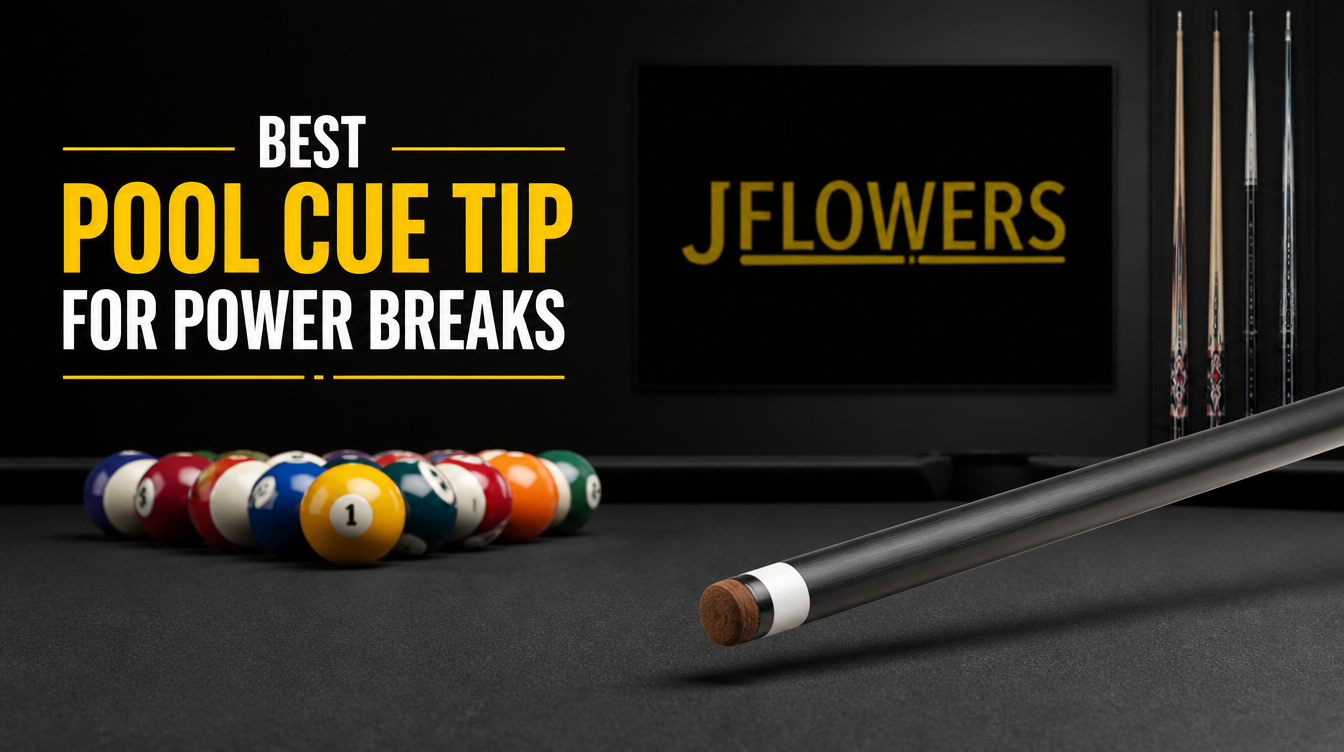
The break shot is the most violent thing you do to a pool cue tip. A full-speed break puts more impact force through the tip than any other shot in the game — repeatedly. The tip that serves you perfectly for delicate position play is not necessarily the right tip for your break cue.
Listen to this article
This guide covers break tip selection specifically: what properties matter for breaking, why break tips are different from playing tips, and what the best options are in 2026 for players who want to maximize break power and accuracy.
Why Break Tips Are Different
Playing tips are optimized for spin transfer, chalk retention, and feel feedback across a wide range of shot types. Break tips are optimized for a single purpose: transferring maximum energy from the shaft to the cue ball on a center or slightly above-center hit, with reliability over hundreds of hard impacts.
The optimal tip for this job is harder, more impact-resistant, and more durable than a playing tip. Softness that helps with english on playing shots actively hurts break performance — soft tips compress under break impact, absorbing energy that should go to the cue ball and mushrooming rapidly under the stress of power strokes.
Phenolic Tips — The Maximum Power Option
Phenolic tips are made from hard resin rather than leather. They’re the hardest pool cue tips available and produce the maximum power transfer from shaft to cue ball. The contact is extremely hard and direct — nothing compresses, nothing absorbs. Your full stroke energy goes to the cue ball.
Advantages of phenolic for breaking:
Maximum power transfer — stiffer contact means more energy to the cue ball
Exceptional durability — phenolic doesn’t compress, mushroom, or wear under break impact
Very long lifespan — phenolic break tips last significantly longer than leather alternatives
Trade-offs: phenolic tips are not suitable for playing cues. The hit is too harsh, there’s essentially no feel feedback, and they’re not designed for english work. Phenolic is exclusively for dedicated break cues. Popular phenolic options: Tiger Everest, Predator approved phenolic break tips. Available from most billiards retailers.
Hard Leather Tips for Breaking
For players who prefer leather tips on their break cue — either for feel preference or because they occasionally use the break cue for a jump shot — hard leather is the right choice. Hard leather break tips (Taom hard, Kamui hard, Tiger hard) provide:
Good power transfer — not as maximum as phenolic, but significantly better than medium or soft leather
Adequate durability for break use — hard leather resists mushrooming under break impacts better than softer grades
More feel than phenolic — some players prefer knowing the break contact felt solid
Medium Layered Tips for Breaking — Not Recommended
Medium tips on break cues are a compromise that serves neither purpose well. They compress more than hard tips under break impact (reducing power transfer) and mushroom faster under break stress than either hard leather or phenolic. If you’re using your playing cue for breaks because you don’t own a separate break cue, medium is what you have — but protect the tip and replace it more frequently.
Should You Have a Dedicated Break Cue?
Yes — if you compete seriously in nine ball, ten ball, or rotation, a dedicated break cue is worthwhile. It allows you to:
Use a heavier cue (21oz+) optimized for break power without affecting your playing feel
Use a hard or phenolic tip optimized for breaking without sacrificing your playing tip
Break as hard as you want without worrying about tip damage on your playing cue
The investment in a dedicated break cue at the $100-$200 level pays for itself in protected playing tips and better break performance. See Best Cue for Nine Ball for the full nine ball setup discussion.
Break Tip Shape
Break tips benefit from a slightly flatter profile than playing tips — some break tip users prefer a very slightly rounded flat rather than full nickel radius. The reasoning: center contact is the primary break shot aim, and a very slightly flatter tip provides a more stable center contact for maximum power transfer.
Extreme off-center shots aren’t the goal on a break, so the english-range benefit of a dome matters less. That said, nickel radius on a break tip is also fine and more consistent with standard tip maintenance habits. Don’t let tip shape be a major variable in your break setup.
Chalk for Breaking
Quality chalk on a break tip matters — even on center-contact breaks, the tip can slide at maximum impact speeds without chalk. Apply Taom or quality chalk to the break tip before every break. Don’t use the dry house chalk at the end of the table.
Pros and Cons
Phenolic break tips
Maximum power transfer — all your stroke energy goes to the cue ball
Exceptional durability under repeated break impacts
Very long lifespan
Not suitable for any playing shots — break cue only
No feel feedback — purely functional
Hard leather break tips
Good power transfer with some feel feedback
Can be used for occasional jump shots
More familiar feel for players coming from leather playing tips
Less maximum power transfer than phenolic
Still mushrooms faster than phenolic under break stress
Expert Recommendation For dedicated break cues: phenolic is the performance choice if maximum power is the goal. Hard leather is the choice if you want some feel feedback or occasionally use the break cue for jump shots. In both cases, use a heavier cue (21oz+), quality chalk, and never use your playing cue’s tip for maximum-power breaks.
Conclusion
Break tip selection is simple once you understand what breaking actually demands: maximum power transfer and maximum durability. Phenolic gives you the most of both. Hard leather gives you good performance with some feel feedback. Protect your playing cue’s tip by using a dedicated break setup, and choose the tip hardness that matches how you prioritize power versus feel on that opening shot.
Frequently Asked Questions
Q: What tip is best for breaking in pool? Phenolic tips provide maximum power transfer for dedicated break cues. Hard leather (Taom hard, Kamui hard) is the best leather option for breaking. Q: Can I use my playing tip for breaks? Yes, but it accelerates tip wear and requires more frequent replacement. A dedicated break cue with a hard or phenolic tip is the better long-term investment. Q: What is a phenolic cue tip? A tip made from hard resin rather than leather. Maximum hardness, maximum durability, maximum power transfer. Used exclusively on break and jump cues. Q: What weight break cue is best? 21-25oz for most serious break players. Heavier cue weight combined with hard tip and fast stroke produces maximum break power. Q: Do hard tips give a harder break? Yes. Harder tips transfer more energy to the cue ball because they compress less under impact. Phenolic transfers the most; hard leather the second most. Q: How long do break tips last? Phenolic break tips can last years. Hard leather break tips last longer than soft or medium alternatives but will still compress over many hundred break impacts. Q: Should I chalk before every break? Yes. Even on center-contact power breaks, chalk prevents the tip from sliding at maximum impact speeds. Q: What break tip do professional players use? Phenolic or hard leather depending on format and personal preference. Nine ball professionals often use phenolic for maximum break power.
After comparing JFlowers to Predator, Mezz, McDermott, Meucci, Jacoby, Pechauer, and a dozen more brands across every price point and construction philosophy — the question that started all of it deserves a direct answer: which pool cue brand actually offers the best value for serious competitive players in
2026?
Players Technology is one of the most widely used cue brands in American pool halls. Their two-piece cues at $40-$150 have introduced millions of American players to personal cue ownership. Nearly every serious pool player in America either started on a Players cue or played against someone who did. Comparing Players to JFlowers isn’t really a direct competition — it’s a marker on the journey from beginner to serious competitor.