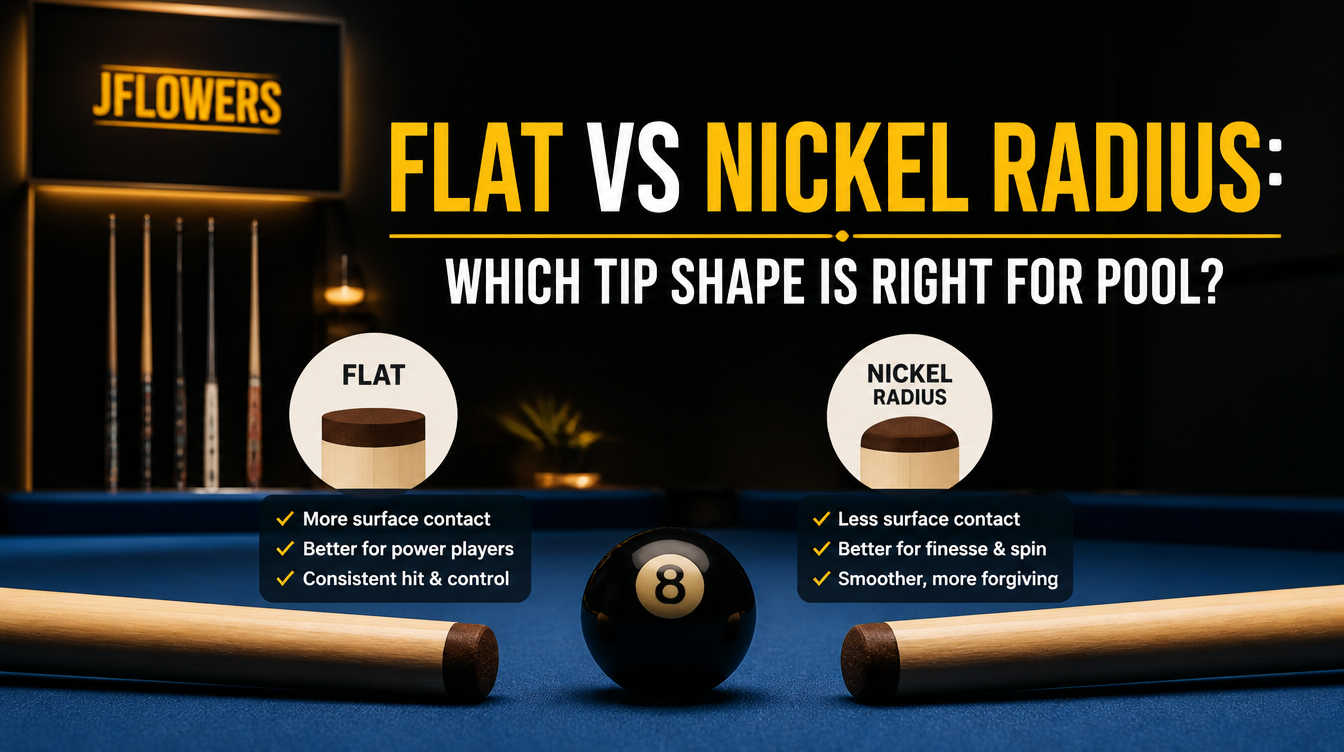
Flat vs Nickel Radius: Which Tip Shape Is Right for Pool?
JFlowers Cues
If you've heard the advice 'keep your tip shaped to a nickel radius' and wondered exactly why — or if you've noticed your tip going flat and wondered how much it actually matters — this guide has the specific answers.
Listen to this article
Flat vs nickel radius isn’t a preference debate. One shape is correct for most pool applications; the other actively undermines your game. Here’s the clear explanation.
Why This Comparison Matters
A pool cue tip naturally flattens over time from play. The impacts compress the tip’s center, gradually reducing its dome until the contact face becomes flat or nearly flat. For most players, this happens without them noticing — the tip looks fine until you inspect it carefully, but it’s been playing flatter and flatter for weeks.
Many players who struggle with inconsistent english or higher-than-expected miscue rates are actually playing with a flat tip. The fix is a 30-second tip reshaping, not a new shaft or a different stance.
How Flat Tips Fail at Contact
When a flat tip contacts the cue ball center, the full flat face of the tip makes contact. This feels stable and solid — which is why some players initially like flat tips. The problem appears immediately on off-center shots.
As you move the contact point away from center to apply english, a flat tip’s edge begins to engage the cue ball at an increasingly steep angle. At maximum english distance (close to the edge of the cue ball), the flat tip is contacting the ball almost tangentially — which dramatically increases miscue risk and makes the contact geometry unreliable.
The flat tip is also unforgiving on any slightly off-center center-ball shot. If your cueing is even slightly imprecise, the flat tip’s contact angle changes more than it would on a domed tip.
How Nickel Radius Works
A nickel radius tip contacts the cue ball at a single point — the apex of the dome. This is true whether you’re hitting center ball or applying english. As the contact point moves away from center to apply english, the curved tip maintains a consistent angle to the cue ball surface. The contact geometry stays reliable across the full english range.
This consistent contact geometry is why nickel radius is the standard for competitive pool. It’s not arbitrary tradition — it’s physics. A domed tip works better at contact than a flat tip, and the nickel radius provides the right amount of dome for all-round play.
The Physics Explained Simpl
Think of it this way: you’re trying to press a curved surface (the cue ball) with a flat surface versus another curved surface. Two curved surfaces that contact at a single point maintain consistent geometry as the contact point moves. A flat surface touching a curved surface changes its contact angle dramatically as the contact point moves away from center. For pool’s demands — reliable contact across the english range — single-point curved contact wins every time.
For more on how tip shape interacts with english performance across the full range, see Best Cue Tip for English.
How Often Tips Go Flat
The rate at which a tip flattens depends on: tip hardness (soft tips flatten faster), play volume, and stroke style. A soft tip on heavy competitive use can go noticeably flat in 3-5 sessions without reshaping. A hard tip might maintain its shape for 2-3 weeks of regular play before needing attention. See How Often Should You Shape a Cue Tip? for the maintenance schedule that keeps your tip at the right shape for your play volume.
Reshaping to Nickel Radius
Reshaping a flat tip to nickel radius takes about 30-60 seconds with the right tool. A tip shaper or scuffer with a nickel-radius profile is the correct instrument. Light, even strokes around and across the tip face to remove material from the center and build the dome. Check by sight — the tip should show a clear dome when viewed from the side.
Don’t over-shape. You’re removing tip material, which shortens the tip’s lifespan. Maintain the radius with light frequent shaping rather than heavy infrequent grinding.
Nickel vs Dime: the Next Question
Once you understand why flat is wrong, the next question is nickel vs dime radius. Nickel radius (more gentle dome) is the standard for general competitive play. Dime radius (more aggressive dome) suits players who use heavy english. For the full comparison, see Tip Shape Guide.
Pros and Cons
Nickel radius
Consistent contact geometry across the full english range
Reliable performance on both center-ball and english shots
Industry standard for good reason — proven across all formats
Requires regular maintenance to prevent flattening during play
Flat tip
Feels solid on dead center hits
Dramatically increases miscue risk on off-center shots
Inconsistent contact geometry on english shots
Should be reshaped immediately — not a legitimate playing choice
Expert Recommendation Maintain nickel radius. Full stop. Get a tip shaper with a nickel-radius profile, use it briefly every few sessions, and your contact geometry will be consistent every time you pick up the cue. The 30 seconds it takes to reshape your tip is the highest-return maintenance activity in all of pool equipment care.
Conclusion
Flat vs nickel radius is the clearest tip shape decision in pool — one is right, one is wrong. A flat tip is an equipment problem with a 30-second fix. Invest in a tip shaper, build the nickel radius maintenance habit, and eliminate contact inconsistency from your game permanently. Your english shots will be better immediately after the first reshaping session.
Frequently Asked Questions
Q: Is a flat tip bad for pool? Yes. A flat tip produces increasingly poor contact geometry on off-center shots, dramatically raising miscue risk and making english unreliable. Q: Should my pool cue tip be flat or round? Round — specifically, a nickel radius dome. A flat tip should be reshaped to a dome before playing. Q: How do I know if my tip is flat? Look at the tip from the side while the cue is horizontal. A properly shaped tip shows a clear dome. A flat tip shows a flat or very slightly domed surface. Q: Will a flat tip affect my english? Significantly. A flat tip makes maximum english much harder to apply reliably and dramatically increases miscue risk on off-center shots. Q: What tool do I use to reshape my tip? A tip shaper or scuffer with a nickel-radius profile. Available from billiards retailers for $5-$15. Essential maintenance equipment for any serious player. Q: How long does tip reshaping take? 30-60 seconds per session for maintenance reshaping. Longer if the tip is badly flattened and requires more material removal. Q: Does tip shape affect break shots? Less so than playing cue shots — break shots use center or slightly above-center contact where flat vs domed matters less. But nickel radius on a break cue still provides more consistent contact than flat.
After comparing JFlowers to Predator, Mezz, McDermott, Meucci, Jacoby, Pechauer, and a dozen more brands across every price point and construction philosophy — the question that started all of it deserves a direct answer: which pool cue brand actually offers the best value for serious competitive players in
2026?
Players Technology is one of the most widely used cue brands in American pool halls. Their two-piece cues at $40-$150 have introduced millions of American players to personal cue ownership. Nearly every serious pool player in America either started on a Players cue or played against someone who did. Comparing Players to JFlowers isn’t really a direct competition — it’s a marker on the journey from beginner to serious competitor.