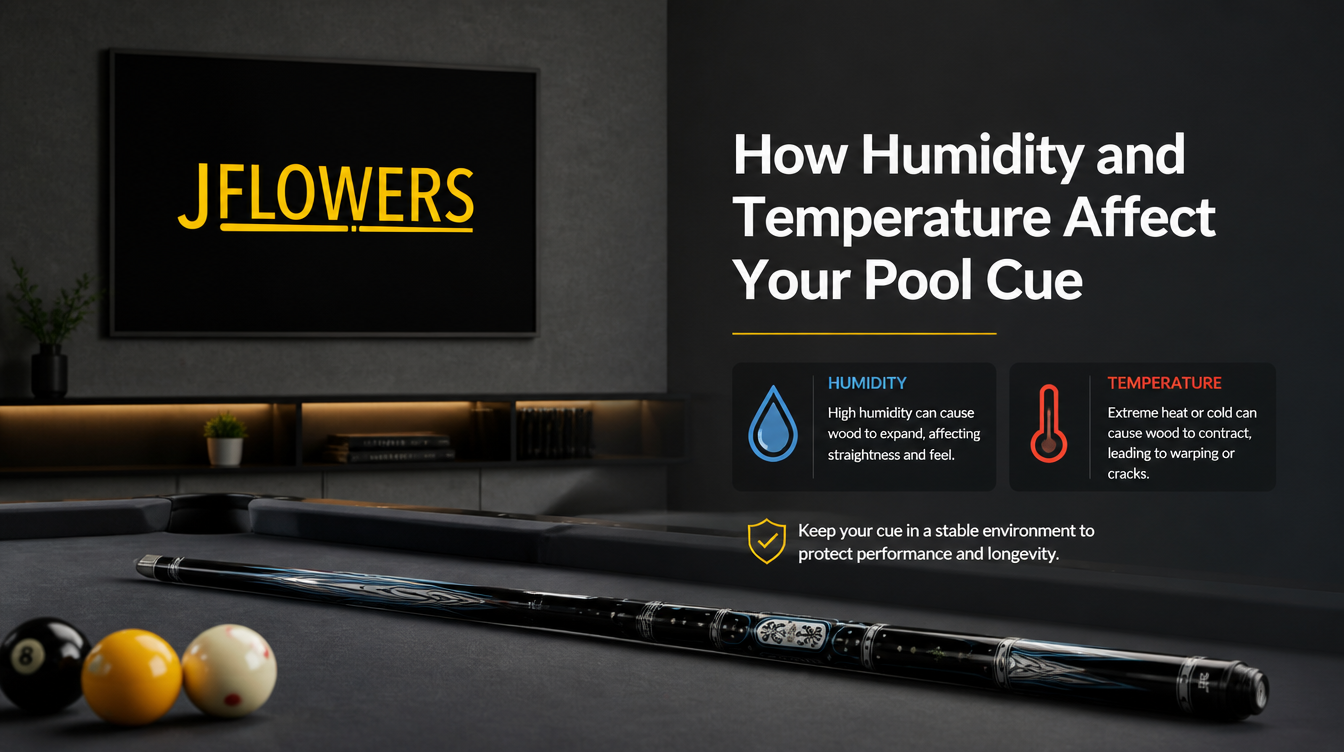
Pool cues are sensitive instruments. The same stick that plays perfectly in the controlled climate of your home practice room can feel and perform differently on a humid summer evening at the local pool hall. Wood is a living material that responds to its environment — and that responsiveness has real consequences for your game.
Listen to this article
This guide covers how humidity and temperature affect every part of your cue: the shaft, the tip, the wrap, and the joint — and what you can do to protect your equipment across different environments and seasons.
Effects on Wood Shafts
The biggest environmental effect on pool cues happens in wood shafts. Wood is hygroscopic — it absorbs moisture from high-humidity air and releases it in low-humidity conditions. This moisture exchange causes the wood to swell and contract, which produces several effects:
Shaft swelling in high humidity — the shaft diameter increases slightly, changing how it feels through the bridge and potentially affecting joint fit
Shaft contraction in low humidity — can cause surface drying, minor cracking, and dimensional changes in the opposite direction
Warping from uneven moisture absorption — the most serious outcome, covered fully in Preventing Pool Cue Warpage
Surface texture changes — a wood shaft feels rougher in dry conditions (wood grain opens) and smoother in humid conditions (grain swells)
Temperature effects on wood shafts are primarily indirect — temperatures that cause moisture changes (hot car driving off moisture, cold dry winter air) affect the shaft through humidity change rather than temperature directly.
Why Carbon Fiber Eliminates This Problem
Carbon fiber shafts are completely unaffected by humidity and temperature changes. The material has no hygroscopic properties — it doesn’t absorb moisture, doesn’t swell, doesn’t contract. A carbon fiber shaft plays identically in January dry air and July humidity. For the full explanation of why carbon fiber doesn’t warp, see Why Carbon Fiber Doesn’t Warp.
For tournament players who travel to different regional venues with different climate profiles, carbon fiber’s environmental stability is one of its strongest practical advantages. This is directly why professional carbon fiber adoption is highest among players who compete most frequently in varied environments. See Do Professionals Use Carbon Fiber?.
Effects on Cue Tips
Leather cue tips are also affected by humidity and temperature:
High humidity softens leather — a medium tip can feel and play softer in very humid conditions, with slightly different chalk retention
Low humidity hardens leather — dry conditions make tips feel firmer and can cause surface cracking on old or poorly maintained tips
Temperature extremes — very hot conditions (cars in summer) can cause tip adhesive to soften, risking tip separation
The practical implication: your tip’s feel may vary slightly between a humid pool hall and a dry home practice room. This is one reason consistent tip maintenance — proper shaping, scuffing, and chalking — is important regardless of environment.
Effects on the Joint
Wood-to-wood or wood-to-metal joint connections can be subtly affected by moisture. In high humidity, wood near the joint pin can swell slightly, affecting how smoothly the shaft threads on. In very dry conditions, wood can shrink slightly, potentially loosening the joint fit over time.
Metal joint pins and collars are essentially unaffected by humidity. Modern phenolic joint materials are also largely humidity-stable. The main concern is any wood component near the joint end.
Effects on Wrap
Irish linen wraps are particularly sensitive to humidity. In high humidity, the linen absorbs moisture and can feel damp, affecting grip character. In dry conditions, linen can dry out and feel slightly rougher or more brittle. Regular wiping after each session removes moisture from the wrap and slows both of these effects.
Leather wraps are somewhat less sensitive to humidity than linen but can dry out and crack in very low humidity without occasional conditioning. SeeIrish Linen vs Leather Cue Wrap for wrap-specific care guidance.
The Car Problem
Storing a pool cue in a car is one of the most damaging things you can do to a wood shaft. Parked cars reach extreme temperatures — 140-180°F in summer — that rapidly drive moisture out of wood, causing dramatic and often irreversible warping. Even in moderate temperatures, the humidity swings in a car are dramatic and unpredictable.
Carbon fiber shafts are unaffected by car storage. For wood shafts: never leave your cue in a car for extended periods, especially in summer. A hard case helps but doesn’t fully protect against the temperature extremes of a parked car. See How to Store a Pool Cue Properly for the full storage guide.
Protecting Your Cue Year-Round
Store your cue standing vertically in a stable humidity environment when not in use
Use a quality hard case for transport — it provides thermal buffer and physical protection
Never leave a wood-shafted cue in a parked car
If you play on a wood shaft, allow it to acclimate to the playing environment for 15-20 minutes before an important match
Wipe down the shaft after every session to remove moisture your hands transferred during play
Consider upgrading to carbon fiber if environmental variability is affecting your game
Pros and Cons
Carbon fiber shaft for environmental stability
Completely immune to humidity and temperature effects
Plays identically in every environment
No acclimation time needed between different venues
Higher upfront cost than wood
Wood shaft with proper care
Traditional feel unaffected by good storage habits
Lower cost
Requires environmental management to maintain consistent performance
Car storage can be catastrophic
Expert Recommendation For competitive players who play in varied environments, travel to tournaments, or have experienced environmental variability affecting their game: the JFlowers SMO Carbon Fiber Shaft eliminates the entire humidity and temperature category of equipment problems. For wood shaft users: store vertically, avoid the car, and allow acclimation time in new environments.
Conclusion
Humidity and temperature are equipment variables that most players manage reactively rather than proactively. Understanding what they do — and building simple protective habits — protects your investment. For the most complete protection, a carbon fiber shaft like the JFlowers SMO removes the entire environmental variable from your equipment equation.
Frequently Asked Questions
Q: Does humidity affect a pool cue? Yes, significantly — for wood shafts. Humidity causes wood to swell and contract, affecting shaft feel, diameter, and in extreme cases causing warping. Carbon fiber shafts are unaffected. Q: Can you leave a pool cue in a hot car? Wood shaft cues should never be stored in hot cars. The extreme temperatures cause rapid moisture loss and warping. Carbon fiber shafts can tolerate car storage safely. Q: Why does my pool cue feel different in winter? Dry winter air causes wood shafts to lose moisture, affecting surface texture, diameter, and feel. Tips may also feel slightly harder in dry conditions. Q: Does temperature affect pool cue tips? Yes. High humidity softens leather tips slightly. Extreme heat can soften tip adhesive. Cold dry air firms up leather and can cause surface cracking on neglected tips. Q: How do I protect my pool cue from humidity? Store vertically in a stable humidity environment, use a quality hard case, wipe down after play, and consider a carbon fiber shaft for environmental immunity. Q: Should I let my cue acclimate to a new environment? For wood shafts, yes — 15-20 minutes of acclimation before an important match in a different environment is worthwhile. Carbon fiber shafts require no acclimation. Q: What humidity level is best for wood pool cues? 40-55% relative humidity is the ideal storage range for wood shafts. Below 30% risks drying and cracking. Above 70% risks moisture absorption and potential warping.
After comparing JFlowers to Predator, Mezz, McDermott, Meucci, Jacoby, Pechauer, and a dozen more brands across every price point and construction philosophy — the question that started all of it deserves a direct answer: which pool cue brand actually offers the best value for serious competitive players in
2026?
Players Technology is one of the most widely used cue brands in American pool halls. Their two-piece cues at $40-$150 have introduced millions of American players to personal cue ownership. Nearly every serious pool player in America either started on a Players cue or played against someone who did. Comparing Players to JFlowers isn’t really a direct competition — it’s a marker on the journey from beginner to serious competitor.