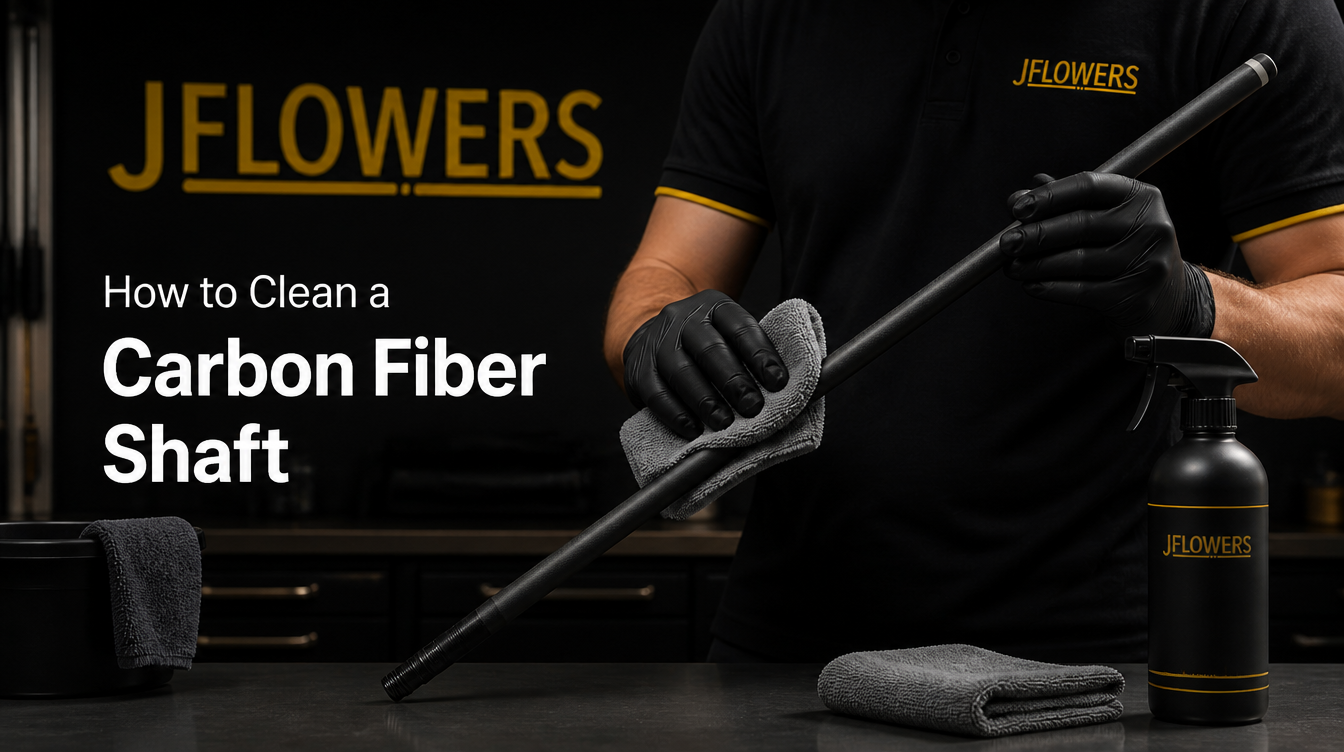
One of the biggest practical advantages of a carbon fiber shaft is how little maintenance it needs compared to maple. But "low maintenance" still means some maintenance. Players who switch from maple sometimes carry over their old cleaning habits — and some of those habits aren't appropriate for carbon fiber.
Listen to this article
Simple, correct, and won’t damage your shaft — the complete guide
This guide covers exactly what to do, how often to do it, and what to avoid so your carbon fiber shaft stays in top condition for as long as you own it.
Why Carbon Fiber Is Easier to Clean Than Maple
Maple is a porous natural material. Its surface has microscopic texture that traps chalk dust and absorbs skin oils over time. That’s why maple shafts develop a tacky, slow feel if they’re not cleaned regularly — the buildup changes the surface characteristics of the wood.
Carbon fiber has a smooth, non-porous surface. Chalk and oils sit on top rather than soaking in. A quick wipe removes them efficiently without the need for the deeper cleaning routines that maple requires. The surface stays more consistent between sessions naturally.
Bottom line: Where maple shafts need regular deeper cleaning to stay at their best, a carbon fiber shaft stays in good shape with quick wipe-downs and almost nothing else.
The After-Session Routine: What to Do Every Time You Play
After every session — before you put the cue in the case — do this:
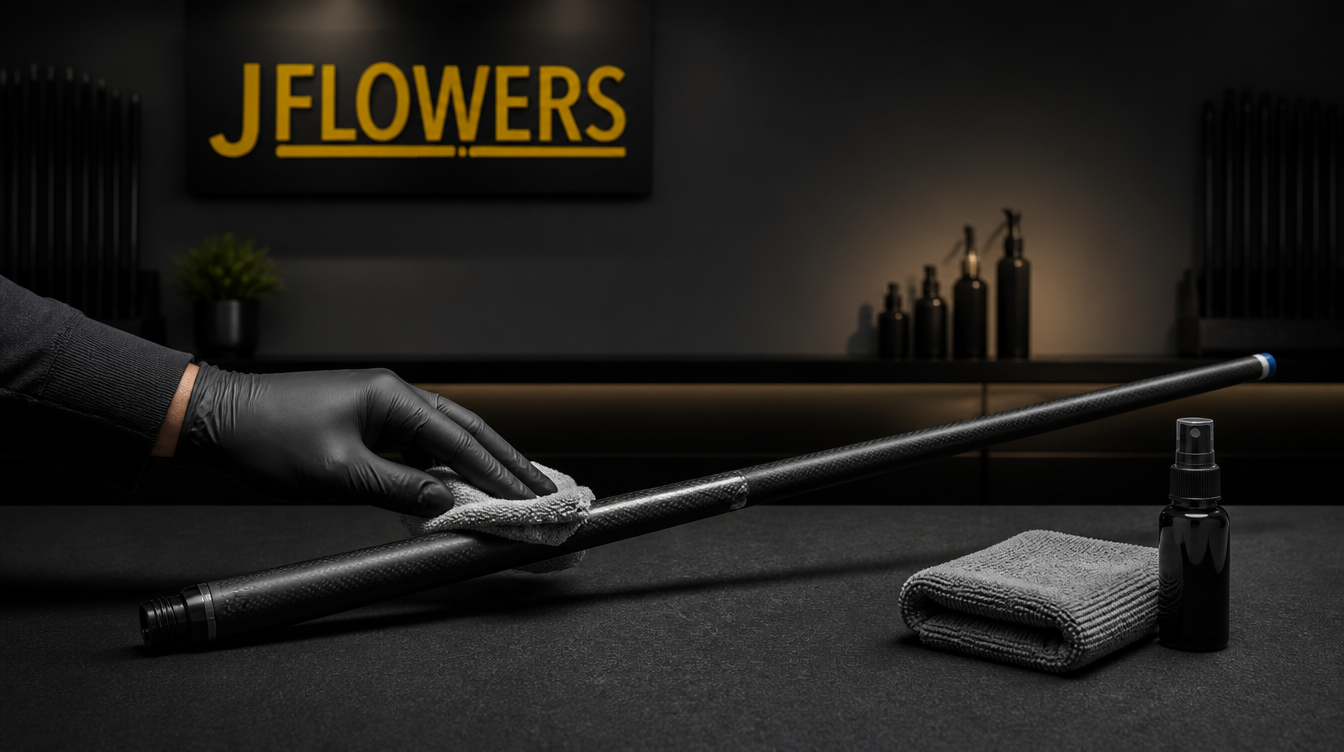
Take a clean, dry lint-free cloth (microfiber works well)
Wipe the full length of the shaft from joint collar to ferrule
One or two firm passes is enough
That’s it
This removes surface chalk dust and any skin oils before they have a chance to accumulate. It takes about ten seconds and is the single most important maintenance habit for keeping a carbon fiber shaft looking and feeling like new.
If the shaft looks clean and feels smooth after a dry wipe, you’re done. If there’s visible residue that didn’t come off dry, move to the damp cloth step.
When You Need More Than a Dry Wipe
After heavy sessions, playing in a dusty environment, or if you notice any stickiness or residue on the shaft, a slightly damp cloth handles it:
Take a clean cloth and dampen it slightly — wring it out well until it’s barely moist
Wipe the shaft from joint to ferrule
Follow immediately with a dry cloth to remove any remaining moisture
Let it air briefly before casing — don’t put a slightly damp shaft directly into a closed case
Barely damp is the key phrase. Carbon fiber itself doesn’t absorb moisture the way wood does, but the joint area and ferrule seams can be affected by excessive moisture. Use minimal water.
Deep Cleaning (Rarely Needed)
If your carbon fiber shaft has a persistent residue that a damp cloth doesn’t fully address — dried chalk spray, a sticky substance, or heavy grime from an unusually dirty environment — a gentle soap solution works:
Mix a tiny drop of mild dish soap in water
Apply to a cloth — not directly to the shaft
Wipe the affected area gently
Follow with a clean water-damp cloth to remove soap residue
Finish with a dry cloth
This level of cleaning should be infrequent — a few times a year at most for regular players. The after-session dry wipe and occasional damp cloth should handle everything that normally accumulates.
What NOT to Use on a Carbon Fiber Shaft
This is where players who carry over their maple shaft cleaning habits can do unintentional damage:
Maple shaft cleaners and conditioners: These are formulated for wood — the solvents and conditioners in them are not appropriate for carbon fiber surfaces and can damage the finish.
Isopropyl alcohol in quantity: Light occasional use is generally fine, but regular heavy use of alcohol can affect the surface finish on some carbon fiber shafts over time.
Sandpaper of any grit: Never. Sanding a carbon fiber shaft damages the surface permanently — you can’t “smooth” carbon fiber the way you might sand a rough maple shaft. A scratched CF surface stays scratched.
Abrasive pads or scrubbing cloths: Same issue — abrasives damage the surface of carbon fiber.
Leather burnishing pads: Burnishing is a maple shaft technique — not appropriate for carbon fiber. There’s nothing to close on the surface of carbon fiber the way there is with wood pores.
WD-40 or lubricants: Not appropriate for any part of the cue, including carbon fiber shafts.
The ferrule at the tip end of a carbon fiber shaft accumulates chalk residue just like any other cue. A damp cloth or cotton swab removes chalk effectively. Pay attention to the seam where the ferrule meets the shaft material — chalk can accumulate there and is easy to miss.
Don’t use abrasive products on the ferrule. The ferrule’s surface finish and precise dimensions matter for tip fit and contact feel — scratching or wearing the ferrule surface changes those characteristics.
Cleaning the Joint Area
The joint collar and threads on a carbon fiber shaft need periodic attention. Chalk dust accumulates in the thread grooves and affects how the cue assembles over time.
Use a dry soft brush (a clean toothbrush works) or compressed air to clear debris from the threads. Do this monthly or whenever you notice the cue assembling less smoothly. Never use water or lubricants in the joint threads — the connection needs to be dry and clean.
Does a Carbon Fiber Shaft Need to Be “Broken In”?
No — and this is one of its clearest practical advantages over maple. A maple shaft needs to be broken in — the wood goes through a settling process where oils and handling gradually change the surface feel and playability. Carbon fiber doesn’t do this.
The shaft you buy performs consistently from session one through session five hundred. There’s no “before break-in” versus “after break-in” period. What you buy is what you get — immediately and permanently.
How often should I clean my carbon fiber shaft? A quick wipe with a dry cloth after every session. A slightly damp cloth when needed (a few times a month for regular players). That’s genuinely the entire routine.
Can I use the same cloth for my maple shaft and carbon fiber shaft? Use separate cloths. Cleaning products appropriate for maple may transfer to the carbon fiber and aren’t appropriate for it. Keep dedicated cloths for each material.
My carbon fiber shaft looks dull. Is that normal? Some carbon fiber shafts have a matte finish rather than a glossy one — this is by design, not a problem. If a previously glossy shaft has gone dull, it may have surface buildup or minor scratching. A gentle clean should restore the surface if it’s buildup. Scratching is permanent.
Can I polish a carbon fiber shaft? Only with products specifically labeled as safe for carbon fiber composite. Standard wood polishes and cue waxes are not appropriate. If your shaft has the kind of finish that benefits from polish, check with the manufacturer about what products they recommend.
Is there anything I should apply to the shaft surface after cleaning? Generally, no. Carbon fiber shafts don’t need conditioners, waxes, or protectants the way maple does. A clean surface is the right surface. If the manufacturer specifically recommends a product, follow their guidance — otherwise keep it clean and bare.
Will cleaning change how the shaft plays? Cleaning removes buildup that can create drag or inconsistency — so a properly cleaned shaft plays better than a dirty one. But a clean carbon fiber shaft doesn’t feel meaningfully different session to session the way a maple shaft might after conditioning or burnishing.
Final Thoughts
Cleaning a carbon fiber shaft is genuinely simple: wipe it down after you play, use a barely damp cloth when needed, stay away from products designed for maple, and clean the joint periodically. That’s the entire maintenance routine for the shaft itself.
The tip is a different matter — that’s the consumable that needs active maintenance and eventual replacement. But the shaft itself, cleaned correctly and stored properly, should look and play like new for many years.
After comparing JFlowers to Predator, Mezz, McDermott, Meucci, Jacoby, Pechauer, and a dozen more brands across every price point and construction philosophy — the question that started all of it deserves a direct answer: which pool cue brand actually offers the best value for serious competitive players in
2026?
Players Technology is one of the most widely used cue brands in American pool halls. Their two-piece cues at $40-$150 have introduced millions of American players to personal cue ownership. Nearly every serious pool player in America either started on a Players cue or played against someone who did. Comparing Players to JFlowers isn’t really a direct competition — it’s a marker on the journey from beginner to serious competitor.