What causes it, who it affects, and how to make sure it never happens to your cue.
A warped pool cue shaft is one of the most frustrating equipment problems in the game — and one of the most preventable. The warp doesn't happen overnight. It develops slowly over weeks or months of suboptimal storage, usually without the player noticing until the shot inconsistency has gotten bad enough to investigate.
Listen to this article
This guide covers exactly what causes warping, which cues are vulnerable, what you can do to prevent it, and what your options are if it’s already happened.
What Is Cue Warpage?
Warpage is a permanent bend or curve that develops in a pool cue shaft over time. A warped shaft doesn’t roll straight on a flat surface — it rocks as it rolls, revealing the curve. During play, a warped shaft introduces inconsistency into every shot because the shaft isn’t delivering the tip to the cue ball in a straight line.
The warp can take different forms: a gentle curve over the full length of the shaft, a more abrupt bend near the tip end, or in severe cases a twisted warp that makes the shaft corkscrew slightly. All of them affect play; the more severe the warp, the more it costs you.
What Causes Warping
Humidity Changes This is the primary cause of most cue warps. Wood is a hygroscopic material — it absorbs and releases moisture in response to the humidity of its environment. When humidity is high, wood fibers absorb moisture and swell. When humidity drops, they dry and contract. When this moisture change is uneven — one side of the shaft absorbs more moisture than the other, or one end dries faster — the wood fibers change dimension unevenly, which causes the shaft to bend toward the wetter side. Repeated humidity cycles accumulate this stress until a permanent bend develops.
Temperature Extremes Heat softens the wood fibers in a maple shaft slightly and accelerates moisture movement. A cue left in a hot car on a humid summer day is experiencing both high temperature and high humidity — exactly the conditions that accelerate warp development.
Improper Storage Position A cue stored horizontally unsupported — or supported only at the ends — can develop a gravity-induced sag over time. This is less common than humidity-caused warps but is a real issue for cues stored improperly for extended periods.
Leaning Against Surfaces Leaving a cue leaned against a wall, a chair, or any surface that applies lateral force to the shaft over time creates pressure that can contribute to bending. Even a gentle lean sustained for weeks adds up.
Maple Shafts: High Vulnerability Any wood shaft is vulnerable to warping because wood responds to environmental moisture. The quality of the wood, how it was dried during manufacturing, and the finish on the shaft all affect how quickly a warp can develop — but no maple shaft is immune. Higher quality maple shafts that have been properly kiln-dried and finished are more resistant to warping than cheaper shafts. But “more resistant” is not the same as immune. Even the best maple shaft stored badly can warp.
Carbon Fiber Shafts: Zero Vulnerability Carbon fiber does not warp. Period. The composite material is not hygroscopic — it doesn’t absorb moisture, doesn’t respond to humidity changes, and doesn’t develop bends from storage conditions. A carbon fiber shaft stored in a hot, humid car trunk all summer plays identically to one stored in a climate-controlled case.
This is one of the most practically significant advantages of carbon fiber for real-world players. The storage anxiety that maple owners deal with simply doesn’t apply. If preventing warpage is a priority for you — especially if you travel frequently or can’t always control storage conditions — carbon fiber is the definitive solution.
How to Prevent Warping in a Maple Shaft
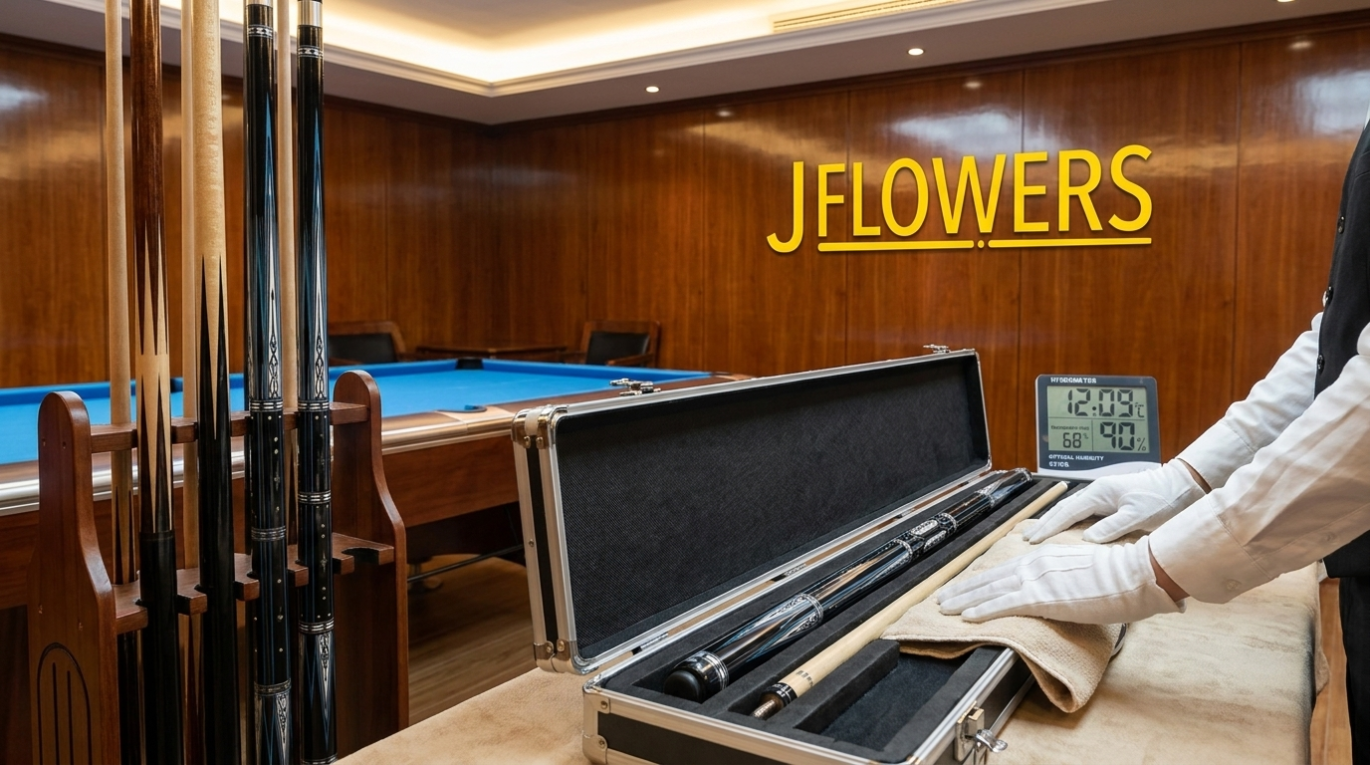
Always Use a Hard-Sided Case The case is the first line of defense. A hard-sided case insulates the shaft against rapid humidity and temperature changes, protects against the worst storage conditions, and prevents the casual leaning and laying that contributes to bend development.
Control Storage Environment Store your cue in an environment with stable temperature and humidity. Indoor, climate-controlled spaces are ideal. The specific humidity range that’s best for maple is 45-55% relative humidity — typical comfortable indoor conditions in most climates.
Avoid: basements without dehumidifiers (high humidity in summer, very dry in winter)
Avoid: garages without climate control (extreme swings in both temperature and humidity)
Avoid: near HVAC vents that create drying cycles
Avoid: near windows with direct sun exposure
Store Vertically A cue stored vertically (upright) experiences gravity evenly along its length — there’s no lateral force that can induce a sag. If you must store horizontally, support the shaft at multiple points along its length, not just at the ends.
Avoid Hot Car Storage Don’t leave a maple shaft cue in a hot car for extended periods. Short transport (driving to the pool hall and back) is fine. Leaving the cue in a hot car all afternoon, or in the trunk through multiple hot days, is asking for trouble.
Keep the Shaft Clean and Finished A properly sealed shaft surface resists moisture absorption better than a rough, unsealed one. Keep your shaft clean, burnished, and in good surface condition. Some players apply a very light coat of shaft wax or conditioner annually to help maintain the surface seal. How to Clean a Pool Cue
Rolling Test: How to Check for Warp The simplest warp test: disassemble the cue and roll the shaft on a perfectly flat surface (a glass table, a billiard table with the cover removed, or similar). A straight shaft rolls smoothly and doesn’t rock. A warped shaft will rock and wobble as it rolls — the curve causes it to rise and fall as it moves.
For a more precise check, hold the shaft at the joint end and sight down toward the tip with one eye closed, like aiming down a rifle barrel. Any curve in the shaft will be visible as a bow in the straight line from joint to tip. Check from multiple angles — 90 degrees apart — to identify whether the warp is in one plane or twisted.
What to Do If Your Cue Is Already Warped
A slight warp detected early can sometimes be corrected — or at minimum slowed from getting worse. A severe warp is typically permanent and requires shaft replacement.
Minor Warp: Self-Correction Attempt For a very slight bend, some players have success with the following: identify the direction of the warp (which way it bends), apply gentle hand pressure in the opposite direction, and store the shaft under slight opposing pressure in a stable environment. This is not guaranteed to work and works best on very slight bends detected early.
Moderate Warp: Cue Technician A cue technician with the right equipment can sometimes straighten a moderately warped shaft through controlled application of heat and pressure. Results vary — not all warps can be fully corrected, and the shaft may require ongoing careful storage to maintain the correction. Ask a reputable technician to evaluate whether correction is viable.
Severe Warp: Replace the Shaft A severely warped shaft that can’t be corrected needs to be replaced. If the butt is in good condition, a replacement shaft is much less expensive than a complete new cue. This is also a good opportunity to upgrade to a low-deflection or carbon fiber shaft that won’t develop the same problem.
Frequently Asked Questions
Can a new cue warp quickly if stored badly? Yes. Even a brand-new, high-quality maple shaft can develop a warp within weeks of bad storage particularly in conditions with extreme humidity. New doesn’t mean immune.
My cue has a very slight warp. Does it matter? A very slight warp has a smaller but still real effect on performance — particularly on long shots and precision shots where small deviations accumulate across distance. Even a slight warp is worth addressing, and preventing it from getting worse is important.
Is there a humidity monitor I can use to check my storage conditions? Yes — affordable hygrometers (humidity monitors) are available for $10-20. If you store your cue in a space where humidity varies (basement, garage), monitoring and knowing when conditions are problematic is worth the small investment.
Does a cue case prevent warping on its own? A case significantly reduces the rate of humidity change the shaft experiences — which helps. But a case in a very humid environment is not fully protective. The case helps; controlling the storage environment helps more.
Final Thoughts
Cue warpage is almost entirely preventable with the right habits. Always case your cue. Store it in a stable environment. Keep it out of hot cars for extended periods. Store vertically. Those four habits eliminate the vast majority of warp risk for maple shaft cues.
And if warp anxiety is something you don’t want to deal with at all — carbon fiber is the straightforward answer. A material that genuinely doesn’t warp, regardless of what you do with it storage-wise, is one of the clearest practical wins carbon fiber brings to everyday players.
After comparing JFlowers to Predator, Mezz, McDermott, Meucci, Jacoby, Pechauer, and a dozen more brands across every price point and construction philosophy — the question that started all of it deserves a direct answer: which pool cue brand actually offers the best value for serious competitive players in
2026?
Players Technology is one of the most widely used cue brands in American pool halls. Their two-piece cues at $40-$150 have introduced millions of American players to personal cue ownership. Nearly every serious pool player in America either started on a Players cue or played against someone who did. Comparing Players to JFlowers isn’t really a direct competition — it’s a marker on the journey from beginner to serious competitor.