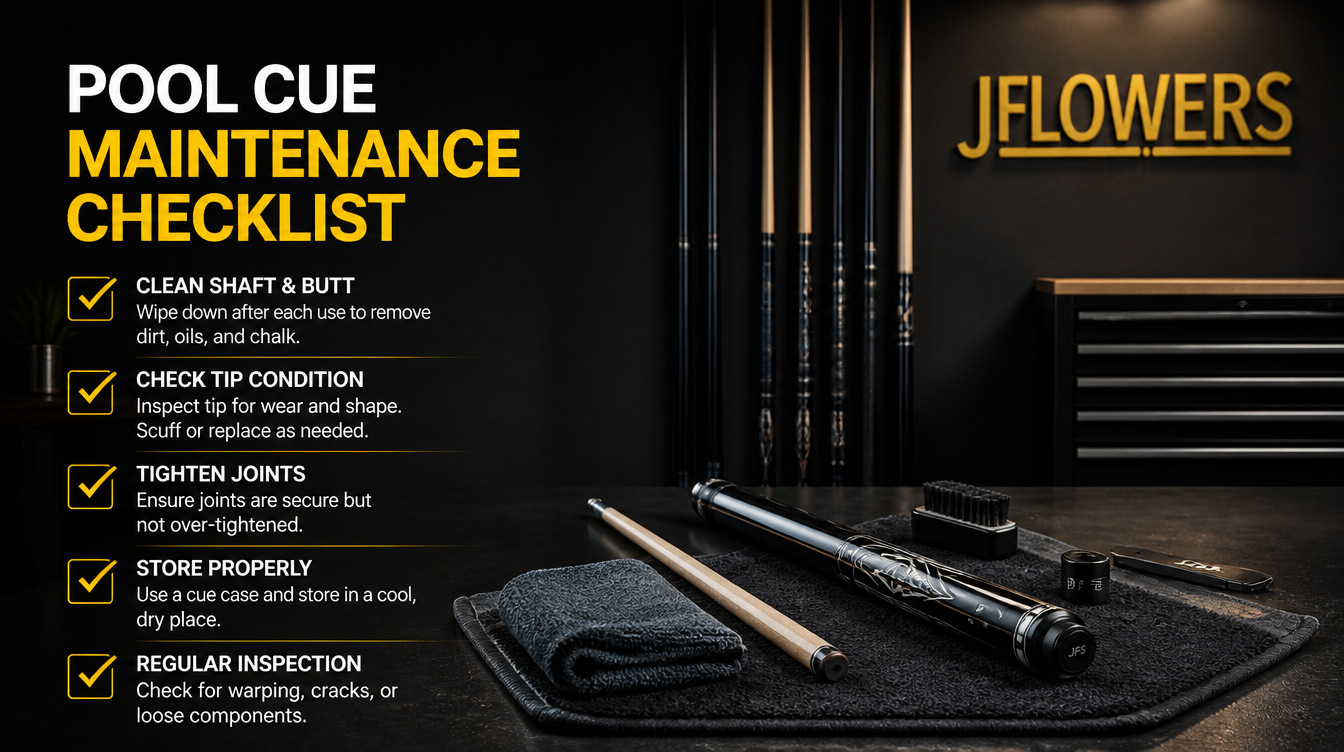
Most pool players either over-maintain their cues (applying products that aren't needed and sometimes cause problems) or under-maintain them (doing nothing until something obviously breaks). The right maintenance routine is somewhere in the middle — simple, consistent, and organized by how often each task actually needs to happen.
Listen to this article
Everything you need to do — organized by frequency — to keep your cue in top
condition
This checklist gives you exactly that: a clear, actionable schedule for every maintenance task your cue needs. Print it, bookmark it, or just read it once and build the habits. Either way, following it means your cue stays in top condition without unnecessary effort.
After Every Session
Wipe Down the Shaft Maple shaft: wipe with a clean, dry cloth from joint to ferrule. This removes surface chalk and skin oil before it builds up. For heavier residue, use a barely damp cloth followed by a dry one. Carbon fiber shaft: same process — dry wipe, damp wipe if needed. Carbon fiber is much less prone to buildup, so a quick dry wipe is usually all that’s required.
Wipe Down the Butt A quick wipe of the butt — including the wrap area — removes chalk and sweat that accumulates during play. For linen wraps, a dry cloth or gentle brush. For leather wraps, a dry cloth. For wrapless butts, a barely damp cloth works well.
Check and Chalk the Tip Before putting the cue away, glance at the tip. Is the dome still round? Does the surface look properly chalked and textured? If the tip is starting to flatten, give it a quick reshape with a tip tool. This two second check extends tip life significantly.
Case the Cue Always. No exceptions. A cue left out of its case overnight is a cue exposed to whatever humidity, temperature, and physical risks the room holds.
Tip Shape Check A proper dome check takes five seconds. Hold the tip up to the light and compare the dome curvature to a nickel. If it’s flattening, reshape with a tip shaper. A well-shaped tip performs better and chalks more evenly.
Light Tip Scuffing A few light passes with a tip pick every week maintains the surface texture that helps chalk adhere. Don’t overdo it — light scuffing, not aggressive digging. The goal is maintaining micro-texture, not removing significant material.
Chalk Check If you use a specific chalk brand (Kamui, Taom, Master), check your supply. Running out of chalk mid-session is an annoying and avoidable problem. Keep a backup piece in your case.
Monthly
Deep Shaft Clean (Maple) Once a month, give a maple shaft a proper cleaning beyond the after-session wipe. Apply shaft cleaner or lightly dampened cloth, wipe thoroughly, dry completely, then burnish with a smooth cloth or leather pad. This restores the shaft surface and keeps the feel smooth.
Joint Cleaning Use a dry soft brush (clean toothbrush) or compressed air to clear chalk dust and debris from the joint threads on both shaft and butt. Never use water or lubricants. Clean, dry threads assemble smoothly and resist wear.
Full Visual Inspection Look over the entire cue: check the shaft for any signs of warp (roll it on a flat surface), inspect the ferrule for cracks or loosening, check the joint area for wear, look at the butt for any damage to inlays or finish, and check the wrap condition.
Tip Height Check Measure or estimate remaining tip height. If it’s at 6-7mm or below, plan for a replacement soon. Better to replace proactively than to have the tip fail during a session or competition.
Tip Replacement Soft tips: every 2-4 months for regular players. Medium tips: every 4-8 months. Hard tips: every 8-14 months. These are baseline estimates — adjust based on how your tip is actually performing. Don’t wait for failure; replace proactively.
When replacing, choose a quality layered tip (Kamui, Taom, Tiger Everest) rather than a generic stock tip. Have it installed by a cue technician or a player experienced in tip work.
Annually or As Needed
Shaft Conditioning (Maple Only) Some players apply a very light coat of cue wax or shaft conditioner to their maple shaft once a year to help maintain the surface seal. Apply sparingly — a little goes a long way. Buff off any excess. This is optional but beneficial for players who do it consistently.
Leather Wrap Conditioning If your cue has a leather wrap, condition it with a quality leather conditioner once a year or when it starts to feel dry. Apply sparingly, work in gently, wipe off excess. Well-conditioned leather resists chalk and sweat better.
Full Warp Check (Maple) Roll the shaft on a flat surface at least once a year — or any time you suspect something is off with your shot consistency. Catching a very slight warp early gives you more options than discovering a significant warp later.
Case Inspection Check your case for any damage — broken zippers, torn interior padding, damaged latches. A case that can’t close properly or doesn’t secure the cue correctly isn’t doing its job. Replace if significantly damaged.
The Carbon Fiber Simplified Checklist
If you play on carbon fiber, your maintenance checklist is significantly shorter:
After every session: dry wipe the shaft, wipe the butt, check the tip, case the cue
Weekly: tip shape check and light scuffing
Monthly: joint cleaning, ferrule inspection, tip height check
Per tip schedule: tip replacement (same schedule as any other cue)
The shaft itself on a carbon fiber cue needs almost no maintenance. The tip and joint are the areas that need attention — and they’re the same on any cue.
Emergency Maintenance Kit: What to Carry in Your Case
Every serious player should have a basic maintenance kit in their case at all times:
2-3 pieces of your preferred chalk — don’t run out mid-session
Tip pick/scuffer — for quick tip maintenance between sessions
Tip shaper — to restore the dome when needed
One replacement tip — for a field repair emergency
Small amount of tip glue — if you can install tips yourself
Clean microfiber cloth — for wiping the shaft between racks
This kit takes up almost no space in a case pocket and covers the most likely equipment emergencies you’ll face during play.
Frequently Asked Questions
How long does a full maintenance session take? The after-session routine takes under a minute. Monthly maintenance — deep clean, joint brush, inspection — takes 10-15 minutes. That’s it for the whole month. This is a trivially small time investment relative to what it protects.
Can I skip the after-session wipe if I’m tired? The wipe takes 20 seconds. Do it every time. The cumulative effect of consistent wipe-downs versus irregular ones is significant over months of play.
What’s the most important single maintenance habit? Always case the cue. Second most important: wipe the shaft after every session. Those two habits alone prevent the majority of cue damage and degradation that players deal with.
Do I need all the products listed in the checklist? Not all at once. A cloth, a tip pick, a tip shaper, and your chalk are the essentials. Shaft cleaner and conditioner are useful additions. The full product list represents the complete toolkit, not the minimum required.
Final Thoughts
Pool cue maintenance isn’t complicated and doesn’t take much time. The checklist above covers everything. Build the after-session habit first — wipe, check tip, case the cue. Add monthly maintenance once the after-session routine is automatic. Your cue will thank you with consistent performance and a significantly longer useful life.
After comparing JFlowers to Predator, Mezz, McDermott, Meucci, Jacoby, Pechauer, and a dozen more brands across every price point and construction philosophy — the question that started all of it deserves a direct answer: which pool cue brand actually offers the best value for serious competitive players in
2026?
Players Technology is one of the most widely used cue brands in American pool halls. Their two-piece cues at $40-$150 have introduced millions of American players to personal cue ownership. Nearly every serious pool player in America either started on a Players cue or played against someone who did. Comparing Players to JFlowers isn’t really a direct competition — it’s a marker on the journey from beginner to serious competitor.