Most pool players replace their cue tip too late. The tip has been quietly degrading for weeks, introducing inconsistencies into their game that they've been blaming on their stroke, the table, the cloth, or their concentration. Then they finally replace the tip and wonder why they didn't do it sooner.
Listen to this article
How to know when your tip is done — before it starts costing you shots
This guide gives you the clear signs to look for — visual, tactile, and performance-based — so you know exactly when it’s time to replace, and so you never let a dead tip cost you a match.
Why Tip Condition Matters So Much
The tip is the only part of your cue that contacts the cue ball. Every bit of spin, every speed decision, every piece of english goes through that small piece of leather. When the tip degrades — when it flattens, hardens, glazes, or wears down — the effects show up in your game in ways that are easy to misattribute.
A player with a dead tip will struggle with inconsistent english, unexpected miscues, and shots that require more chalk than normal. None of those problems go away with practice — they go away with a tip replacement. Which is why being able to recognize the signs early is genuinely valuable.
A properly shaped tip has a dome — a rounded surface that contacts the cue ball across a curved surface rather than a flat one. This dome shape is what allows the tip to grip the cue ball effectively across the full range of contact positions.
When a tip flattens — from use, from miscues, or from not being maintained — the contact changes from a controlled dome to a flat surface that contacts the cue ball across a wider, less controlled patch. This reduces spin transfer, increases miscue risk especially on off-center hits, and changes the feel of the contact.
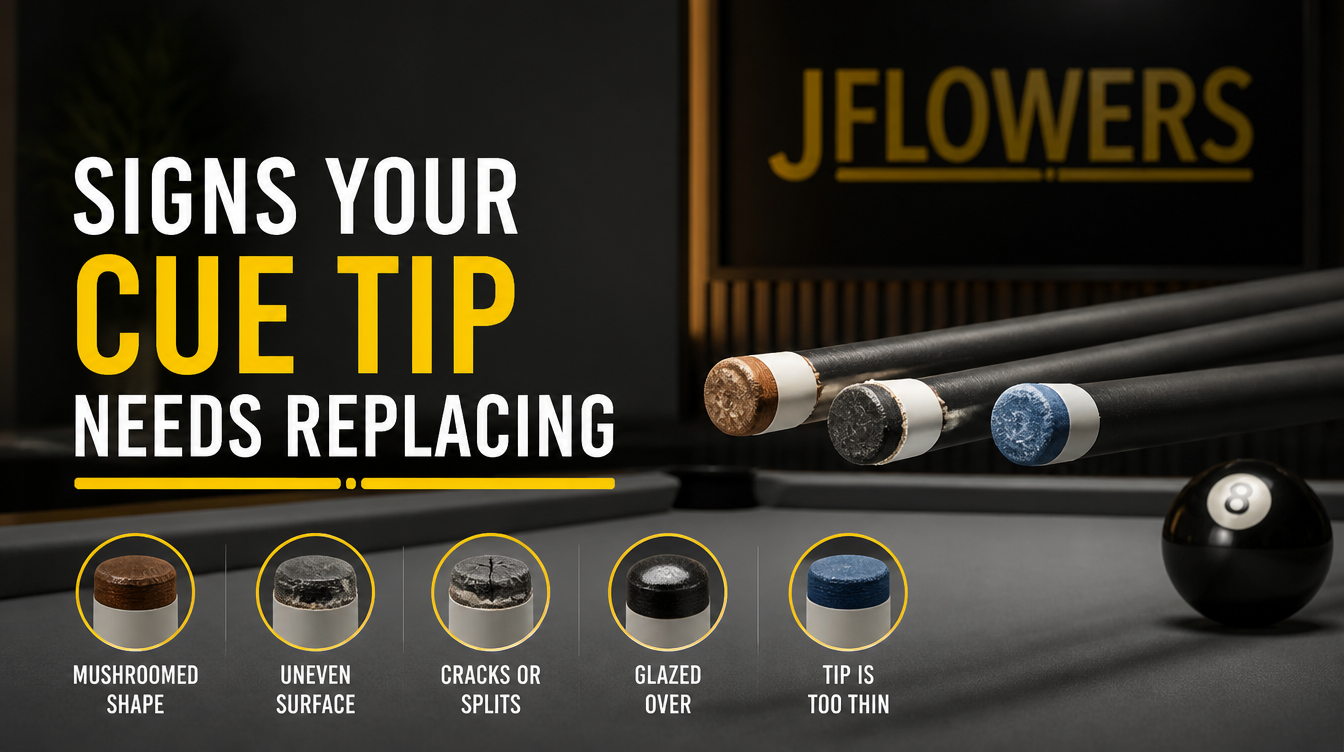
Check your tip by looking at it from the side. A properly shaped tip should be domed to roughly the curvature of a nickel coin. If it’s flat, it needs reshaping at minimum. If it’s worn too thin to reshape, it needs replacing.
Quick test: Set a nickel on top of the tip. The curved edge of the coin should roughly match the dome of the tip. If the tip is noticeably flatter than the nickel’s curve, reshape it. If it’s completely flat, replace it.
Sign 2: Consistent Miscues Despite Fresh Chalk
Occasional miscues happen to everyone — you were a hair off-center, you didn’t chalk well enough, you rushed the shot. That’s normal. What’s not normal is miscuing consistently despite proper chalk application.
When a tip glazes over — develops a smooth, hard, compressed surface from use — it stops holding chalk effectively. The tip surface becomes almost slick, chalk doesn’t adhere the way it should, and the result is miscues that happen even when you think you’ve chalked properly.
If you’re miscuing more than once or twice per session despite consistent chalk habits, check the tip surface. A glazed tip looks smooth and somewhat shiny compared to a properly textured tip. Scuffing with a tip pick can restore the surface — but if the tip is glazed badly or very worn, replacement is the right call.
Tips start at roughly 10-13mm in height (depending on brand and type) and wear down with use. When a tip has worn to approximately 6-7mm or less, it’s nearing the end of its useful life — even if it still seems to be performing adequately.
A very thin tip has less material to shape properly, is more prone to mushrooming, and doesn’t provide the contact geometry that a full-height tip does. More practically: a thin tip means a new tip is going to need to go on soon anyway, and doing it now — when you’re not in the middle of competition — is better than being forced to do it urgently.
Measure tip height by looking at the tip from the side. If it looks significantly shorter than a new tip on a comparable cue, it’s probably due.
Sign 4: The Tip Is Mushrooming
Mushrooming happens when the edges of the tip expand and curl over the sides of the ferrule — the tip gets wider than the ferrule diameter, hanging over the edge like a mushroom cap. This happens faster with softer tips and with tips that aren’t being regularly shaped.
A mushroomed tip has several problems: the overhanging edges don’t contribute to contact with the cue ball, they can catch on the cue ball on off-center shots and cause unexpected cue ball behavior, and they indicate the tip has been compressed and deformed beyond its designed shape.
Minor mushrooming can be addressed by trimming the tip edge back to the ferrule with a tip tool. Severe mushrooming — where the tip is significantly wider than the ferrule and very thin — indicates a replacement is needed.
Sign 5: Your English Has Become Inconsistent
This is the most insidious sign because it’s the easiest to misattribute. When your english shots — draw, follow, side spin — become less consistent or require noticeably more effort than they used to, your tip is often the culprit.
A worn or glazed tip grips the cue ball less effectively. You apply what should be a standard amount of english and the cue ball doesn’t respond the way it used to. You chalk more. You apply more spin. Nothing quite works the way it did a few months ago. Sound familiar?
If your game has degraded in ways you can’t explain through technique changes, check the tip condition before concluding the problem is your stroke. A fresh tip often solves performance issues that players have been struggling with for weeks.
Tips compress and harden with use over time. A medium tip that performed with good grip and feel when new gradually becomes stiffer and less responsive. At some point it feels more like a hard tip than the medium you started with — less spin transfer, less feedback, more direct and unresponsive contact.
This hardening process is normal and inevitable. It’s one of the reasons why proactive tip replacement — on a schedule — is smarter than waiting for obvious failure. The tip has been degrading for a while before it reaches “obviously needs replacing” territory.
The Proactive Approach: Replace on a Schedule
The smartest tip maintenance approach is replacing on a schedule rather than waiting for failure signals:
Soft tips: every 2-4 months for regular players (2-3 sessions per week)
Medium tips: every 4-8 months for comparable use
Hard tips: every 8-14 months for comparable use
Know your last replacement date. Set a reminder. Replace proactively before the tip starts costing you shots, not after. Competition players especially should replace tips on a schedule — don’t let a worn tip be the reason you lose a match you should have won.
Can a tip be saved or does it always need replacing? Minor flattening: reshape with a tip tool. Glazed surface: scuff with a tip pick. These interventions extend tip life. But a tip that’s very thin, badly mushroomed, or consistently miscuing despite maintenance needs replacing — those problems can’t be fixed by reshaping.
How do I know if it’s my tip or my technique causing miscues? Check the tip first — it’s the most common cause of unexpected miscues. Look for glazing (shiny surface), flattening, and inadequate chalk adhesion. If the tip looks healthy and is properly chalked, then technique is the more likely issue.
Should I replace my tip before a tournament? If it’s been 6+ months or you’re seeing any of the signs above, yes — replace it well before the tournament, not the night before. You want to play with a fresh tip you’ve had a few sessions to get used to, not a brand-new one in your first competitive match.
How much does tip replacement cost? A cue technician typically charges $10-25 for labor plus the cost of the tip ($5-40 depending on brand). Total: $20-60 for a professional installation with a quality tip. Well worth it given the performance impact.
Can I replace a tip myself? With the right tools, yes. Tip replacement is a learnable skill. A tip clamp, razor blade, and sandpaper are the basics. For your first several replacements, watch an experienced player or cue technician do it first — improper installation creates its own problems.
Final Thoughts
Your cue tip works hard every session. It’s the consumable in your setup — the component that wears out so the shaft doesn’t have to. Paying attention to tip condition and replacing proactively on a schedule keeps your game consistent and removes a variable that quietly degrades performance for weeks before most players notice.
When in doubt: if you’re asking whether your tip needs replacing, it probably does.
After comparing JFlowers to Predator, Mezz, McDermott, Meucci, Jacoby, Pechauer, and a dozen more brands across every price point and construction philosophy — the question that started all of it deserves a direct answer: which pool cue brand actually offers the best value for serious competitive players in
2026?
Players Technology is one of the most widely used cue brands in American pool halls. Their two-piece cues at $40-$150 have introduced millions of American players to personal cue ownership. Nearly every serious pool player in America either started on a Players cue or played against someone who did. Comparing Players to JFlowers isn’t really a direct competition — it’s a marker on the journey from beginner to serious competitor.