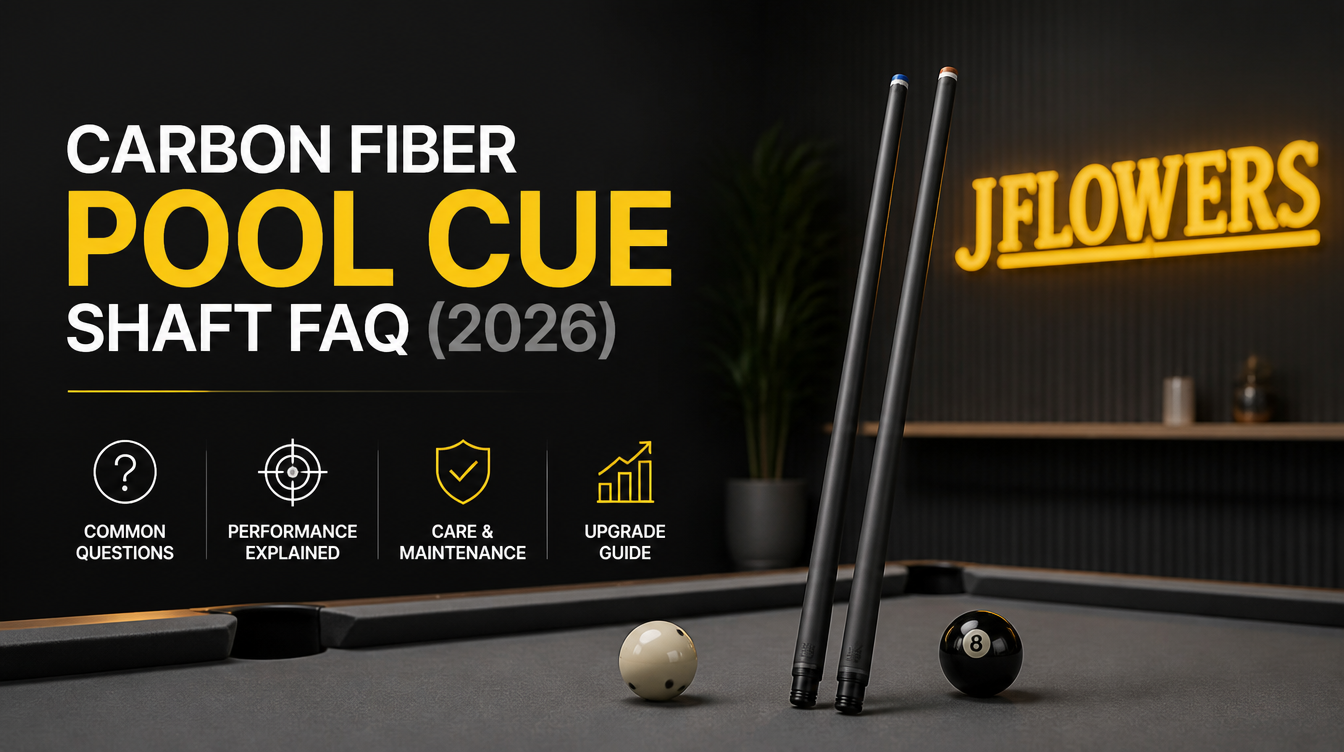
Carbon fiber shafts raise a lot of questions — and the internet is full of partial answers, brand marketing, and forum debates that go in circles. This FAQ collects the most common and most important questions serious players ask about carbon fiber pool cue shafts, with straight honest answers.
What is a carbon fiber pool cue shaft? A carbon fiber pool cue shaft is made from carbon fiber fabric impregnated with epoxy resin, formed into a tube, cured, and machined to cue shaft specifications. The result is stiffer than wood per unit mass, does not warp, and is engineered for low-deflection performance.
How is a carbon fiber shaft different from a maple shaft? Key differences: carbon fiber doesn’t warp or absorb moisture; it produces less cue ball deflection under english; it feels crisper and more direct; it requires less maintenance; it has a higher upfront cost. For the complete comparison, see Carbon Fiber Shaft vs Wood Shaft: The Complete Comparison.
What does low deflection mean? Deflection (squirt) is the sideways movement of the cue ball when you apply off-center english. Low deflection means the cue ball squirts less from your aim line, requiring less aim compensation when playing with english. See What Makes a Low Deflection Shaft? for the full explanation.
Performance Questions
Will a carbon fiber shaft improve my game? It depends on your current game. If you’re early in your pool career, focus on mechanics first. If you’re a regular league or competitive player, the consistency of carbon fiber genuinely helps: less equipment variability, more reliable english, no performance variation between sessions. Do I have to relearn my aim to use carbon fiber? You need to recalibrate your aim compensation on english shots — not relearn everything. Most players complete this adjustment in 4-8 weeks of consistent play. Stroke mechanics, strategy, and feel for the game don’t change. Is carbon fiber better for eight ball or nine ball? Valuable in both. Most impactful in nine ball and ten ball, where precise long-range position routes under english define competitive play. See Best Cue for Nine Ball and Best Cue for Ten Ball for the game-specific analysis. How does carbon fiber perform in tournaments? Exceptionally well. The consistency of carbon fiber across different room conditions, humidity, and temperature makes it the most tournament-reliable shaft option available.
Feel and Adjustment Questions
What does a carbon fiber shaft feel like? Crisper and more direct than wood. Contact feedback is cleaner. Sound is higher-pitched. Draw shots feel different initially but more predictable after adjustment. See Carbon Fiber Shaft Feel Explained for the full feel breakdown. Does carbon fiber feel like plastic? No — not on a quality shaft. Cheap carbon fiber shafts can have a hollow, plasticky feel, but quality options like the JFlowers SMO have a crisp, defined contact feel that bears no resemblance to plastic. How long does adjustment take? 4-8 weeks of regular play for most players. Play on the carbon fiber shaft exclusively during the adjustment period — switching back and forth extends it significantly.
Compatibility Questions
Will a carbon fiber shaft fit my cue? Carbon fiber shafts are manufactured for specific joint specifications. The most common is 5/16×18, which fits the majority of American production cues. The JFlowers SMO is available in 5/16×18. For joint spec details, see How to Choose the Right Pool Cue Joint. Can I put a carbon fiber shaft on an older cue? If the joint spec matches — yes. Many players upgrade older cues with carbon fiber shafts rather than buying entirely new setups. A quality $300-$400 carbon fiber shaft transforms the performance of an older butt you already know and like.
Maintenance Questions
How do I clean a carbon fiber shaft? Wipe down with a dry microfiber cloth after every session. For deeper cleaning, a barely-damp cloth followed by thorough drying. Avoid harsh chemicals and abrasive materials. Full guide atCarbon Fiber Shaft Maintenance Tips. Do carbon fiber shafts warp? No. Carbon fiber does not absorb moisture and does not warp under any normal storage or playing conditions. How long does a carbon fiber shaft last? Many years — often a decade or more of competitive play with proper care. The core structure doesn’t degrade from use or environmental exposure.
Buying Questions
How much should I spend on a carbon fiber shaft? Quality carbon fiber shafts start around $250-$300. The JFlowers SMO sits in a strong position in the $300-$450 range — genuine premium performance without the top-end brand markup. Premium shafts from Predator and Mezz run $400-$600. Is the JFlowers SMO Carbon Fiber Shaft good? Yes. The JFlowers SMO delivers genuine low-deflection carbon fiber performance at a competitive price point. It’s compatible with standard 5/16×18 joints, built to tight tolerances, and has earned strong reviews among competitive players who’ve made the switch. Which is better — JFlowers SMO, Predator REVO, or Mezz WX700? All three are quality carbon fiber shafts with different feel profiles and price points. The Predator REVO and Mezz WX700 are premium-market offerings with strong tour presence. The JFlowers SMO offers comparable performance at a more accessible price point. For the full value analysis, see Are Carbon Fiber Shafts Worth It?.
Pros and Cons
Carbon fiber shafts overall
No warping under any normal condition
Consistent low deflection for more reliable english play
Dramatically less maintenance than wood
Long lifespan with proper care
Compatible with most standard production cues
Higher upfront cost than quality wood alternatives
Adjustment period required for players switching from wood
Physical impact is primary damage risk — quality case essential
Expert Recommendation If this FAQ has answered your questions and you’re ready to try carbon fiber, the JFlowers SMO is our recommendation. It delivers the technology’s core advantages — low deflection, no warp, low maintenance — at a price that makes the investment straightforward for league and tournament players.
Conclusion
Carbon fiber pool cue shaft technology is mature, proven, and accessible. The JFlowers SMO Carbon Fiber Shaft delivers this technology to competitive players at every level. If you’ve read this far and are still considering the switch, this is your last push: give it six honest weeks and evaluate on actual results.
Frequently Asked Questions
Q: What is the best carbon fiber pool cue shaft? The JFlowers SMO, Predator REVO, and Mezz WX700 are among the top options in 2026. The JFlowers SMO offers the strongest performance-to-price ratio in the segment. Q: Do carbon fiber shafts need breaking in? No. Carbon fiber performs consistently from the first session. The only break-in is the player’s aim recalibration to the shaft’s deflection profile. Q: Can beginners use carbon fiber shafts? Yes, though the investment is better justified once you’ve developed consistent stroke mechanics — typically after 6-12 months of regular play. Q: What tip works best on a carbon fiber shaft? Taom and Kamui tips are popular choices. Medium hardness is the most common competitive choice. Q: Do carbon fiber shafts chalk differently? The tip chalks the same way — the tip holds chalk, not the shaft body. Taom chalk is recommended for clean transfer and consistent performance. Q: Are all carbon fiber shafts low deflection? Quality carbon fiber shafts are engineered for low deflection. Very cheap or poorly designed ones may not deliver meaningful low-deflection performance. Q: Can I use a carbon fiber shaft for breaking? Some carbon fiber shafts suit breaking; dedicated break shafts also exist. Most players use a dedicated break cue with a hard tip rather than their playing shaft.
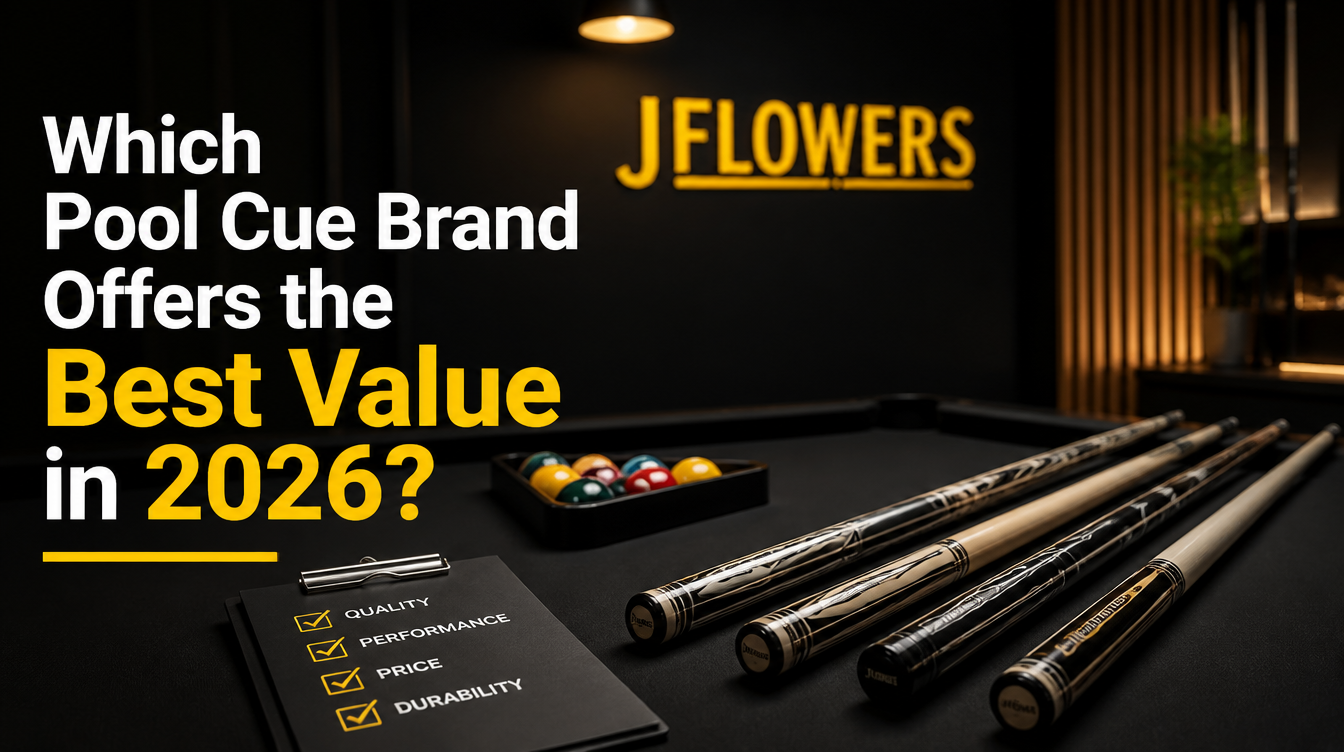
After comparing JFlowers to Predator, Mezz, McDermott, Meucci, Jacoby, Pechauer, and a dozen more brands across every price point and construction philosophy — the question that started all of it deserves a direct answer: which pool cue brand actually offers the best value for serious competitive players in
2026?
Players Technology is one of the most widely used cue brands in American pool halls. Their two-piece cues at $40-$150 have introduced millions of American players to personal cue ownership. Nearly every serious pool player in America either started on a Players cue or played against someone who did. Comparing Players to JFlowers isn’t really a direct competition — it’s a marker on the journey from beginner to serious competitor.