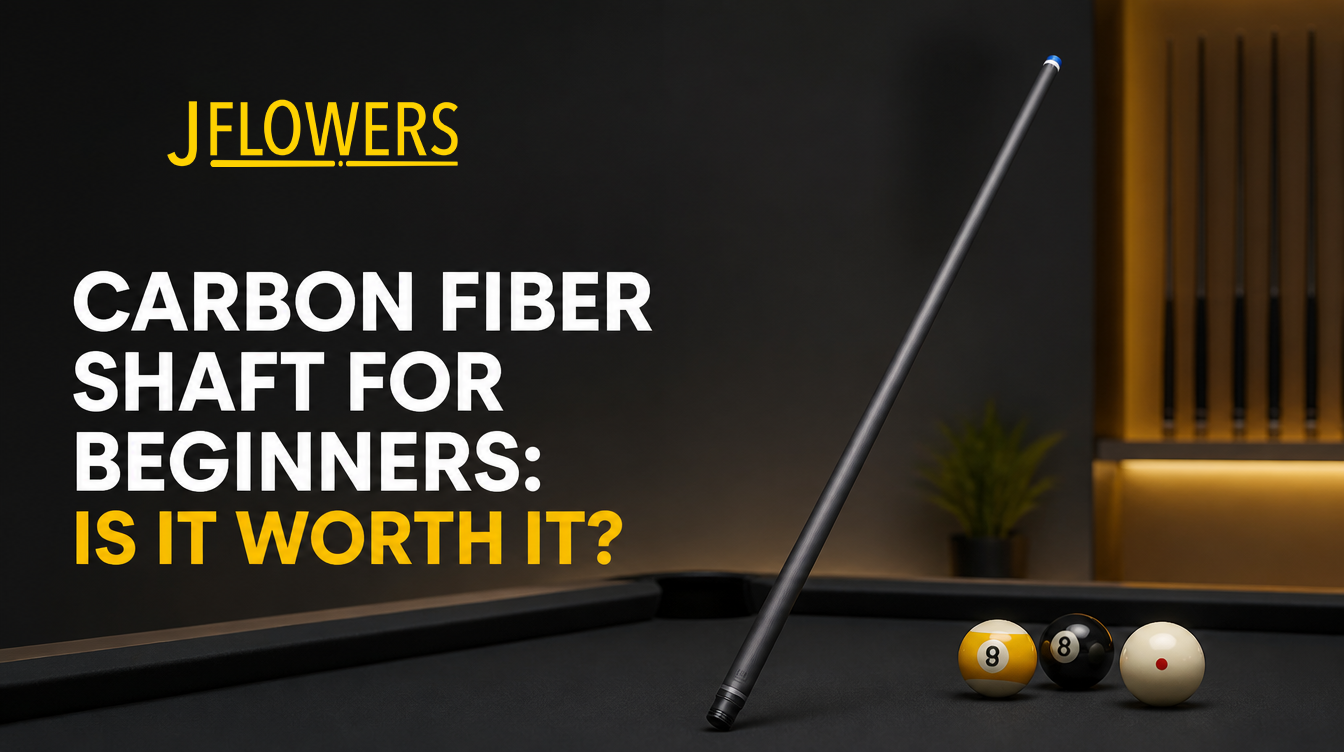
If you've just started playing pool and you're already reading about carbon fiber shafts, you're either a serious person or you went down a YouTube rabbit hole. Either way, the question deserves a direct
answer: should beginners use a carbon fiber pool cue shaft?
Listen to this article
The short answer is: probably not immediately, but sooner than you might think. This guide explains the reasoning, the timing, and how to approach carbon fiber as a beginner so you get the benefits without the frustration.
The Case Against Carbon Fiber Immediately
Carbon fiber shafts require an aim recalibration period. The lower deflection profile of carbon fiber means that the aim compensation you’ve learned — or are currently learning — for wood shafts needs to be adjusted. For a beginner who is still learning fundamental stroke mechanics, this creates two simultaneous learning challenges: building a consistent stroke AND calibrating for a different deflection profile.
Experienced instructors and coaches generally recommend that beginners develop their stroke mechanics on one shaft type before switching. Not because carbon fiber is harder — but because changing equipment variables while you’re still learning fundamentals creates confusion about whether a missed shot was caused by poor mechanics or by aim miscalibration.
There is no universally correct timeline, but a few practical signals indicate you’re ready:
You’ve been playing regularly for 6-12 months and have a developing consistent stroke
Your fundamentals — stance, bridge, backswing, follow-through — are repeatable
You’ve begun playing english intentionally rather than accidentally
You’re noticing inconsistency in your english shots and wondering about deflection
That last signal is particularly important. When you start noticing that your cue ball goes somewhere unexpected on english shots and you begin wondering why — that’s when understanding deflection and experiencing carbon fiber’s lower deflection becomes genuinely educational rather than confusing.
The Specific Beginner Advantage of Carbon Fiber
Here’s the case in favor of beginning players using carbon fiber: you’ve never calibrated for a high-deflection shaft yet. Players who’ve been on maple for years have deeply ingrained aim compensation that has to be unlearned. Beginning players building their aim calibration from scratch have the option of calibrating for low-deflection from the start.
Some instructors actually recommend that serious beginners who are committed to the game make the switch to carbon fiber early — before they’ve spent years ingraining maple aim compensation — specifically because it’s easier to build low-deflection aim from scratch than to tear down and rebuild existing calibration.
Carbon fiber shafts cost $250-$500 for quality options. For a beginner player, that’s a significant investment before you’ve established that you’re committed to the game long-term. A quality wood shaft in the $150-$250 range is a reasonable starting point.
The upgrade path that makes sense for beginners: start with a quality production cue in the $200-$300 range. Play on it for 6-12 months. When you’re committed to the game, you notice your english is developing, and you want to invest in equipment that you’ll play on for years — that’s when the JFlowers SMO Carbon Fiber Shaft becomes the right upgrade. For the full budget breakdown, see How Much Should You Spend on a Pool Cue?.
If a Beginner Does Start on Carbon Fiber
If you do start on a carbon fiber shaft — either because an instructor recommended it or because you bought into the game fully from the start — here’s how to approach it:
Stay on the carbon fiber shaft exclusively — no switching back and forth to comparison shop
Play straight shots first and build confidence before focusing on english
When you start practicing english shots, do so deliberately and notice where the cue ball lands relative to where you aimed
Be patient — calibration takes time even when you’re building from scratch
The JFlowers SMO is a good beginning carbon fiber shaft precisely because its deflection profile is well-designed and consistent. There’s no learning curve in the shaft behavior itself — only in your adaptation to it.
Pros and Cons
Beginners starting on carbon fiber
No old maple calibration to unlearn — build low-deflection aim from scratch
Long-term investment in equipment you won’t outgrow
Consistency and no-warp advantages apply from day one
Two simultaneous learning challenges: mechanics AND aim calibration
Higher cost than entry-level wood options
Investment harder to justify before confirming long-term commitment to the game
Beginners starting on wood and upgrading later
Lower entry cost to confirm commitment before investing Focus entirely on mechanics without deflection variable Will need to unlearn maple aim calibration when eventually switching Developing on higher-deflection equipment may ingrain compensation habits
Expert Recommendation For a beginner: start with a quality production cue in the $200-$300 range and play on it for 6-12 months. Once you’re committed, developing english intentionally, and ready for a long-term equipment investment — that’s when the JFlowers SMO Carbon Fiber Shaft makes sense. You’ll be ready to calibrate for it properly, and the investment will serve you for years.
Conclusion
Carbon fiber is not the right first purchase for most beginners — but it’s often the right second purchase. Develop your mechanics, commit to the game, and when you’re ready to invest in long-term equipment, the JFlowers SMO Carbon Fiber Shaft gives you a tool that grows with your game rather than limiting it. The players who make the switch and commit to it don’t regret it.
Frequently Asked Questions
Q: Should beginners use carbon fiber pool cue shafts? Not immediately, unless you’re very committed to the game from day one. Most coaches recommend developing basic mechanics first, then upgrading to carbon fiber once you’re ready to work on english intentionally. Q: When is a beginner ready for carbon fiber? After 6-12 months of regular play when fundamentals are developing and you’re beginning to work on english shots intentionally. Q: Is it easier to learn pool on carbon fiber or maple? Maple for fundamental mechanics. Carbon fiber if you want to build low-deflection aim calibration from scratch without unlearning maple habits. Q: What shaft should a beginner use? A quality production shaft in the $150-$250 range to start. The JFlowers playing cue’s stock shaft is a solid option. Upgrade to the JFlowers SMO when you’re ready. Q: Do beginners need a carbon fiber shaft? Not immediately, but it’s a worthwhile upgrade once you’ve been playing 6-12 months and are serious about developing your game. Q: Is the JFlowers SMO good for beginners? Yes, for beginners who are committed to the game and have developed basic mechanics. Its consistency and clear deflection profile are actually helpful for beginners building aim calibration from scratch. Q: How long does it take a beginner to adjust to carbon fiber? Typically 4-8 weeks of regular play, similar to experienced players. The adjustment may actually be faster for true beginners who haven’t developed deep maple calibration habits.
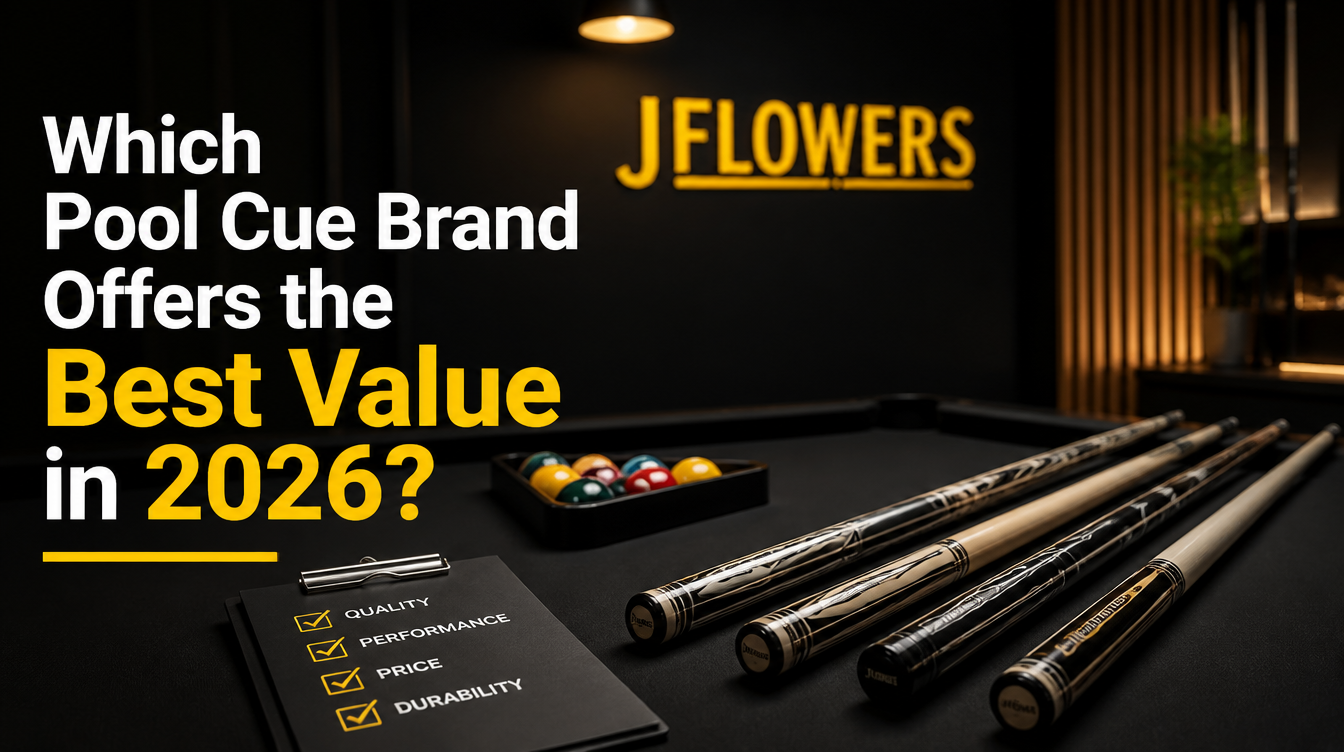
After comparing JFlowers to Predator, Mezz, McDermott, Meucci, Jacoby, Pechauer, and a dozen more brands across every price point and construction philosophy — the question that started all of it deserves a direct answer: which pool cue brand actually offers the best value for serious competitive players in
2026?
Players Technology is one of the most widely used cue brands in American pool halls. Their two-piece cues at $40-$150 have introduced millions of American players to personal cue ownership. Nearly every serious pool player in America either started on a Players cue or played against someone who did. Comparing Players to JFlowers isn’t really a direct competition — it’s a marker on the journey from beginner to serious competitor.