Deflection is one of those pool concepts that every player encounters early and most players never fully understand. You apply right english and the cue ball goes somewhere unexpected. You compensate a little. You compensate too much. Your english shots stay inconsistent for years — sometimes for an entire playing career — because nobody ever properly explained what's actually happening.
Listen to this article
What it is, why it happens, and how to manage it in your game
This guide fixes that. We’re going to cover what cue ball deflection is, what causes it at a physical level, how your shaft affects it, how you compensate for it correctly, and what modern equipment does to reduce the problem. By the end you’ll have a clear mental model of deflection that you can actually use at the table.
What Is Cue Ball Deflection?
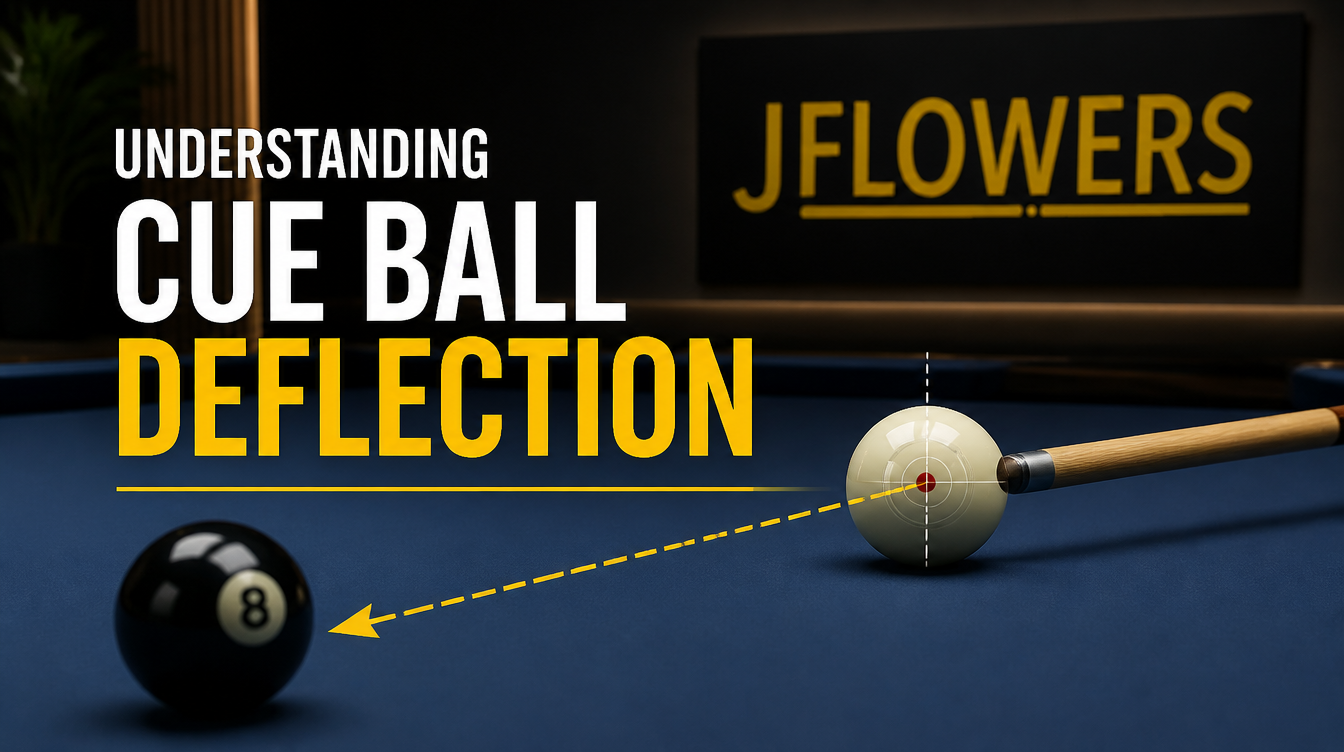
Cue ball deflection — also called squirt — is the sideways deviation of the cue ball from your aim line when you strike it off-center. When you apply side spin by hitting the cue ball to the left or right of center, the ball doesn’t travel in a straight line from the contact point. It pushes sideways, in the direction opposite to the spin applied.
Here’s the simplest way to visualize it: imagine you’re shooting a straight shot to the corner pocket. If you hit the cue ball dead center, it rolls straight to your aim point. Now apply right-hand english by hitting slightly right of center. The cue ball pushes slightly left — away from your right-side contact point. That leftward deviation from your aim line is deflection.
The amount of deviation varies based on how far off-center you strike, how much english you apply, and most importantly — the characteristics of your shaft.
Key point: Deflection is not a mistake. It’s a predictable physical phenomenon. Once you understand it, you can account for it consistently rather than guessing.
The Physics Behind It
At the moment of contact between the cue tip and the cue ball, two things happen simultaneously. First, the tip pushes the cue ball forward — that’s the primary direction of the shot. Second, because the contact is off-center, the tip pushes the cue ball sideways relative to the stroke direction.
The sideways push comes from the mass of the shaft near the tip. When the tip contacts the ball off-center, the tip and the forward portion of the shaft create a lateral force on the cue ball — pushing it to the side. The heavier that portion of the shaft, the more lateral force is created, and the more deflection results.
This is why shaft design has such a significant effect on deflection. It’s not about the total weight of the cue — it’s about how much mass exists in the tip section of the shaft at the moment of contact.
Deflection vs. Swerve vs. Squirt: Clarifying the Terms
These three terms get used interchangeably in pool conversations, but they technically describe different things. Understanding the distinction matters for diagnosing what’s happening in your game.
Deflection (Squirt) Deflection and squirt refer to the same thing — the immediate sideways push on the cue ball at the moment of contact. It happens instantly at impact, before the cue ball even starts rolling. The cue ball’s initial path off the contact point is already deviated from your aim line. This is the phenomenon that shaft design directly addresses.
Swerve Swerve is a different phenomenon — the curved path the cue ball travels after contact when side spin and cue elevation are combined. When you elevate the cue and apply side spin, the ball initially curves in one direction (due to cue elevation) and then curves back (as the spin takes effect). This is swerve, and it’s more influenced by cue elevation and shot technique than by shaft design.
Both deflection and swerve cause the cue ball to deviate from a straight line, which is why they get confused. But they have different causes and different remedies. A low deflection shaft reduces squirt — it doesn’t eliminate swerve, which comes from technique and cue angle.
How Much Does Deflection Actually Affect Your Game?
The honest answer: it depends on how much english you use and how consistently you apply it. If you’re a new player who rarely uses side spin and mostly hits center-ball, deflection has almost no effect on your game. You might not even notice it for months.
If you’re an intermediate or advanced player who uses english regularly for position play — running patterns that require spin to control where the cue ball ends up — deflection is affecting nearly every shot you play. The inconsistency you feel on english shots, the shots that seem to miss in the same direction every time, the english shots that work at close range but not on long tables — deflection is often a root cause of all of these.
At the competitive level, where players are applying precise english across long distances to achieve specific cue ball positions, deflection management is one of the fundamental technical skills that separates consistent players from inconsistent ones.
How Players Compensate for Deflection
Because deflection is predictable for a given shaft, it can be compensated for through aim adjustment. This is what experienced players do — often without being consciously aware of it.
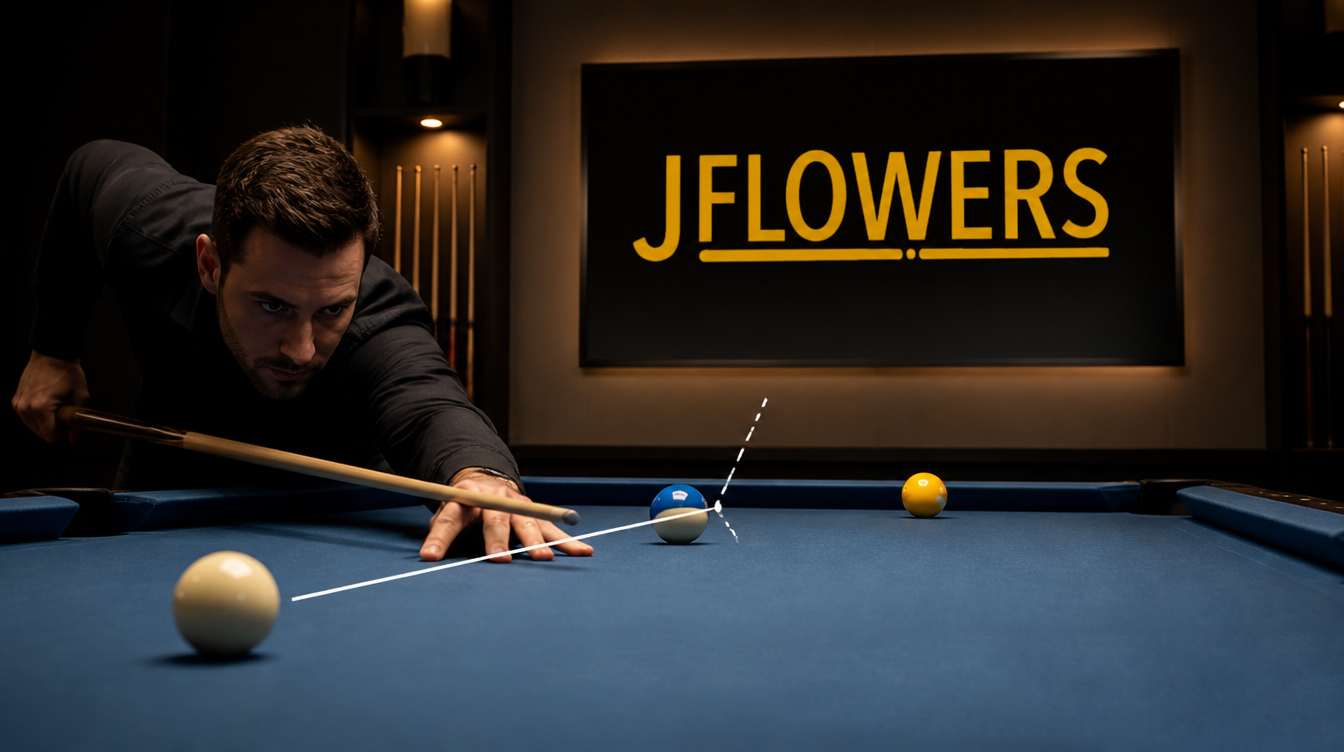
When you apply right english and know the cue ball will push slightly left, you aim slightly right of your intended contact point. The amount you compensate is calibrated to your specific shaft’s deflection characteristics and the amount of english you’re applying.
This compensation becomes muscle memory over time. It’s one of the things that makes switching shafts — especially from a high-deflection standard shaft to a low-deflection shaft — temporarily disorienting. Your trained compensation is wrong for the new shaft, so shots that used to go in start missing until you recalibrate.
The Problem With Manual Compensation Manual deflection compensation works — experienced players on high-deflection shafts make it work consistently. But it adds a variable to every english shot: you have to apply the right amount of aim compensation for the specific amount of english you’re using on that specific shot length. Get the compensation slightly wrong and the shot misses.
Low deflection shafts reduce the required compensation, which reduces the margin for error. Your instinctive aim is more accurate, and the penalty for slightly imperfect compensation is smaller.
Your shaft is the primary equipment variable in deflection. The same player applying the same amount of english will produce different amounts of deflection depending on what shaft they’re using.
Standard maple shafts — solid maple tapered from joint to tip — have relatively heavy tip sections, which produce more deflection. Low deflection maple shafts use hollow cores, lighter materials, or aggressive tapering to reduce tip-section mass. Carbon fiber shafts are inherently low-deflection because the material is light and stiff — less tip mass means less lateral force on the cue ball.
The deflection profile of your shaft is fixed by its construction. You can’t change it through tip choice or maintenance. If you want lower deflection, you need a different shaft.
Practical Drills for Understanding Your Deflection
The best way to understand your specific shaft’s deflection is to measure it directly.
The Straight-Line Test Set up a straight shot from the center of the table to the center of a pocket — a shot you’re confident making with center-ball. Mark your aim point mentally. Now shoot the same shot with one tip of right-hand english. Observe how far left of the pocket the cue ball traveled. That deviation is your shaft’s deflection at one tip of english.
Repeat with increasing amounts of english — two tips, maximum english — and note how the deviation scales. This gives you a practical sense of how much your specific shaft deflects at different english levels.
The Ghost Ball Method Check If you use the ghost ball aiming method, you may have noticed that it becomes less reliable when you apply english. The deviation from your ghost ball aim line on english shots is largely deflection. Understanding your shaft’s specific deflection profile helps you apply the right correction to ghost ball aim when using spin.
Frequently Asked Questions
Does every pool cue shaft produce deflection? Yes. Every shaft produces some deflection when english is applied. Low deflection shafts produce significantly less — but none produce zero deflection. The best low-deflection options still require some aim adjustment when using english.
Is deflection the same at close range and long range? The physical deflection amount (the angle at which the cue ball leaves the contact point) is the same regardless of distance. But the practical effect — how far the cue ball misses the target — is larger at longer distances because the same angle produces more distance deviation across a longer travel path.
Can I use swerve to cancel out deflection? Yes — this is an advanced technique some players use. By slightly elevating the cue when applying side spin, you can induce a slight swerve that partially counteracts deflection. It requires precise execution and works better at medium distances than very short or very long shots.
Does tip hardness affect deflection? Minimally. Tip hardness affects contact time and spin transfer but is a much smaller factor in deflection than shaft mass distribution. Changing your tip won’t meaningfully change your shaft’s deflection profile.
How long does it take to adjust to a low deflection shaft? Most players fully recalibrate within 2-4 weeks of regular play. The adjustment involves re-training the automatic aim compensation your muscle memory applies for english shots. Stick with it through the adjustment — most players who do don’t go back.
If I learn on a high-deflection shaft, is it bad to switch later? Not bad — just requires adjustment. Many excellent players developed on high-deflection shafts and switched later. The adjustment period is real but finite. Some coaches argue it’s easier to learn on low deflection from the start since your aim calibration develops correctly from the beginning.
Does the table size affect deflection? The physics of deflection at the moment of contact don’t change based on table size. But longer tables make deflection errors more visible — the cue ball has more distance to travel, so the same deflection angle produces a larger miss distance.
Final Thoughts
Deflection is one of the most consistently misunderstood concepts in pool — and one of the most impactful once you properly understand it. Once you have a clear mental model of what’s happening at the moment of contact, your english shots become more purposeful and your misses become more diagnosable.
Understand your shaft’s deflection profile. Practice your compensation deliberately rather than relying on trial and error. And if your english shots are consistently inconsistent, consider whether a low deflection shaft upgrade might be the highest-value equipment change available to you.
After comparing JFlowers to Predator, Mezz, McDermott, Meucci, Jacoby, Pechauer, and a dozen more brands across every price point and construction philosophy — the question that started all of it deserves a direct answer: which pool cue brand actually offers the best value for serious competitive players in
2026?
Players Technology is one of the most widely used cue brands in American pool halls. Their two-piece cues at $40-$150 have introduced millions of American players to personal cue ownership. Nearly every serious pool player in America either started on a Players cue or played against someone who did. Comparing Players to JFlowers isn’t really a direct competition — it’s a marker on the journey from beginner to serious competitor.