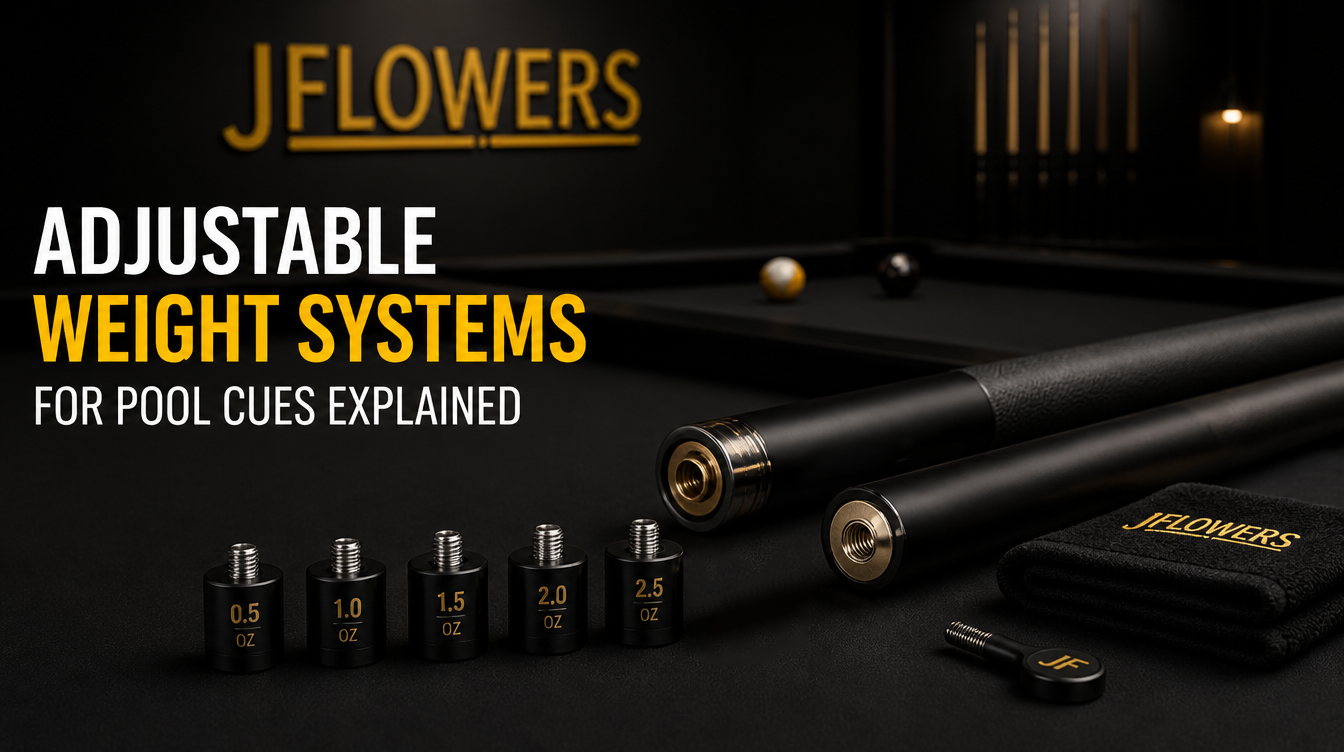
Pool cue weight adjustment isn't new — players have been adding weight to cue butts for decades. What's evolved is how systematically manufacturers have approached built-in adjustability, from basic bolt systems to sophisticated internal mechanisms. This guide covers how different adjustable weight system designs work and what to look for when evaluating a cue's weight adjustment capability.
Listen to this article
Basic Weight Bolt Systems
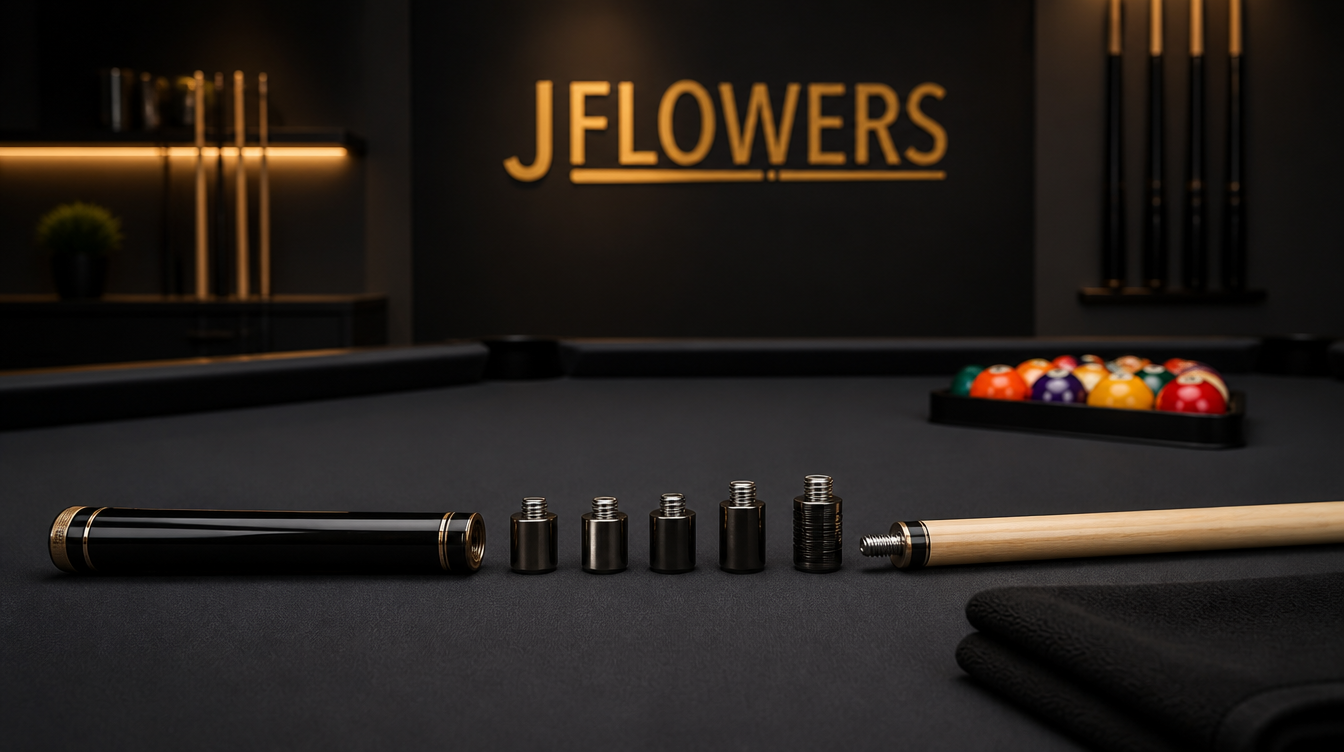
The most common adjustable weight design: metal cylinders or bolts that screw into threaded sockets inside the cue butt. Accessible through the butt cap or a separate port. The simplest version uses a single cavity that accepts multiple bolts. More sophisticated versions have multiple cavities at different positions along the butt for both weight and balance adjustment.
Where the weight is placed in the butt significantly affects how weight adjustment feels:
Rear-load systems (weight near the butt cap): adding weight shifts the balance point rearward, creating a more butt-heavy feel. Removing weight shifts balance forward. Total weight and balance change together.
Front-load systems (weight near the joint end): adding weight here shifts balance forward, toward the joint. Less common in standard production cues but used in specialty designs.
Multi-position systems: some advanced butts have adjustment points at multiple positions along the butt length, allowing weight and balance to be adjusted somewhat independently.
Threaded weight systems (where bolts screw into the butt cavity) provide secure weight retention and precise adjustment. The threads can wear over many adjustment cycles, but quality threaded systems last years of regular use.
Non-threaded weight systems (where cylinders drop into a cavity and are secured by the butt cap) are simpler but can rattle if the fit is loose. Quality non-threaded systems have tight tolerances that prevent movement; budget versions sometimes rattle noticeably.
The Complete Adjustment Range’),
When evaluating a cue’s weight system, the relevant questions:
What is the minimum weight (all weight components removed)?
What is the maximum weight (all weight components installed)?
What is the adjustment increment (how much does each bolt add)?
How accessible is the adjustment mechanism?
A well-designed system might offer 17.5-21.5 oz in 0.5 oz increments — covering the full competitive preference range. A system with only 1-2 oz of range at 1 oz increments has limited practical value.
Using Weight Adjustment After a Shaft Change’),
The most practically useful application of weight adjustment is compensating for shaft weight changes during an upgrade. When installing a JFlowers SMO Carbon Fiber Shaft on an existing butt, the assembled cue weight will likely differ from the previous maple shaft configuration. Weight bolts let you arrive at exactly your preferred total weight rather than accepting whatever the new shaft combination happens to produce
Process: assemble the cue with the new shaft, weigh it if you have a postal scale (or use a pool hall cue scale), compare to your preferred weight, and add or remove weight bolts to close the gap.
Weight Systems and Cue Balance’),
As covered in the balance discussion, weight bolt position affects balance as well as total weight. For the full interaction between weight and balance, see Carbon Fiber Shaft Balance Explained for the specific shaft-side considerations.
Pros and Cons
Multi-position weight systems
More independent control of weight and balance
Greater flexibility for fine-tuning the assembled cue feel
Adapts to different shaft types and playing preferences
More complex mechanism — more potential failure points
Higher cue cost for premium multi-position designs
Basic rear-load weight bolt systems
Simple, reliable, and adequate for most adjustment needs
Easy to use and maintain
Weight and balance change together — not fully independent
Expert Recommendation For most players: a standard rear-load weight bolt system provides all necessary adjustability. When upgrading to a JFlowers SMO Carbon Fiber Shaft, use the weight adjustment to arrive at your exact preferred total weight. Don’t overthink weight system complexity — the basic system on a JFlowers cue does everything most competitive players need.
Conclusion
Adjustable weight systems give competitive players a meaningful tuning capability that fixed-weight cues lack. The most practical use is compensating for shaft changes, followed by format-specific weight preferences. Understand how your cue’s system works — rear vs front load, threaded vs non-threaded, range and increments — and use that knowledge to arrive at the exact assembled weight your game performs best at.
Frequently Asked Questions
Q: What is a pool cue adjustable weight system? A mechanism inside the cue butt that allows weight bolts or cylinders to be added or removed, adjusting total cue weight within a set range. Q: How do I know what weight my cue is? Check the manufacturer’s spec sheet, or use a postal or kitchen scale to weigh the assembled cue. Q: What’s the difference between front-load and rear-load weight systems? Rear-load systems place weight near the butt cap, shifting balance rearward. Front-load systems place weight near the joint end, shifting balance forward. Q: Can I add weight to any pool cue? Only cues with built-in weight adjustment mechanisms. Some cues can be retrofitted by a cue technician, but this is a significant modification. Q: How often should I adjust my cue weight? Only when there’s a specific reason — after a shaft change, when experimenting with different weights for different formats. Don’t adjust frequently for no reason.
After comparing JFlowers to Predator, Mezz, McDermott, Meucci, Jacoby, Pechauer, and a dozen more brands across every price point and construction philosophy — the question that started all of it deserves a direct answer: which pool cue brand actually offers the best value for serious competitive players in
2026?
Players Technology is one of the most widely used cue brands in American pool halls. Their two-piece cues at $40-$150 have introduced millions of American players to personal cue ownership. Nearly every serious pool player in America either started on a Players cue or played against someone who did. Comparing Players to JFlowers isn’t really a direct competition — it’s a marker on the journey from beginner to serious competitor.