Balance is one of those cue characteristics that experienced players feel immediately but struggle to explain precisely. When a cue feels 'right' in the bridge hand — when it hangs naturally and swings through the stroke without effort — balance is doing that work. Understanding how carbon fiber shafts approach balance differently from maple helps you choose a shaft that serves your stroke.
Listen to this article
What Balance Means on a Pool Cue Shaft
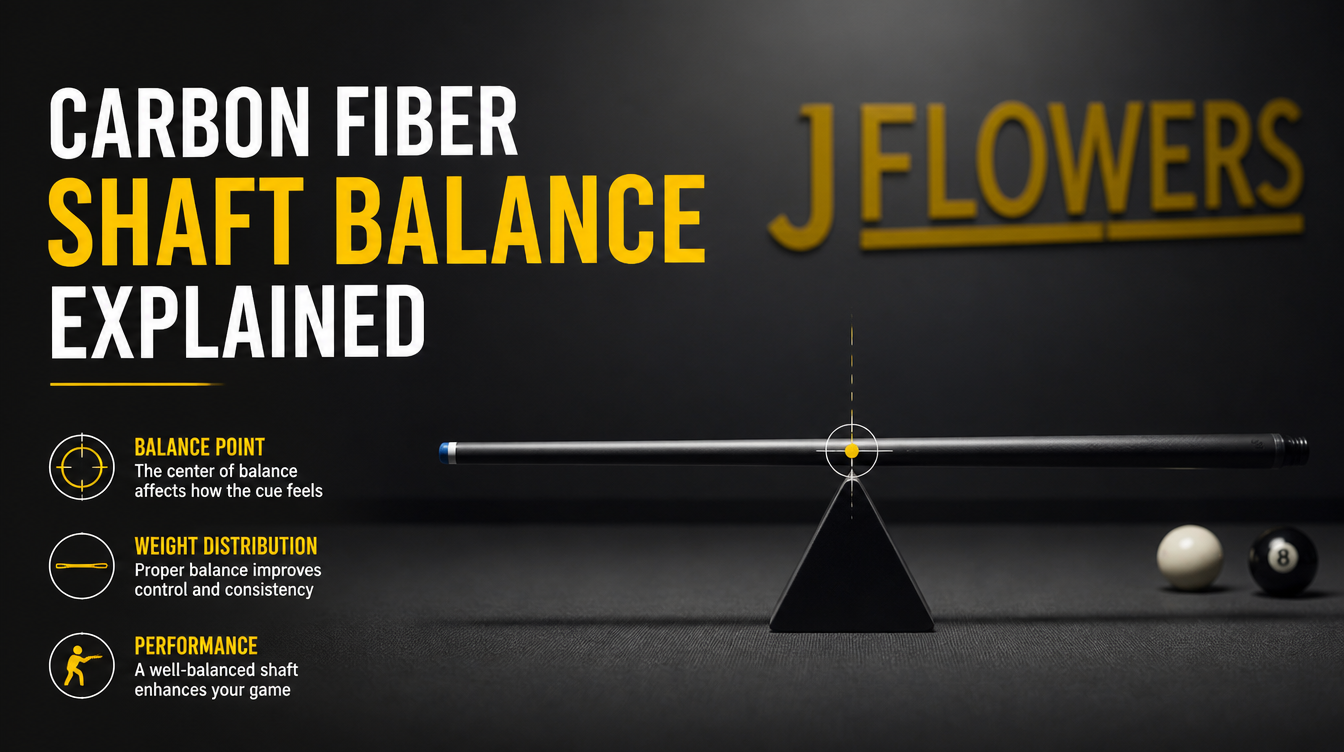
Shaft balance refers to how weight is distributed along the shaft’s length from tip to joint. A shaft that is heavier toward the tip is described as tip-heavy or forward-balanced. A shaft that is heavier toward the joint end is described as butt-heavy or rear-balanced. The shaft’s balance contributes to the overall balance of the assembled cue. For the full picture of how cue balance affects your game, see How Cue Balance Affects Performance and Forward Balance vs Rear Balance Pool Cues.
How Carbon Fiber Shaft Balance Differs From Maple
Carbon fiber shafts — particularly ferrule-less designs like the JFlowers SMO — tend to have their mass distributed more evenly along the shaft’s length than traditional maple shafts, with deliberately reduced mass at the tip end.
Traditional maple shafts have a ferrule and leather tip at the tip end — both of which add localized mass at that point. This gives maple shafts a slight tip-forward balance character. Carbon fiber shafts, with minimal tip-end mass, often feel slightly more neutral or even rear-biased compared to ferrule-equipped maple shafts.
This is one of the feel differences players notice when first picking up a carbon fiber shaft. The shaft feels different in the bridge hand — not heavier or lighter necessarily, but balanced differently.
How Shaft Balance Interacts With Butt Balance
The assembled cue’s balance point is determined by the combined balance of the shaft and butt together. Adding a carbon fiber shaft with slightly different balance characteristics to your existing butt will shift the assembled cue’s balance point compared to your previous maple shaft.
In most cases, a carbon fiber shaft on a quality butt produces a neutral to slightly rear-biased balance in the assembled cue — which many players find comfortable for position play and natural stroke delivery. If you need to adjust the balance after switching shafts, most quality butts have accessible weight bolt systems for fine-tuning.
Balance and the Bridge Hand Feel
The bridge hand experiences the shaft’s balance directly through the weight distribution across the bridge. A shaft that is well-balanced for your grip style hangs naturally in the bridge without requiring you to maintain an active grip throughout the stroke. A shaft that is poorly balanced for your style requires subtle grip adjustments that can introduce inconsistency.
For most players, the JFlowers SMO’s balance profile — which is engineered alongside the shaft’s weight and stiffness characteristics — produces a natural, effortless feel through the bridge hand during the stroke. This contributes to the shaft’s consistent feel that players comment on.
Adjusting for Balance When Switching to Carbon Fiber
If you switch to a carbon fiber shaft and find the assembled cue’s balance point has shifted from your preference, here’s the approach:
First, play with it for 2-3 sessions — your perception of balance often adjusts as you get used to the shaft’s overall feel
If the balance still feels wrong after adjustment, use your butt’s weight bolt system to shift the balance point
Adding weight to the butt’s rear end shifts the assembled balance rearward; adding to the front shifts it forward
Make small adjustments — weight bolt changes have a bigger effect than most players expect For the full cue weight selection framework that applies here, see How Cue Weight Affects Your Stroke.
Balance and Deflection
The reduced tip-end mass of carbon fiber shafts serves double duty: it contributes to the shaft’s balance character AND it reduces cue ball deflection. The two are connected — the same engineering decision (minimizing tip-end mass) produces both the balance and the low-deflection performance. This is why understanding shaft balance helps explain why carbon fiber deflects less. For the full deflection physics, see Carbon Fiber Shaft Weight Explained and Carbon Fiber Shaft Flex Explained.
Pros and Cons
Carbon fiber shaft balance characteristics
Reduced tip-end mass contributes to both balance and low-deflection performance
Neutral to rear-biased shaft balance suits most stroke styles
Balance is permanent — doesn’t change with humidity or temperature
Different balance from maple may require assembled cue adjustment
Weight bolt adjustment needed if the shaft shifts assembled balance away from preference
Expert Recommendation The JFlowers SMO’s balance profile is engineered as part of its overall performance design. When you switch to the SMO, check your assembled cue balance after a few sessions. If adjustment is needed, use your butt’s weight bolt system in small increments. The goal is a cue that hangs naturally in your bridge and swings without effort.
Conclusion
Carbon fiber shaft balance is an engineering decision that serves performance — the reduced tip-end mass that creates the shaft’s balance character is the same feature that produces low deflection.
Understanding this helps you work with the shaft’s balance rather than against it. The JFlowers SMO’s balance profile is designed for natural stroke delivery — adjust your assembled cue weight and balance as needed after switching, and let the engineering work for your game.
Frequently Asked Questions
Q: How does carbon fiber shaft balance differ from maple? Carbon fiber shafts typically have reduced mass at the tip end compared to ferrule-equipped maple shafts, resulting in a slightly different balance character — typically more neutral or slightly rear-biased. Q: Will a carbon fiber shaft change my cue’s balance? Possibly — the different weight distribution of carbon fiber vs maple can shift the assembled cue’s balance point. Check after switching and adjust weight bolts if needed. Q: Why do carbon fiber shafts have less tip-end mass? Reduced tip-end mass is an engineering approach to reducing cue ball deflection. It also contributes to the shaft’s distinct balance feel compared to ferrule-equipped maple shafts. Q: Can I adjust the balance of my cue after switching to carbon fiber? Yes — most quality butts have weight bolt systems for adjusting the assembled cue’s balance point. Make small adjustments and test between changes. Q: Does shaft balance affect stroke mechanics? Yes. A shaft that is well-balanced for your grip style hangs naturally in the bridge and swings through the stroke without requiring active grip compensation.
After comparing JFlowers to Predator, Mezz, McDermott, Meucci, Jacoby, Pechauer, and a dozen more brands across every price point and construction philosophy — the question that started all of it deserves a direct answer: which pool cue brand actually offers the best value for serious competitive players in
2026?
Players Technology is one of the most widely used cue brands in American pool halls. Their two-piece cues at $40-$150 have introduced millions of American players to personal cue ownership. Nearly every serious pool player in America either started on a Players cue or played against someone who did. Comparing Players to JFlowers isn’t really a direct competition — it’s a marker on the journey from beginner to serious competitor.