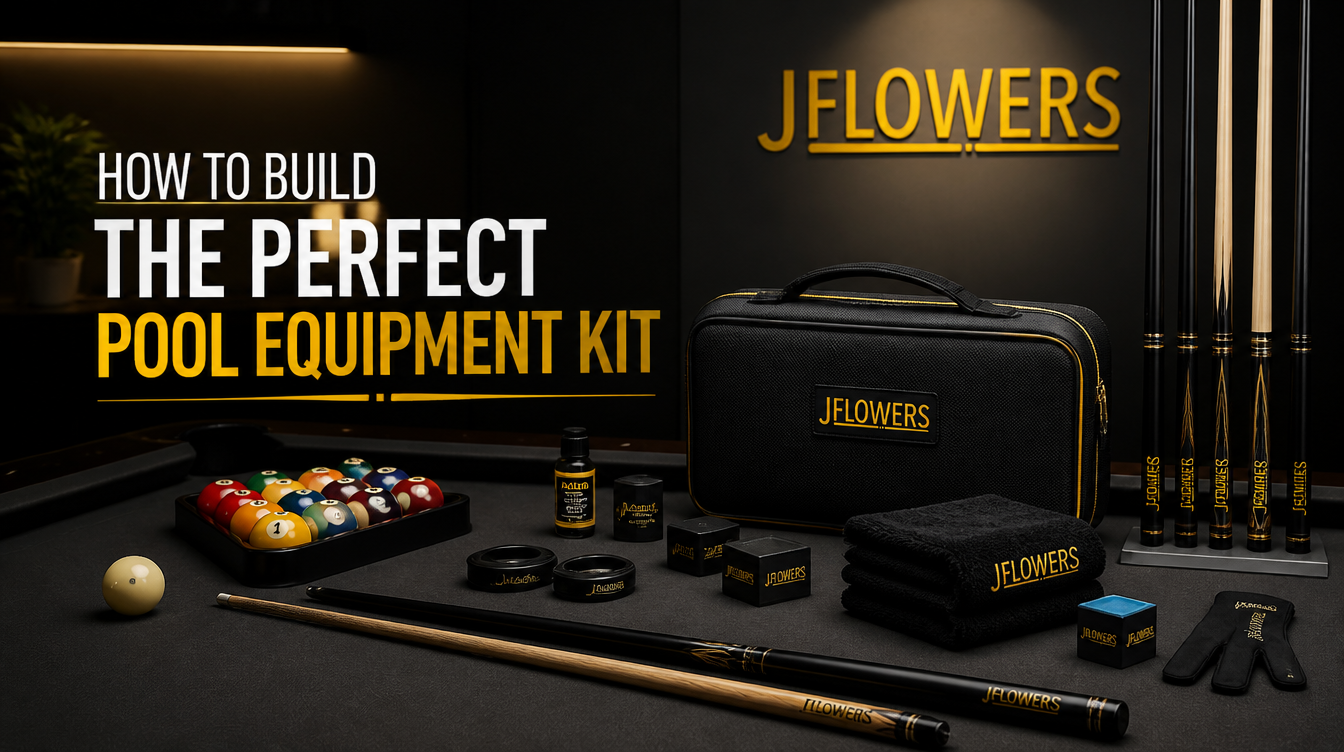
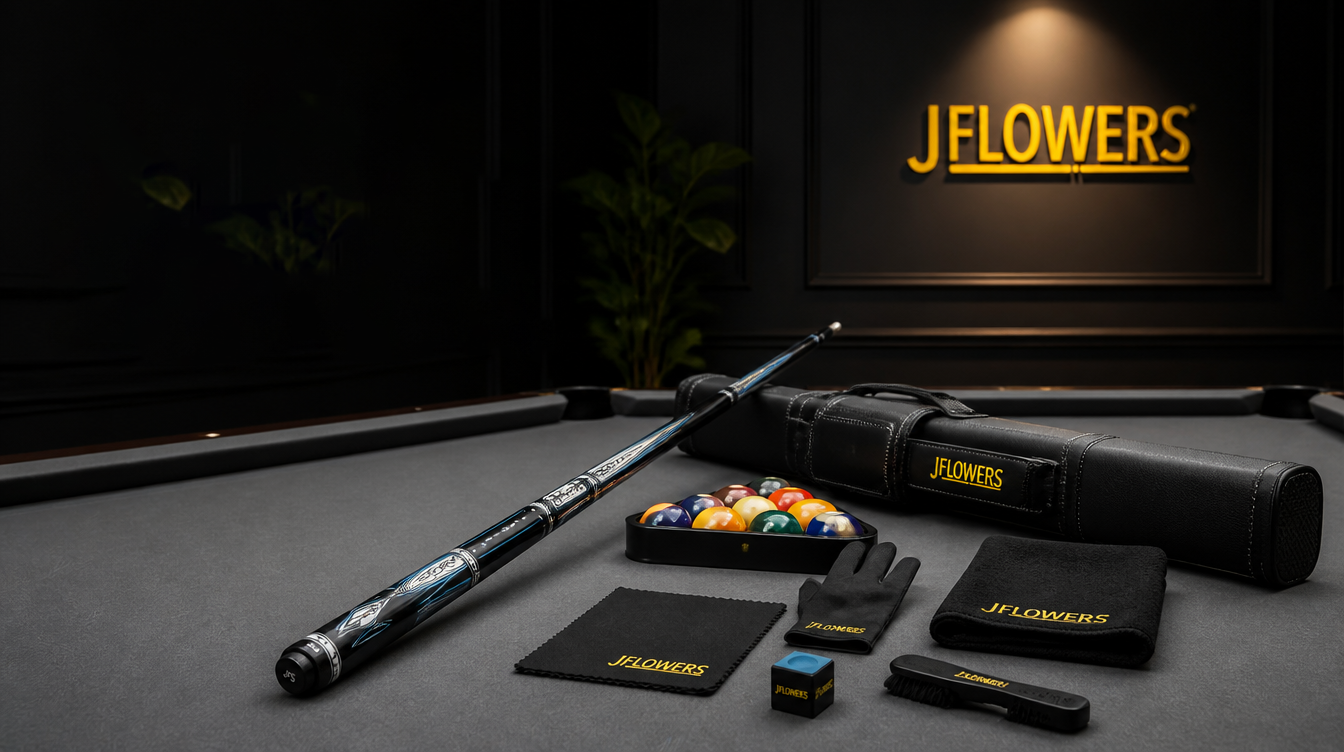
A perfect pool equipment kit isn't the most expensive setup. It's the setup that removes every equipment variable from your game while matching your competitive level, budget, and playing style. This guide walks through building that setup systematically — from the cue to the accessories — with specific
recommendations at each step.
Listen to this article
Step 1: The Cue
The foundation of the kit. Choose a quality production cue from a reputable brand in a weight and configuration that suits your game. For most competitive players who want genuine performance without overpaying for brand legacy:
The JFlowers playing cue delivers premium build quality — tight joint tolerances, deliberate balance design, quality Irish linen wrap — at a price point that makes the complete kit accessible without compromising on quality. For the full buying framework, see How Much Should You Spend on a Pool Cue?.
Step 2: The Shaft
The performance component. This is where the biggest playing difference lives. The choice is between premium maple low-deflection and carbon fiber.
For a complete competitive setup in 2026: the JFlowers SMO Carbon Fiber Shaft. No warp, consistent low deflection across all environments, lower maintenance than maple, and performance that holds its own against shafts at twice the price. Pair it with the JFlowers playing cue on a 5/16×18 joint and you have a complete, professionally competitive playing setup. For the full shaft decision, seeCarbon Fiber vs Maple Shafts: The Complete Comparison.
Step 3: The Tip
The contact point. Install a Taom medium tip on the SMO shaft. The tip is the only consumable in the shaft setup — replace it when it shows the replacement indicators rather than waiting until it’s clearly failing. For the full tip selection discussion, see Best Cue Tip Brands.
Step 4: The Break Cue
A separate break cue protects your playing tip and allows break-optimized equipment. A mid-range break cue with a hard leather or phenolic tip at $100-$200 is the right investment here — not a $50 house-cue-quality stick, but not a $600 playing-cue-quality investment either. The break cue doesn’t need to play position; it needs to break hard and reliably.
Step 5: The Case
A quality hard 2×4 case. Two butts (playing cue + break cue) and four shafts (playing SMO + backup SMO + break shaft + spare) is the complete competitive configuration. Hard exterior for car transport and tournament venues. Quality shaft tubes with tip-end padding to protect the SMO shaft tip end. For case selection, see Cue Case Buying Guide (2026).
A rough budget for the complete kit at competitive level:
JFlowers playing cue: $300-$500
JFlowers SMO Carbon Fiber Shaft: $350-$450
Taom medium tip (installed): $20-$30
Break cue with hard tip: $100-$200
Quality hard 2×4 case: $100-$200
Complete accessories kit: $50-$80
Total complete competitive kit: $920-$1,460. That’s a genuine competitive setup — one that holds its own at any level of league or tournament play — at a price point significantly below what equivalent performance would cost from premium legacy brands.
Building Incrementally’),
You don’t have to build the complete kit at once. Priority order:
Phase 1: Quality playing cue + SMO shaft + Taom tip + accessories kit (~$700-$1,000)
Phase 2: Quality hard case + break cue (~$200-$400)
Every component optimized for your competitive level
No equipment variables left unaddressed
Built for growth — each component scales with your game
Full kit investment requires planning and phased purchasing
Expert Recommendation Start with the playing cue and SMO shaft as the core, add the accessories kit immediately, and build out the complete setup over time. Each phase of the build delivers immediate performance benefit. The JFlowers-based competitive kit delivers professional-level equipment at a price point that doesn’t require a professional’s income.
Conclusion
The perfect pool equipment kit isn’t a mythological best-of-everything wish list — it’s a systematic, complete setup that removes every equipment variable from your game. The JFlowers-based kit does exactly that: playing cue, SMO shaft, Taom tip, break cue, quality hard case, and the complete accessories kit. Build it in phases if needed, but build it completely. Your game deserves equipment that doesn’t hold it back.
Frequently Asked Questions
Q: What makes a perfect pool equipment kit? Quality playing cue + shaft + tip + break cue + hard case + complete accessories. Each component removes equipment variables from the game. Q: How much does a complete competitive pool kit cost? A complete JFlowers-based competitive kit runs $920-$1,460 depending on options. Significantly less than equivalent performance from premium legacy brands. Q: Should I build the kit all at once? Not necessary — build in phases. Start with the playing setup (cue + shaft + tip + accessories), then add the case and break cue. Q: What is the most important component of a pool kit? The shaft. It directly determines how the cue ball moves. A quality shaft on a mid-range butt outperforms a cheap shaft on an expensive butt at every level.
After comparing JFlowers to Predator, Mezz, McDermott, Meucci, Jacoby, Pechauer, and a dozen more brands across every price point and construction philosophy — the question that started all of it deserves a direct answer: which pool cue brand actually offers the best value for serious competitive players in
2026?
Players Technology is one of the most widely used cue brands in American pool halls. Their two-piece cues at $40-$150 have introduced millions of American players to personal cue ownership. Nearly every serious pool player in America either started on a Players cue or played against someone who did. Comparing Players to JFlowers isn’t really a direct competition — it’s a marker on the journey from beginner to serious competitor.