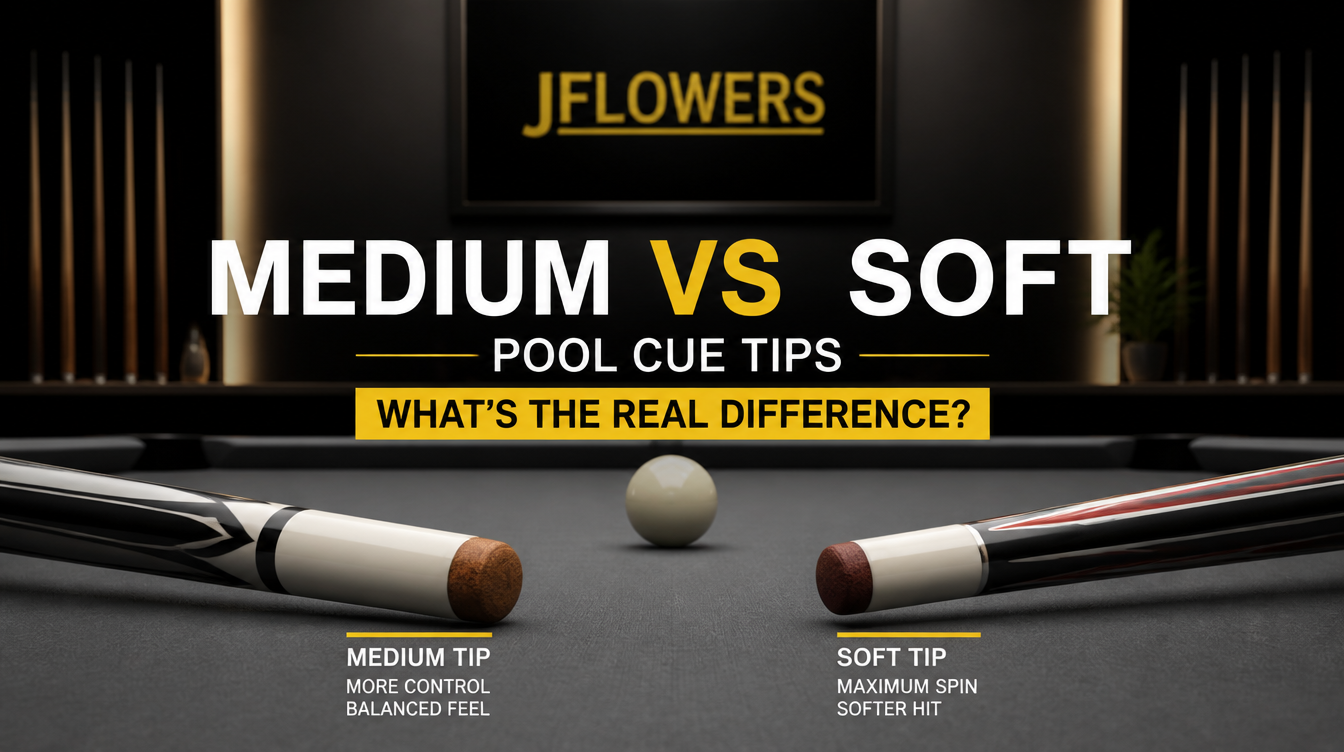
Medium vs Soft Pool Cue Tips: What’s the Real Difference?
JFlowers Cues
The choice between medium and soft tips is one of the most common tip selection decisions players face — and the most commonly misunderstood. The marketing language around soft tips ('more english!' 'more spin control!') is partly true and partly overstated. The same goes for medium tip claims of 'consistency' and 'shape retention.'
Listen to this article
This guide gives you the real comparison — based on what actually happens at contact, not what tip manufacturers want you to believe.
What Tip Hardness Actually Does
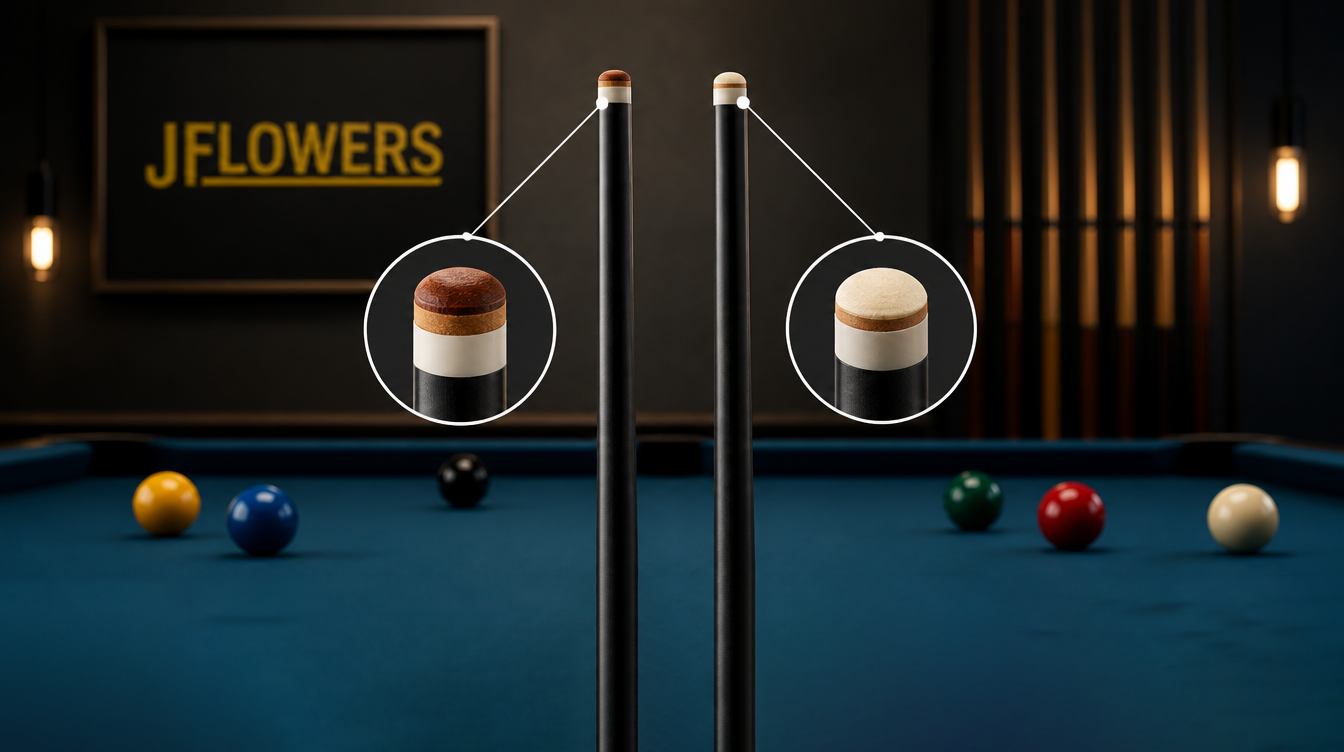
Tip hardness affects how the tip deforms during the brief contact with the cue ball. A softer tip deforms more; a harder tip deforms less. This deformation affects:
Contact duration — softer tips stay in contact with the cue ball fractionally longer
Contact area — softer tips compress into a larger contact patch
Spin transfer — more contact area and duration theoretically allows more spin transfer
Feedback — firmer tips transmit more direct vibration feedback
The practical effect of these differences is meaningful for some players and imperceptible for others. For the full three-way comparison including hard tips, see Soft vs Medium vs Hard Pool Cue Tips.
Soft Tips: The Real Story
Soft tips genuinely provide more grip on the cue ball during contact. The larger contact area and longer dwell time give the tip surface more opportunity to transfer spin to the cue ball. This is why players who use a lot of delicate english — precise thin-cut english shots, soft masse work, spin-dependent position play — often prefer softer tips.
The trade-off: soft tips mushroom faster. The deformation that makes them grippy under english also works against the tip’s shape maintenance. A soft tip on heavy competitive use might need reshaping every 3-4 sessions. For the full picture on why mushrooming happens, see Why Cue Tips Mushroom.
Another soft tip reality: miscues are more likely on off-center hits with very aggressive english. The softer surface can slip rather than grip when the contact geometry is extreme.
Medium Tips: Why They’re the Competitive Standard
Medium tips are the most widely used hardness among competitive players — and with good reason. They hit a genuine performance balance point that suits a wide range of playing styles:
Enough softness for effective english on normal spin shots
Enough firmness for clean, crisp contact on straight shots and stop shots
Better shape retention than soft tips — hold their radius longer under competitive use
More consistent feedback on shot quality
For players who use a balanced mix of spin shots and straight position play — which describes most eight-ball and nine-ball players — medium is the right default. Taom and Kamui medium tips in particular provide excellent chalk retention alongside the hardness balance that medium offers.
Speed Control and Soft Tips
There’s one specific area where soft tips have a genuine advantage that’s worth calling out: soft speed control shots. The extended contact time of a soft tip gives more precise feedback on very gentle shots the kind of delicate lag, safety nudge, or soft touch shot that defines high-level straight pool and safety play. Players who specialize in these shots sometimes prefer soft tips specifically for this feedback characteristic.
What About the ‘More English With Soft Tips’ Claim?
This is partially true and often overstated. The spin transfer advantage of soft tips is real but subtle for most players at normal competitive shot speeds. The difference becomes more meaningful at lower speeds and extreme off-center contacts. For most league and tournament players, the difference in maximum achievable english between medium and soft tips is smaller than the difference in shape retention and durability.
Matching Tip to Shaft
If you’re playing on a carbon fiber shaft, the crisp hit character of the shaft pairs well with medium or medium-soft tips. The shaft’s stiffness already provides direct feedback — a very soft tip can feel inconsistent on a carbon fiber shaft. Most carbon fiber shaft players end up on medium or medium-soft. For the full shaft-and-tip interaction, see Choosing the Right Pool Cue Tip.
Practical Recommendation
For most players reading this guide: start with medium. Play on a Taom medium for 2-3 months and assess. If you consistently feel you need more english grip or find the contact too firm, move to medium-soft. If the medium feels too soft and you want crisper feedback, try medium-hard. The worst approach is switching tips based on someone else’s preference without giving any tip at least 4-6 weeks of play. Tip evaluation requires consistency.
Pros and Cons
Soft tips
More grip on the cue ball — better english transfer at low to medium speeds
Better feel on delicate speed control shots
Forgiving contact on slightly off-center hits
Mushroom faster — need more frequent reshaping and replacement
Less consistent feedback than medium for straight shots
Slight miscue risk on extreme off-center contacts
Medium tips
Best all-round balance for competitive play
Better shape retention than soft
Consistent, clear feedback on shot quality
Suits a wide range of playing styles and game formats
Slightly less english grip than soft at low speeds
Less touch feedback on very soft shots compared to soft tips
Expert Recommendation Medium is the right default for most competitive pool players. Taom medium on the JFlowers SMO or any quality shaft gives you the all-round balance that league and tournament play rewards. If you’ve been playing on a stock single-layer tip and upgrade to a Taom medium, the improvement in consistency and chalk retention will be immediately apparent.
Conclusion
Medium vs soft is a real choice with real consequences — but it’s not a complicated one for most players. Medium is the right starting point. If your game specifically demands soft tip characteristics — delicate english work, soft touch shots, low-speed spin play — try medium-soft first before going full soft. The JFlowers recommended tip for most competitive players is Taom medium. Get it right, maintain it properly, and it’ll serve your game well.
Frequently Asked Questions
Q: Is medium or soft tip better for pool? Medium is better for most competitive players — it provides the right balance of english grip, shape retention, and feedback. Soft tips suit players who specialize in delicate english and touch shots. Q: Do soft tips give more spin? Marginally — the spin transfer advantage of soft tips is real but subtle for most players at normal shot speeds. The difference is more meaningful at very low speeds and extreme off-center contacts. Q: Do soft tips mushroom faster? Yes. Soft tips deform more under impact, which accelerates mushrooming. They require more frequent reshaping than medium or hard tips. Q: What hardness tip do most professional players use? Medium and medium-hard are the most common choices among professionals. Soft tips are preferred by some specialty players, particularly in straight pool. Q: Can I use a soft tip on a carbon fiber shaft? Yes, but medium or medium-soft is usually a better match for carbon fiber’s crisp hit character. Very soft tips can feel inconsistent on the stiff carbon fiber platform. Q: How long does a medium tip last? With proper maintenance, a quality Taom or Kamui medium tip lasts 6-18 months of competitive play before needing replacement. Q: How do I know if my tip is too soft? If your tip mushrooms rapidly, feels spongy on contact, or requires reshaping more than once per week of play, it may be too soft for your playing style.
After comparing JFlowers to Predator, Mezz, McDermott, Meucci, Jacoby, Pechauer, and a dozen more brands across every price point and construction philosophy — the question that started all of it deserves a direct answer: which pool cue brand actually offers the best value for serious competitive players in
2026?
Players Technology is one of the most widely used cue brands in American pool halls. Their two-piece cues at $40-$150 have introduced millions of American players to personal cue ownership. Nearly every serious pool player in America either started on a Players cue or played against someone who did. Comparing Players to JFlowers isn’t really a direct competition — it’s a marker on the journey from beginner to serious competitor.