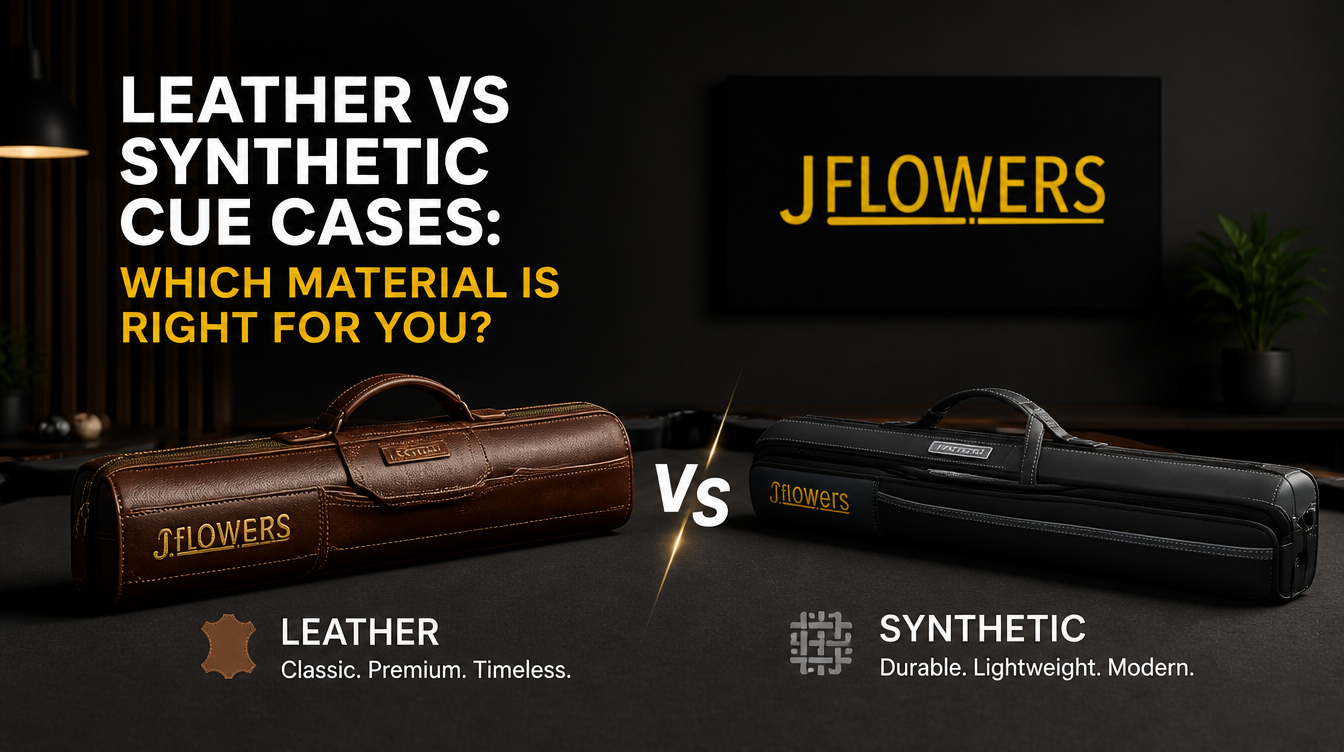
Leather vs Synthetic Cue Cases: Which Material Is Right for You?
JFlowers Cues
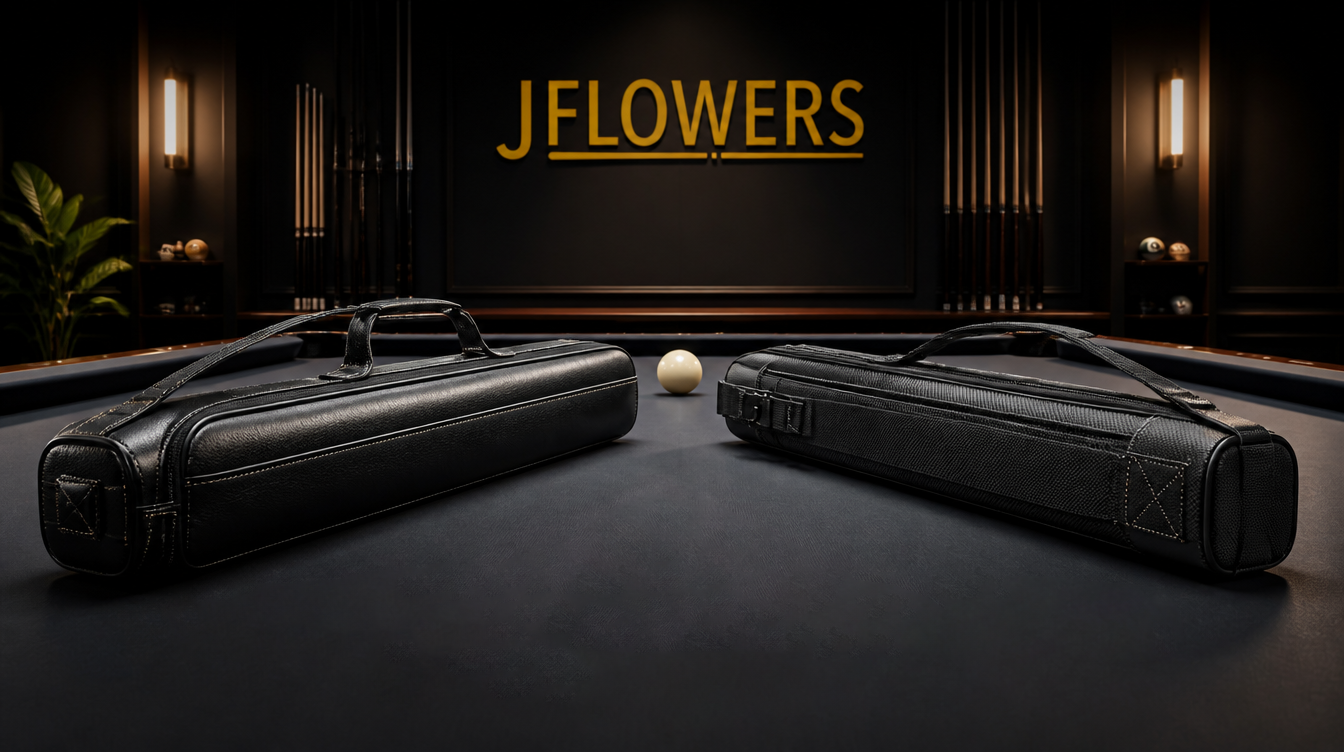
Pool cue cases come in two primary material categories: genuine leather and synthetic alternatives (vinyl, nylon, ballistic nylon, and various man-made composites). The choice between them involves trade-offs on durability, appearance, weight, cost, and how the case handles wear over time.
Listen to this article
This guide covers the real differences between leather and synthetic cue cases — what each material delivers, where each one falls short, and how to decide which suits your playing situation.
Genuine Leather Cue Cases
A genuine leather cue case is a quality product that ages well, looks premium, and provides good protection. Leather is durable, develops a patina with use, and has a weight and feel that synthetic cases typically can’t match.
What Leather Delivers Leather cases have a premium look and feel from day one and improve with age. Quality full-grain leather develops a lived-in patina rather than wearing out — the more it’s used, the better it looks. The structural integrity of leather holds up well against everyday bumps and scrapes.
Leather also provides decent moisture resistance from spills, though it’s not waterproof and prolonged moisture exposure will damage it. Proper leather conditioning (occasional application of leather conditioner) keeps the material supple and extends its life.
Limitations of Leather Cases Genuine leather cases are heavier than comparable synthetic alternatives. For players who travel frequently or carry their case long distances, the weight difference is noticeable. Leather cases also require more maintenance — regular conditioning prevents drying and cracking.
The cost premium for genuine leather over quality synthetic is significant. A good leather 2×4 case typically runs $150-$400+. A comparable synthetic case in a quality ballistic nylon or hard-shell construction runs $60-$200.
Not all leather is equal: bonded leather (scraps bound with adhesive) looks similar to genuine leather in photos but cracks and peels much faster. If you’re buying leather, buy genuine full-grain or top-grain leather, not bonded.
Synthetic Cue Cases
Synthetic cue cases span a wide range — from cheap vinyl cases that barely protect anything to premium ballistic nylon cases used by serious competitive players worldwide. The word ‘synthetic’ does not mean inferior. Some of the best cue cases on the market use synthetic materials.
Nylon and Ballistic Nylon High-quality nylon cases — particularly those using 600D or 1680D ballistic nylon — are extremely durable, abrasion-resistant, and much lighter than leather. They typically offer better pocket organization, more accessory storage, and handle moisture better than leather.
Ballistic nylon resists tears and abrasion better than most leathers under hard travel conditions. For players who travel frequently, fly with their cue, or keep their case in their car, high-quality nylon is often the practical choice.
Hard Shell / Hard Case Hard cases with synthetic exterior shells — ABS, aluminum, or composite materials — provide the best physical protection. These are the cases for airline travel, long road trips, and any situation where the cue needs to be protected from the kinds of impacts that a soft case simply can’t handle. For the full hard case breakdown, see Hard Cue Cases Explained.
Vinyl and Budget Synthetics Budget vinyl cases are the equivalent of the stock single-layer tip — functional but inadequate for serious use. Vinyl cracks in cold, becomes sticky in heat, and provides minimal structural protection. If you’re spending $300+ on a cue, a $20 vinyl case is an investment contradiction.
Which Material for Which Player
Leather is right for: players who value aesthetics and the premium feel of genuine leather, players who primarily transport their cue to a single pool hall and back, collectors who treat the case as part of the overall cue presentation, players willing to invest in and maintain a quality leather product.
High-quality synthetic (ballistic nylon or hard shell) is right for: players who travel frequently, competitive players who want maximum protection, players who want lighter weight, players who want better accessory organization, anyone who needs waterproof or water-resistant properties. For case selection for travel specifically, see Best Cue Cases for Travel.
Protecting the JFlowers SMO Carbon Fiber Shaft
Whatever case material you choose, the internal construction matters for shaft protection. The JFlowers SMO Carbon Fiber Shaft, like all carbon fiber shafts, is vulnerable to hard physical impacts at the tip end. Your case needs to have shaft tubes that fully support the shaft from tip to joint without leaving the shaft rattling or under lateral stress. A case with well-padded, correctly sized shaft tubes protects the shaft investment regardless of whether the exterior is leather or nylon.
Pros and Cons
Genuine leather cases
Premium appearance that ages well
Durable and structurally solid
Classic pool hall aesthetic
Heavier than comparable synthetics
Requires conditioning maintenance
Higher cost for equivalent protection
Not waterproof — moisture exposure damages leather
High-quality synthetic cases
Lighter weight for the same protection level
Better moisture resistance
Better accessory organization options
Often better value per dollar on protection
Budget synthetics (vinyl) are genuinely poor quality
Different aesthetic — not the traditional pool leather look
Expert Recommendation For most competitive players who want excellent protection: quality ballistic nylon or a hard-shell case at the appropriate size. For players who value aesthetics and are willing to invest in and maintain quality leather: a genuine full-grain leather case from a reputable manufacturer. Whatever you choose, spend enough to protect your cue properly. A $400 cue in a $20 case is an equipment contradiction.
Conclusion
Leather vs synthetic is ultimately a combination of aesthetics preference, practical requirements, and budget. Both materials can produce excellent cue cases. The most important variables are the quality within whichever material you choose, the internal construction that actually protects your shaft, and the case capacity that matches how many butts and shafts you carry.
Frequently Asked Questions
Q: Is leather or synthetic better for a cue case? Both can be excellent — the quality within each material category matters more than the category itself. Quality ballistic nylon offers better moisture resistance and lighter weight. Quality genuine leather offers better aesthetics and traditional feel. Q: How do I care for a leather cue case? Clean with a leather-appropriate cleaner, condition with leather conditioner every few months to prevent drying and cracking, and store away from extreme humidity and direct sunlight. Q: Are synthetic cue cases durable? Quality synthetic cases using 600D or higher nylon or hard-shell construction are extremely durable — often more so than leather under hard travel conditions. Budget vinyl synthetics are not durable. Q: What is ballistic nylon? A high-density nylon fabric originally developed for military use. Very resistant to abrasion and tearing. Used in premium cue cases and other travel gear for its durability-to-weight ratio. Q: Is bonded leather a good cue case material? No. Bonded leather peels and cracks quickly under regular use. Genuine full-grain or top-grain leather is the quality standard; bonded leather is a budget material that looks like leather initially. Q: How much should I spend on a cue case? Match the case investment to your cue investment. A $300-$500 cue deserves a $60-$150 quality case minimum. Don’t protect a $400 cue in a $25 vinyl bag. Q: Does cue case material affect protection? Somewhat — hard-shell cases offer the best impact protection regardless of exterior material. Within soft cases, ballistic nylon is more abrasion-resistant than leather or budget vinyl.
After comparing JFlowers to Predator, Mezz, McDermott, Meucci, Jacoby, Pechauer, and a dozen more brands across every price point and construction philosophy — the question that started all of it deserves a direct answer: which pool cue brand actually offers the best value for serious competitive players in
2026?
Players Technology is one of the most widely used cue brands in American pool halls. Their two-piece cues at $40-$150 have introduced millions of American players to personal cue ownership. Nearly every serious pool player in America either started on a Players cue or played against someone who did. Comparing Players to JFlowers isn’t really a direct competition — it’s a marker on the journey from beginner to serious competitor.