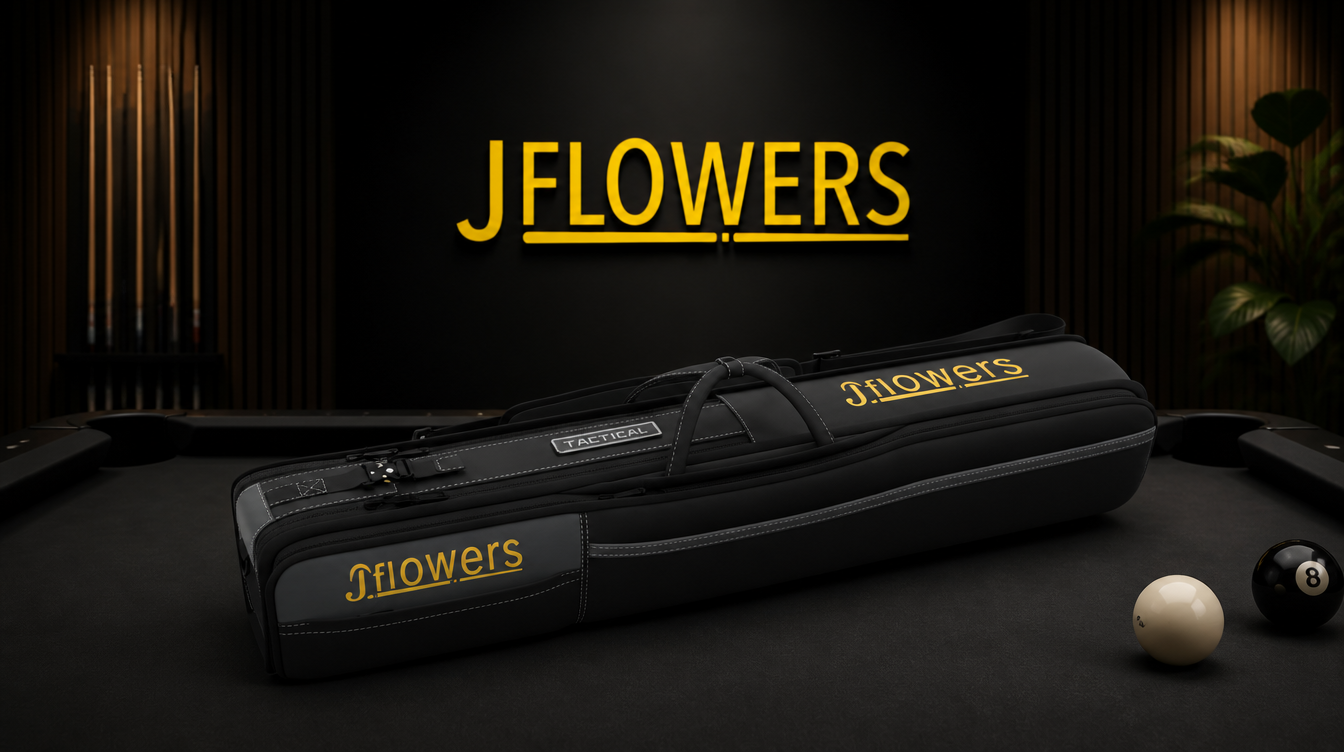
Soft cue cases — bags, sleeves, and soft-exterior cases — are the most common type of cue case in pool halls across America. They're lighter, often more affordable, and frequently offer better accessory organization than hard cases. They're also genuinely inadequate for protecting serious equipment in most
real-world travel situations.
Listen to this article
Understanding what soft cases actually protect against — and where they fundamentally can’t — helps you make the right decision about when a soft case is acceptable and when you need to step up to hard.
Types of Soft Cue Cases
Tube Bags The most common soft case design — a fabric tube with padded interior, typically in a ballistic nylon or similar exterior. Available in 1×1 to 3×5+ configurations. Most competitive pool players carry their cues in a tube bag for everyday league and practice play.
Quality tube bags from established manufacturers use dense foam padding, strong zippers, and quality fabric. Budget tube bags use thin foam, cheap zippers that fail quickly, and fabric that tears under regular use.
Sleeve Cases Minimal single-shaft sleeves — basically a fabric tube sized for one cue. These provide dust protection and minimal scratch protection but almost no impact protection. Useful for house cues or practice sticks but not appropriate for quality playing cues.
Soft Briefcase / Organizer Cases Wider soft cases with a briefcase-style organization layout. These typically offer excellent accessory storage — pockets for chalk, tips, spare shafts, mechanical bridges, and other accessories — with a padded but soft exterior. Popular with league players who carry a lot of equipment.
What Soft Cases Protect Against
Soft cases provide real protection for a limited range of threats:
Dust and dirt — keeping the shaft and butt clean between sessions
Minor scratches from contact with other objects
Light moisture from brief exposure — drizzle, minor spills
Shaft movement that could cause casual contact damage
Within these limits, a quality soft case does its job well. The soft padding around the cue keeps it from touching other surfaces directly and cushions minor handling.
What Soft Cases Cannot Protect Against
This is the critical limitation:
Direct impacts — a soft case dropped from height or struck directly transmits almost all of the impact force to the cue inside
Compression — bags stacked on top of a soft case compress the padding and transfer force directly to the shaft
Lateral force — another bag or heavy object pressing against the side of a soft case bends whatever is inside
Airport baggage handling — checked baggage gets thrown, dropped, and compressed in ways that destroy soft cases
Walking to and from a single local pool hall with full control of the case at all times
Carrying a practice cue or house cue that doesn’t represent a significant investment
Supplementary case for extra shafts or accessories alongside a primary hard case
Short-distance commuter carry where impact risk is minimal
For any of these situations, a quality soft case in ballistic nylon or similar construction is perfectly appropriate.
When You Absolutely Need a Hard Case
Switch to hard when: you’re flying with your cue, you’re driving to tournaments and the cue goes in a car trunk, you’ve had equipment damaged in a soft case, or your cue investment exceeds $300. The protection difference is not marginal — it’s fundamental. For the airline travel guide, see Airline Travel with Pool Cues.
Soft Case Quality Markers
If you’re buying a soft case, here’s what separates quality from budget:
Exterior fabric: 600D nylon minimum; 1680D ballistic nylon for serious use
Zippers: YKK zippers or equivalent — cheap zippers fail at the worst time
Padding: dense foam that actually cushions rather than thin decorative padding
Shaft tubes: snug fit that supports the shaft without rattling
Tip protection: soft end cap or padding at the tip end of the shaft tube
Soft Cases and the JFlowers SMO Shaft
For everyday local transport of a JFlowers SMO Carbon Fiber Shaft in a soft case: a quality tube bag in ballistic nylon with good tip-end padding is adequate for walking and controlled transport. For any situation where the case leaves your hands — car trunks, checked baggage, tournament venue bags — upgrade to hard. The carbon fiber tip end is the vulnerability point; the shaft itself is impact-resistant along its length but the tip end can chip from direct impact.
Pros and Cons
Quality soft cases
Lighter than hard cases
Better accessory organization in organizer-style designs
More flexible — easier to store in small spaces
Generally less expensive than equivalent hard cases
Cannot protect against direct impacts or compression
Not appropriate for airline travel or car trunk use
Budget soft cases provide minimal protection
Expert Recommendation For daily local use with full physical control of the case: a quality ballistic nylon soft case is adequate. For any situation where the case is out of your hands or where impact risk is real: use a hard case. The JFlowers playing cue and SMO shaft deserve at minimum a quality soft case for local use and a hard case for any travel.
Conclusion
Soft cases serve a genuine purpose for everyday local use and organization. Understanding their limitations — particularly the inability to protect against impact and compression — helps you deploy them correctly: for the situations they suit, alongside a hard case for the situations they don’t.
Frequently Asked Questions
Q: Are soft cue cases good enough? For controlled local transport, yes. For travel — particularly flights — no. Soft cases cannot protect against the impacts and compression of real-world travel. Q: What is the best soft cue case material? 1680D ballistic nylon is the quality standard for serious soft cases. 600D nylon is adequate for casual use. Q: Can I use a soft case on an airplane? Only as a carry-on, if the size permits. Never as checked baggage — airline baggage handling will damage a soft case and potentially the cue inside. Q: How much padding should a soft cue case have? Enough that the shaft tube fits snugly without the cue rattling, with soft padding at the tip end. Dense foam is better than thick but soft padding. Q: Should I use a hard or soft case for my JFlowers cue? A quality soft case for local controlled transport. A hard case for any travel where the case leaves your hands.
After comparing JFlowers to Predator, Mezz, McDermott, Meucci, Jacoby, Pechauer, and a dozen more brands across every price point and construction philosophy — the question that started all of it deserves a direct answer: which pool cue brand actually offers the best value for serious competitive players in
2026?
Players Technology is one of the most widely used cue brands in American pool halls. Their two-piece cues at $40-$150 have introduced millions of American players to personal cue ownership. Nearly every serious pool player in America either started on a Players cue or played against someone who did. Comparing Players to JFlowers isn’t really a direct competition — it’s a marker on the journey from beginner to serious competitor.