Tip diameter is one of the shaft specifications that players think about least until they realize it's affecting their game. When you buy a pool cue, the shaft diameter at the tip end is the specification that determines what tip sizes you can install, and it's a number with real implications for your feel, english performance, and contact precision.
Listen to this article
This guide covers everything about pool cue tip diameter: what the common sizes are, what larger versus smaller diameters do at contact, how tip diameter relates to shaft diameter, and how to measure yours.
The Standard Range
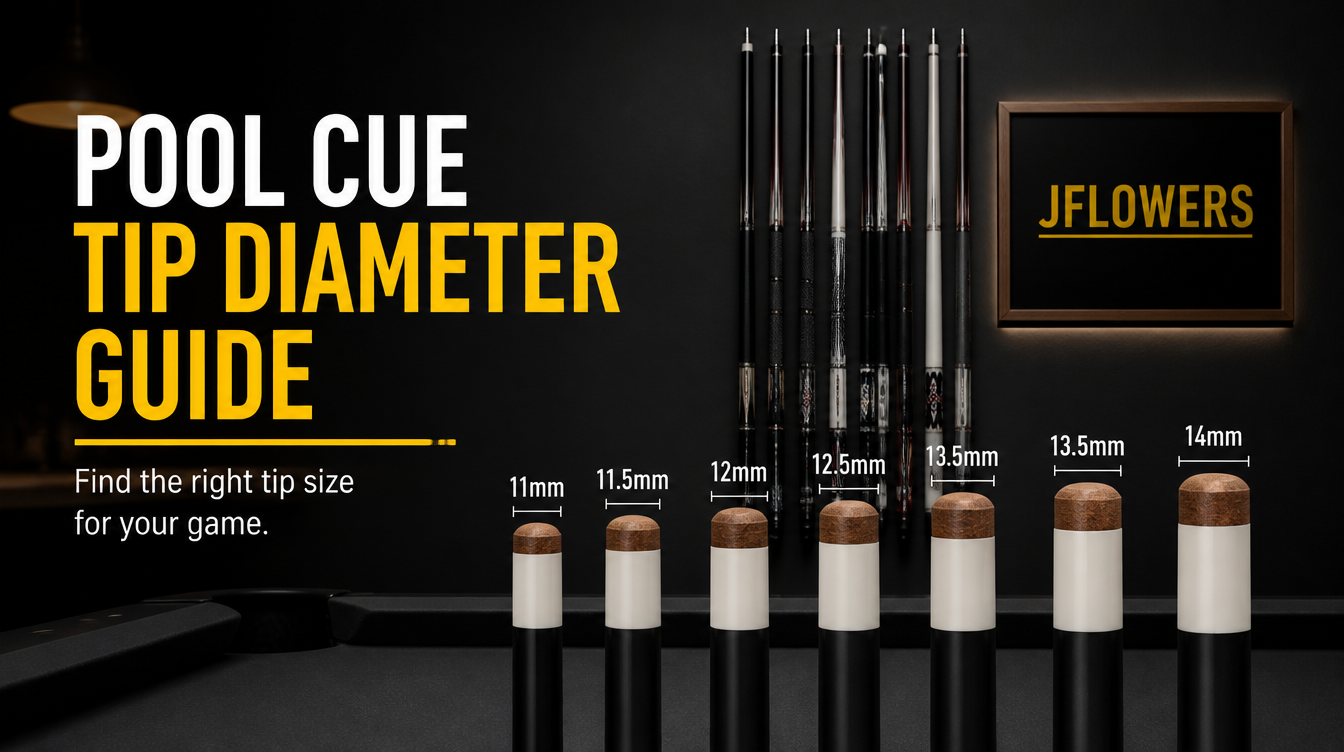
Pool cue tips are measured in millimeters. The practical range for pool runs from about 11mm to 13.5mm, with the most common competitive sizes between 11.75mm and 13mm:
11mm to 12mm — tighter, more precise, popular for english-heavy play
12.25mm to 12.75mm — the most common range for general competitive play
13mm and above — wider, more forgiving, common on house cues and beginning players
Snooker cues use tips in the 8mm-10mm range — much smaller than pool tips, reflecting snooker’s smaller balls and precision demands.
What Smaller Diameter Does
A smaller diameter tip sits on a thinner shaft. Thinner shafts are generally associated with lower deflection (less mass at the tip end), better feedback on precise english contacts, and a feeling of more control on fine positioning work.
Players who use a lot of english, particularly fine english on precise position routes, often prefer tighter diameters — 11.75mm to 12.25mm. The smaller contact area gives more precise feel on where exactly the tip is contacting the cue ball.
The JFlowers SMO Carbon Fiber Shaft is available in a diameter range that suits this competitive preference. For how shaft diameter overall affects the playing experience, see How Shaft Diameter Changes Feel.
What Larger Diameter Does
Larger diameter tips on wider shafts feel more solid and less sensitive. They provide a larger contact margin — the tip is more forgiving on slightly off-center hits. Many players describe larger diameter shafts as feeling more like ‘pushing’ the ball versus the ‘pointing’ feel of a tighter diameter.
Larger diameter tips are common on break cues, where contact precision is less important than power delivery. They’re also popular with players who prefer a more connected, solid feel and don’t play with extreme english.
Measuring Your Current Tip Diameter
The easiest way to measure your tip diameter is a small digital caliper, available for $10-$15 at hardware stores. Measure across the flat face of the tip. Your tip diameter should match the shaft diameter at the tip end — if they don’t match (oversized or undersized tip), it was installed wrong and should be replaced.
If you don’t have calipers, the spec sheet for your cue or shaft typically lists the tip diameter. JFlowers SMO shafts list their tip diameter clearly in the product specs.
Tip Diameter and Tip Selection
When buying replacement tips, match the tip diameter to your shaft. Tips that are slightly large are trimmed during installation. Tips that are undersized are a problem — they can’t be made larger. Most\ quality tip manufacturers (Taom, Kamui) produce tips in multiple standard sizes. Confirm the diameter before ordering.
The relationship between tip diameter and english performance is subtle but real. A smaller diameter tip allows you to apply maximum english at a smaller contact distance from center — because the tip edge reaches the extreme english zone closer to center on a smaller tip. This theoretically allows more extreme english before miscue risk.
In practice, this advantage is most noticeable to experienced players who play close to the edge of the english range regularly. For the best tip choices for english-heavy play, see Best Cue Tip for English.
Pros and Cons
Smaller diameter (11.75mm-12.25mm)
Better feel on precise english contacts
Lower deflection tendency with thinner shafts
More precise feedback on cue ball position
Less forgiving on slightly off-center contacts
Requires more precision in stroke technique
Larger diameter (12.5mm-13mm)
More forgiving on off-center contacts
More solid, connected feel popular with straight-ball players
Better suited to break applications
Less precise english feedback
Slightly more tip-end mass — marginally higher deflection
Expert Recommendation For most competitive players: 12mm to 12.5mm is the sweet spot. If you’re using a JFlowers SMO Carbon Fiber Shaft in this range, pair it with a same-diameter Taom medium tip. The combination delivers the precise feel and chalk retention that competitive pool rewards.
Conclusion
Tip diameter is a simple number with real implications. Know your shaft’s diameter, buy tips in the matching size, and choose the diameter that suits your style — tighter for precision english work, wider for power and forgiving contact. The JFlowers SMO in your preferred diameter gives you the platform; the right tip size and hardness completes the package.
Frequently Asked Questions
Q: What diameter tip should I use for pool? 12mm to 12.5mm suits most competitive players. Players who use a lot of english often prefer 11.75-12.25mm. Players who prefer a solid feel for power play often go 12.5-13mm. Q: Does tip diameter affect english? Yes. Smaller diameter tips can access the full english range at slightly less extreme contact distances. The difference is subtle but meaningful for experienced players. Q: How do I measure my cue tip diameter? Use a small digital caliper across the flat face of the tip. Or check your cue or shaft’s spec sheet. Q: What is the most common pool cue tip diameter? 12mm to 12.5mm covers the majority of competitive playing cues in the American pool market. Q: Do I need to match the tip diameter to my shaft? Yes. The tip should match your shaft’s tip-end diameter. Oversized tips are trimmed during installation; undersized tips are a problem. Q: What tip diameter do professional players use? Most professionals use 12mm to 12.5mm. Some nine-ball specialists prefer 11.75-12mm for maximum english precision. Q: What’s the difference between a 12mm and 13mm tip? 12mm provides more precise feel and slightly lower deflection tendency. 13mm is more forgiving and feels more solid on straight shots. Most competitive players prefer 12-12.5mm.
After comparing JFlowers to Predator, Mezz, McDermott, Meucci, Jacoby, Pechauer, and a dozen more brands across every price point and construction philosophy — the question that started all of it deserves a direct answer: which pool cue brand actually offers the best value for serious competitive players in
2026?
Players Technology is one of the most widely used cue brands in American pool halls. Their two-piece cues at $40-$150 have introduced millions of American players to personal cue ownership. Nearly every serious pool player in America either started on a Players cue or played against someone who did. Comparing Players to JFlowers isn’t really a direct competition — it’s a marker on the journey from beginner to serious competitor.