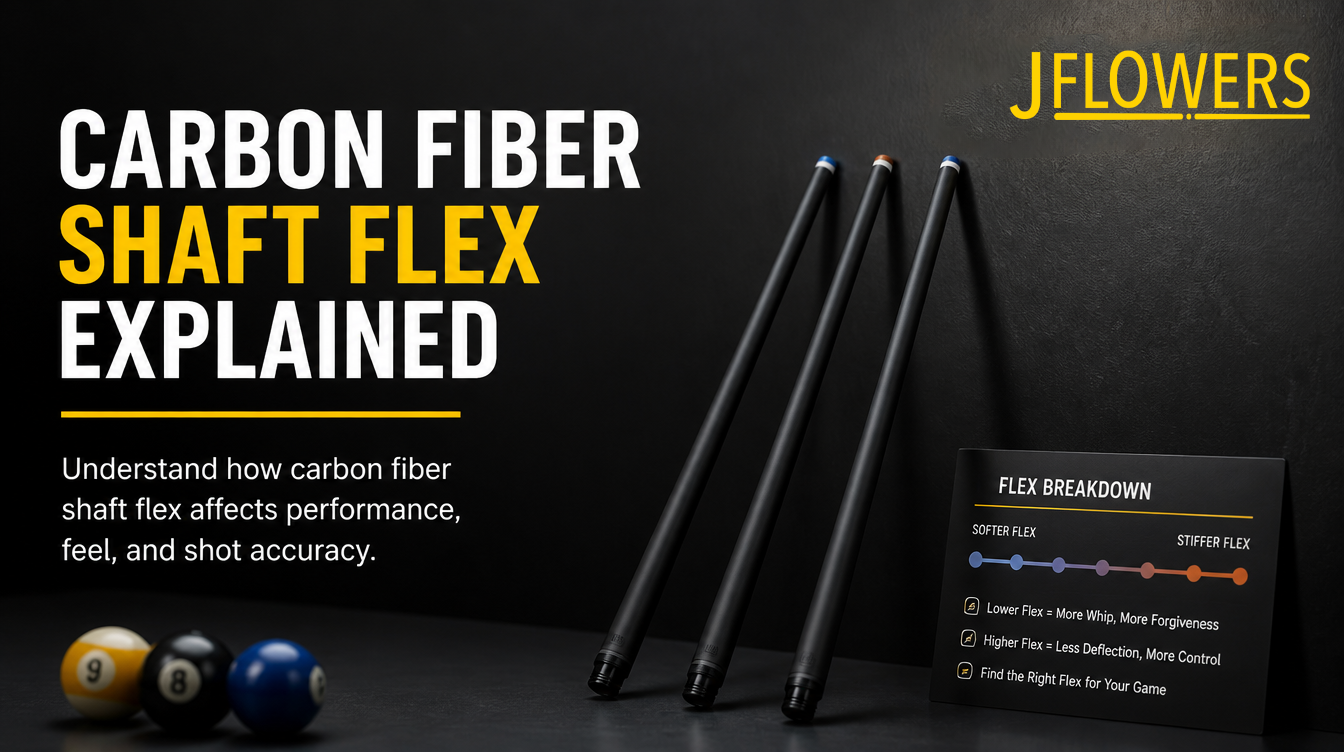
When a pool cue shaft strikes the cue ball off-center, it flexes. That flex is what causes cue ball deflection — the sideways movement of the cue ball away from your aim line when you apply english. Understanding how carbon fiber shafts flex differently from wood explains the core performance advantage of carbon fiber technology.
Listen to this article
This isn’t just theory. The flex characteristics of a shaft directly affect every english shot you play. If you’ve tried a carbon fiber shaft and noticed your english shots landing in different positions than expected, this is exactly why — and why the initial adjustment is worth pushing through.
How Shaft Flex Causes Deflection
When you strike the cue ball to the left of center, the shaft bends slightly to the right at the moment of contact. The tip, following the flex, pushes the cue ball slightly to the right of your aim line. The ball curves back as the english takes effect, but it started its path deflected from your aim line.
This deflection is something experienced players compensate for automatically — they aim slightly opposite to the english they’re applying. The amount of compensation depends on the shaft’s deflection profile. For the complete explanation, see What Is Cue Ball Squirt? and Understanding Cue Ball Deflection.
How Wood Shafts Flex
Wood shafts flex relatively freely under off-center impacts. They produce what players call squirt or deflection. Experienced wood shaft players have internalized the amount of compensation their shaft requires and apply it automatically.
How Carbon Fiber Shafts Flex Differently
Carbon fiber is significantly stiffer than wood per unit mass. Under the same off-center impact, a carbon fiber shaft bends less than a wood shaft of comparable dimensions. Less bend equals less tip deflection from the aim line. The cue ball squirts less.
The result: with carbon fiber, your aim compensation needs to be smaller than with wood. For the same amount of english at the same force, the cue ball deflects less and tracks closer to your aim line. This is what low deflection means in practice. See What Makes a Low Deflection Shaft? for the full breakdown.
The Tip End Mass Factor
One engineering approach to reducing deflection is minimizing mass at the tip end of the shaft. A lighter tip end has less inertia to deflect away from the aim line during contact. This is why many carbon fiber shafts — including ferrule-less designs like the JFlowers SMO — have very minimal mass at the tip end. The combination of carbon fiber stiffness and reduced tip end mass produces genuinely low deflection that maple cannot match at comparable weight.
Flex Under Different Stroke Speeds
Shaft flex varies with stroke speed and contact eccentricity. Faster strokes and more off-center hits produce more flex. Deflection is not constant — it increases with harder, more off-center hits. The advantage of carbon fiber is that its flex profile is more consistent across different stroke speeds, giving players a more predictable deflection relationship to calibrate against.
What This Means for Your Game
The practical effect of carbon fiber’s reduced flex is that you can play english with more confidence. Shots requiring significant off-center hits — thick-cut shots with english, power draw across the table — are more predictable because the shaft deflects less and more consistently. Once you’ve internalized the smaller aim compensation carbon fiber requires, your english shots become more reliable. This is particularly valuable in nine and ten ball. See Carbon Fiber Shaft Feel Explained for the player experience side.
Pros and Cons
Carbon fiber flex characteristics
Less flex under impact means less cue ball deflection
More consistent flex profile across different stroke speeds
More predictable english behavior once aim compensation internalized
Ferrule-less tip end designs further reduce deflection
Different flex profile requires aim recalibration from wood
The stiffer feel takes adjustment for players sensitive to shaft feedback
Expert Recommendation Understanding how carbon fiber flex creates its low-deflection advantage helps you commit to the adjustment period. The recalibration is a one-time investment that pays off in more reliable english play for the rest of your pool career. The JFlowers SMO shaft’s flex profile is optimized for exactly this benefit.
Conclusion
Shaft flex is the mechanism behind cue ball deflection, and carbon fiber’s reduced flex is the mechanism behind its low-deflection advantage. Understanding this relationship demystifies the adjustment experience and helps you commit to the recalibration that makes carbon fiber worthwhile. The JFlowers SMO shaft is engineered to give you the full benefit of this stiffness advantage.
Frequently Asked Questions
Q: Does a carbon fiber shaft flex? Yes, but less than wood. Carbon fiber’s higher stiffness-to-mass ratio means it bends less under off-center impact, producing less cue ball deflection. Q: Why do carbon fiber shafts produce less deflection? Because they’re stiffer than wood per unit mass. Less flex at impact means the tip deviates less from the aim line, producing less cue ball squirt. Q: What is shaft flex in pool? The bending of the shaft during an off-center hit. This flex causes the tip to deviate from the aim line, pushing the cue ball sideways — called deflection or squirt. Q: Is more flex or less flex better? For modern pool play, less flex (lower deflection) is generally preferred because it requires less aim compensation and produces more consistent english results. Q: Do all carbon fiber shafts flex the same? No. Different CF shafts have different flex profiles depending on construction, wall thickness, and tip end mass. The JFlowers SMO is engineered specifically for low deflection. Q: Can I measure shaft flex? Shaft deflection profiles are sometimes published by manufacturers and third-party testers. In practice, the best measure is the amount of aim compensation you need on english shots.
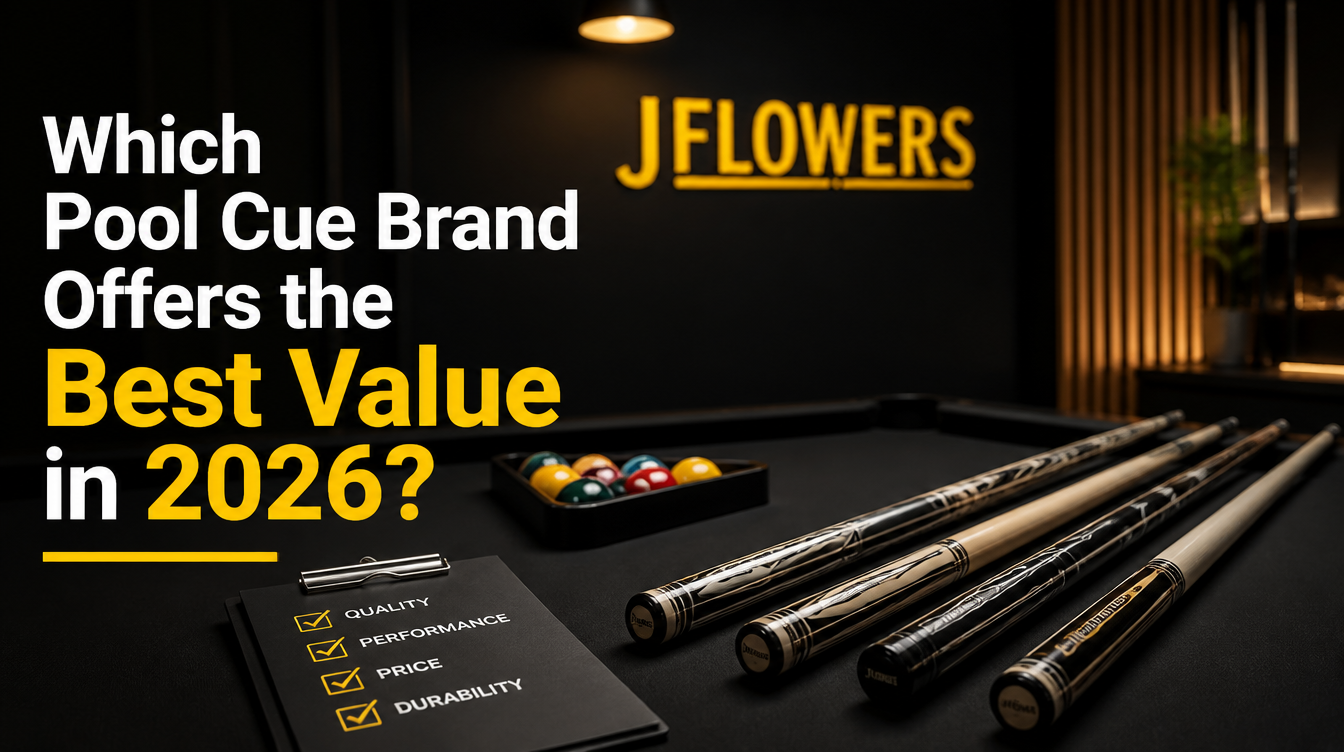
After comparing JFlowers to Predator, Mezz, McDermott, Meucci, Jacoby, Pechauer, and a dozen more brands across every price point and construction philosophy — the question that started all of it deserves a direct answer: which pool cue brand actually offers the best value for serious competitive players in
2026?
Players Technology is one of the most widely used cue brands in American pool halls. Their two-piece cues at $40-$150 have introduced millions of American players to personal cue ownership. Nearly every serious pool player in America either started on a Players cue or played against someone who did. Comparing Players to JFlowers isn’t really a direct competition — it’s a marker on the journey from beginner to serious competitor.