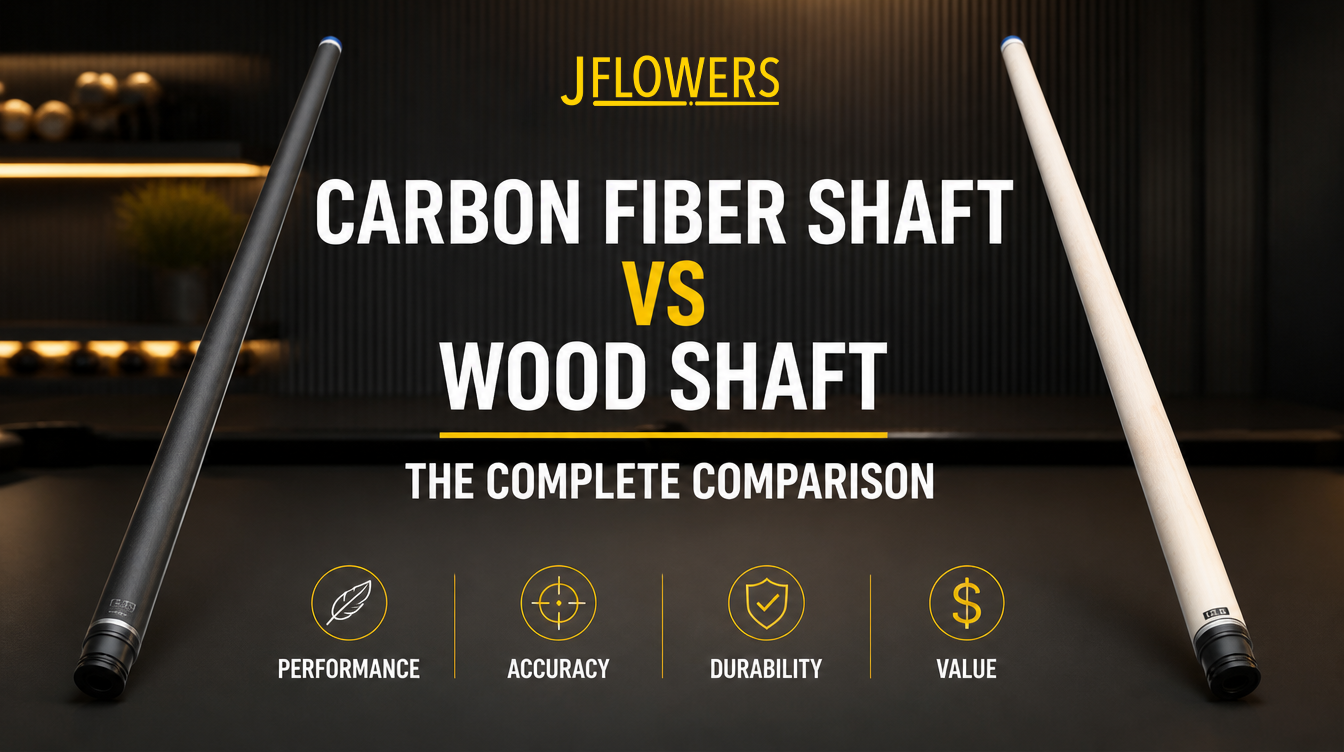
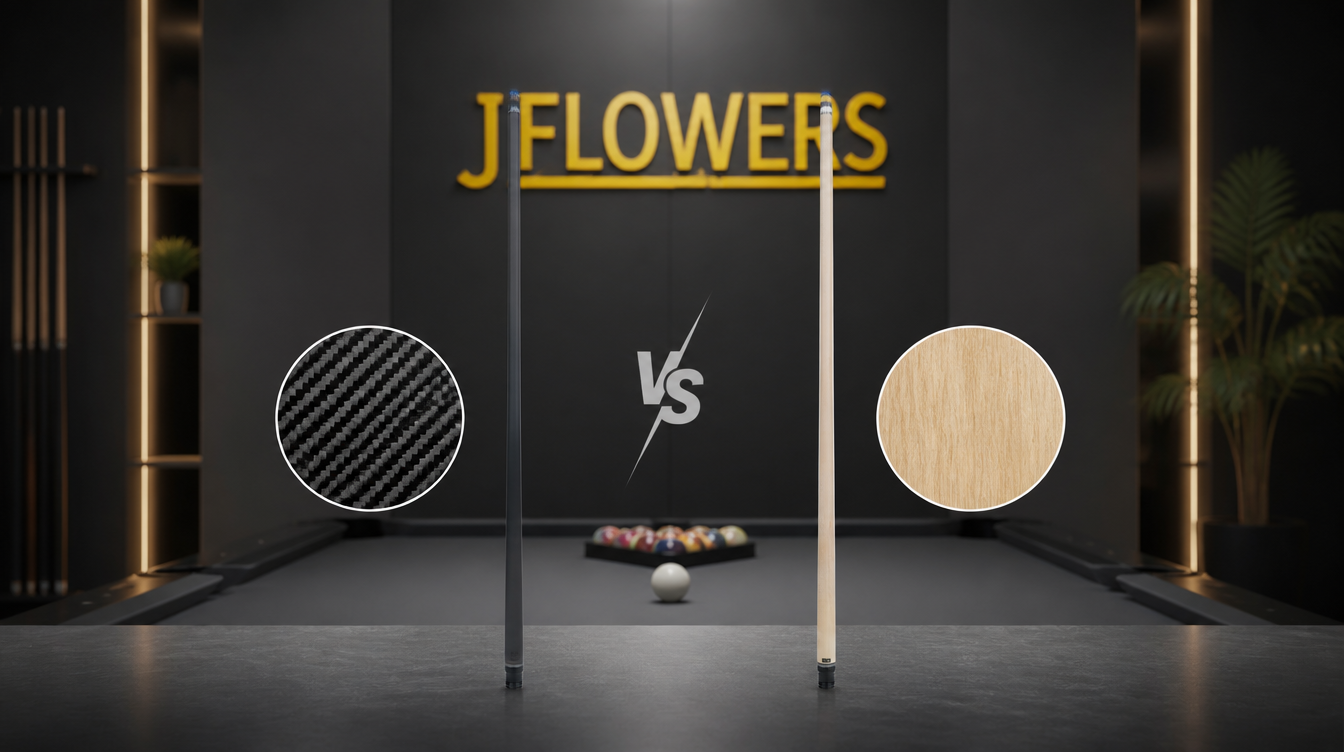
Carbon Fiber Shaft vs Wood Shaft: The Complete Comparison
JFlowers Cues
No equipment debate in billiards gets more airtime than carbon fiber vs wood. Players who've never tried carbon fiber are skeptical. Players who've switched often won't go back. Somewhere in the middle are thousands of players trying to figure out which one is right for their game.
Listen to this article
This guide cuts through the noise. We compare carbon fiber and wood shafts across every metric that matters: performance, feel, deflection, maintenance, durability, cost, and who each technology actually suits. No hype in either direction — just the honest breakdown.
The dominant wood for pool cue shafts in the American market is hard rock maple — selected for tight, straight grain and dried to specific moisture content. High-quality maple shafts are cut from mature heartwood, turned on precision lathes, and finished to consistent diameter tolerances. Ash shafts are standard in European cue traditions, particularly English billiards and snooker. Ash has a slightly softer feel than maple and a more pronounced grain pattern.
What Carbon Fiber Shafts Are Made From
Carbon fiber cue shafts are built from layers of carbon fiber fabric impregnated with epoxy resin, formed into a tube around a mandrel, cured under heat and pressure, and machined to precise tolerances. The result is stiffer than wood per unit mass, lighter per unit stiffness, and completely immune to moisture absorption. The JFlowers SMO Carbon Fiber Shaft uses a construction optimized specifically for the combination of stiffness, weight distribution, and deflection behavior that produces genuine low deflection performance without sacrificing feel.
Deflection and Accuracy
This is the performance difference that matters most. Deflection — or squirt — is the sideways movement of the cue ball when you apply off-center english. Low deflection means the cue ball squirts less and follows your aim line more closely.
Wood shafts produce more deflection than well-designed carbon fiber shafts. Experienced players compensate for this automatically — but the compensation has to be re-learned when switching shaft types. For the full physics, see What Makes a Low Deflection Shaft? and Understanding Cue Ball Deflection.
Feel and Feedback
Wood shafts — particularly high-quality maple — have a warm, organic feel at contact. The slight compression and vibration transfer of wood gives players tactile feedback that many describe as more natural. Carbon fiber shafts feel different: crisper, more direct. The hit is cleaner and feedback is more immediate. The sound is higher-pitched and sharper. Some players love this immediately. Others take time to adjust. For the full feel breakdown, see Carbon Fiber Shaft Feel Explained.
Warping and Environmental Stability
Wood moves. That is its fundamental limitation. Maple shafts absorb and release moisture as humidity changes, causing dimensional changes that add up to visible warping over time. A shaft stored in a hot car or left in a humid bar will eventually develop warp. Carbon fiber does not warp. Ever. The material has no moisture absorption. Temperature changes do not cause warping. A JFlowers SMO shaft stored under any normal conditions plays exactly the same years later as day one. For the science, see Why Carbon Fiber Doesn’t Warp.
Maintenance
Wood shafts require regular maintenance: cleaning with shaft conditioner, occasional burnishing, careful storage away from humidity. Carbon fiber shafts are dramatically lower maintenance. Wipe down with a clean cloth after play. Avoid abrasive cleaners. That’s essentially it. See How to Clean a Carbon Fiber Shaft for the full care routine.
Durability
A quality carbon fiber shaft will outlast most wood shafts under the same conditions. Wood degrades through moisture cycling, grain compression, and surface wear. Carbon fiber is structurally stable indefinitely under normal play. The main failure mode for carbon fiber is physical damage from a hard impact — not gradual degradation.
Cost
Entry-level wood shafts run $50-$150. Premium low-deflection maple from Predator or Mezz runs $200-$400. Quality carbon fiber starts around $250-$300 and runs $400-$600 for premium options. The JFlowers SMO sits in a strong position within this range — premium carbon fiber performance without the top-tier brand markup.
Who Each Technology Suits
Wood is right for: players deeply calibrated to wood feel who don’t want to adjust, players who prefer the traditional organic contact sound, casual players in stable storage environments.
Carbon fiber is right for: players who want the best long-term value from a shaft, competitive players who need consistency across different venues, tournament players, anyone who wants to eliminate equipment variables from their game.
Pros and Cons
Carbon fiber shafts
Consistent low deflection for more accurate english
No warping under any normal storage condition
Dramatically lower maintenance than wood
Excellent long-term durability
Higher upfront cost than mid-range wood shafts
Different feel from wood — requires adjustment period
Different contact sound takes some players getting used to
Wood shafts (quality maple or ash)
Warm, organic feel preferred by traditional players
Lower entry cost for quality play
Familiar sound and feedback deeply ingrained in most players
Susceptible to warping from humidity, heat, and storage conditions
Requires regular maintenance to perform consistently
Expert Recommendation For competitive players who want the best long-term equipment investment: carbon fiber. The JFlowers SMO delivers genuine low-deflection performance, zero warp risk, and a lifespan that outlasts any wood shaft. The adjustment period is real — give it 6-8 weeks of regular play. Once you’re calibrated, most players don’t go back.
Conclusion
Carbon fiber and wood are both legitimate shaft technologies. The difference is that carbon fiber removes variables that wood cannot. For competitive players who travel to different venues, play in varying conditions, or simply want equipment that doesn’t require managing — carbon fiber is the better long term choice. The JFlowers SMO Carbon Fiber Shaft makes that choice accessible.
Frequently Asked Questions
Q: Is carbon fiber better than wood for pool cues? For most competitive players, carbon fiber offers meaningful advantages: lower deflection, no warping, less maintenance. For players who strongly prefer wood feel, quality maple low-deflection shafts remain fully competitive. Q: Does a carbon fiber shaft feel different from wood? Yes. Carbon fiber has a crisper, more direct feel with a higher-pitched contact sound. Most players adjust within 4-8 weeks of regular play. Q: Do carbon fiber shafts warp? No. Carbon fiber does not absorb moisture and does not warp under any normal playing or storage conditions. Q: Are carbon fiber shafts harder to use? The main challenge is the aim adjustment due to lower deflection. This typically takes 4-8 weeks to internalize fully. Q: How long do carbon fiber shafts last? A quality carbon fiber shaft properly maintained will last many years — often a decade or more under competitive play. The main failure mode is physical damage, not gradual wear. Q: Do pros use carbon fiber or wood? Both. Professionals use a wide range of shaft types. Carbon fiber adoption has increased significantly over the past five years at the professional level. Q: Is the JFlowers SMO a good carbon fiber shaft? Yes. The JFlowers SMO delivers genuine low-deflection performance at a competitive price point, with build quality that stands up against more expensive alternatives. Q: Can I put a carbon fiber shaft on any cue? If the shaft matches your cue’s joint specification (most commonly 5/16×18), yes. The JFlowers SMO fits most production cues with this standard joint. Q: Is carbon fiber worth the extra cost over wood? For regular competitive players, yes. The lower maintenance, no-warp guarantee, and consistent deflection add up to real value over time.
After comparing JFlowers to Predator, Mezz, McDermott, Meucci, Jacoby, Pechauer, and a dozen more brands across every price point and construction philosophy — the question that started all of it deserves a direct answer: which pool cue brand actually offers the best value for serious competitive players in
2026?
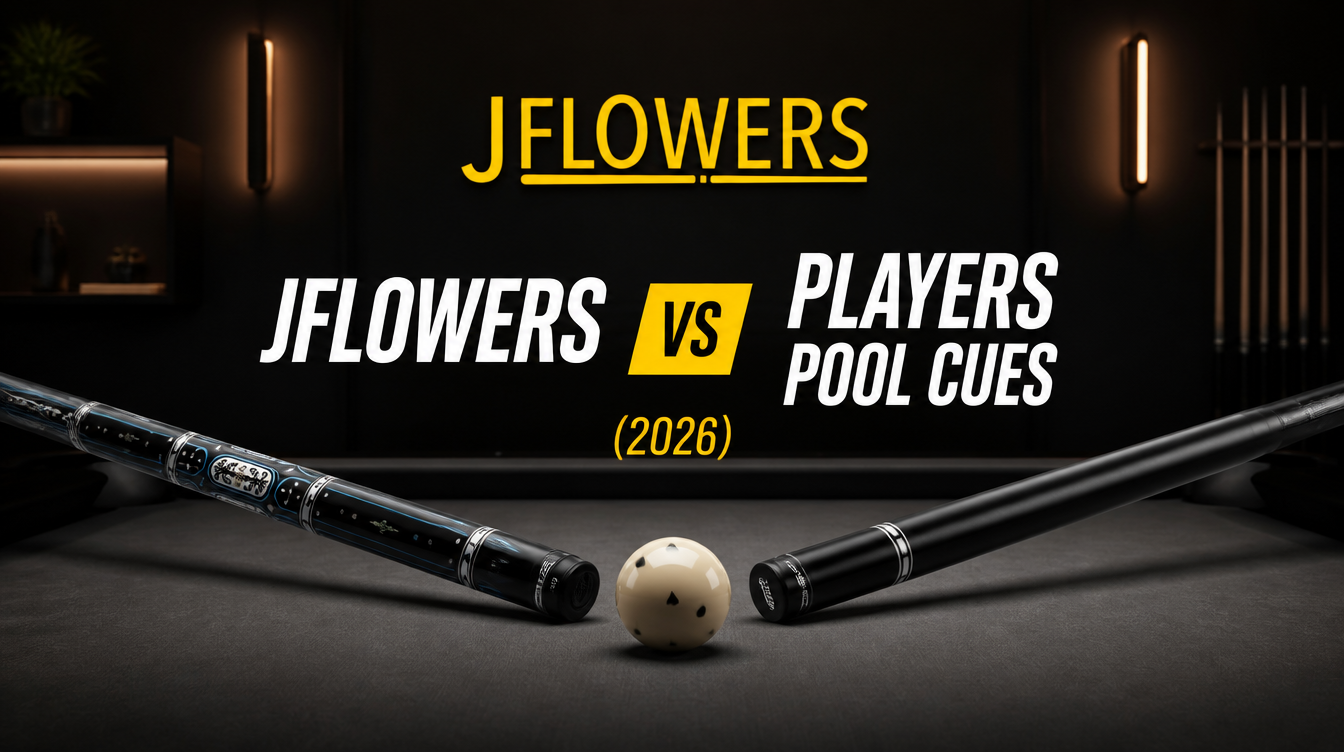
Players Technology is one of the most widely used cue brands in American pool halls. Their two-piece cues at $40-$150 have introduced millions of American players to personal cue ownership. Nearly every serious pool player in America either started on a Players cue or played against someone who did. Comparing Players to JFlowers isn’t really a direct competition — it’s a marker on the journey from beginner to serious competitor.